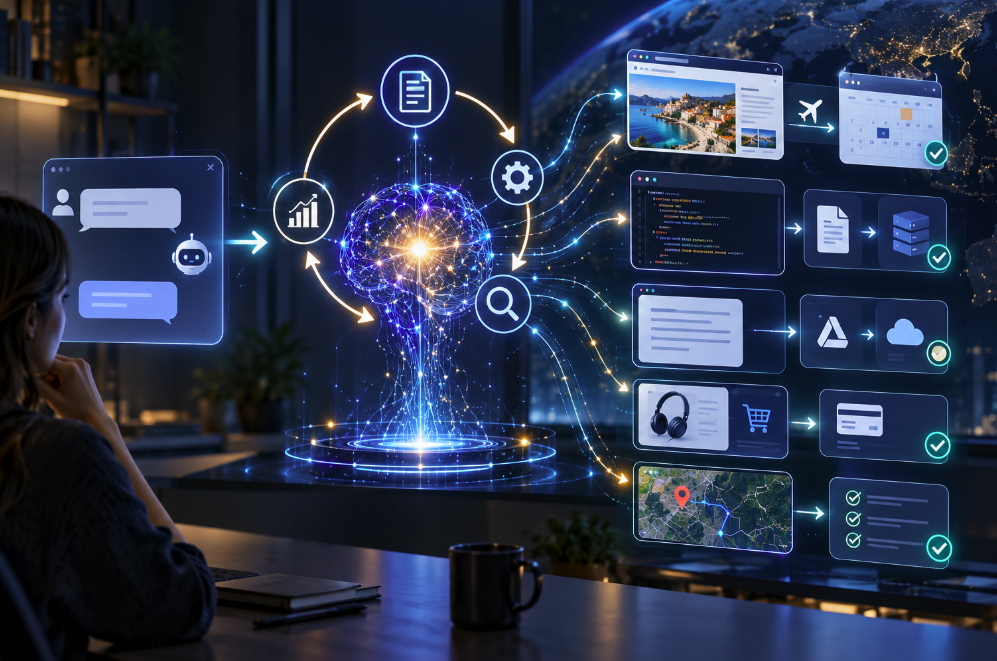
For years, the basic experience of generative AI could be reduced to a remarkably simple exchange: you type something, the machine types something back. Ask for a summary, a translation, an email or a piece of code, and a language model generates an answer. However sophisticated the response may be, the interaction is still fundamentally text-to-text.
Agentic AI changes the unit of work. Instead of asking the system to tell you how to do something, you can increasingly ask it to accomplish an objective. That objective might be researching a trip, checking several websites, manipulating files, running a script, debugging software or moving information between business applications. The AI can decide which steps are necessary, use external tools, inspect the results and continue until it reaches the goal or needs human intervention.
That distinction sounds subtle, but it represents one of the most important shifts in practical artificial intelligence. The chatbot answers. The agent acts.
A language model does not become an agent by itself
At the center of most modern AI agents is still a large language model. On its own, however, the model does not magically have a mouse, a browser, access to your calendar or permission to execute programs. Those abilities come from the software architecture built around it.
The first ingredient is tools. A developer can give a model access to functions such as web search, file retrieval, a calculator, a database, a command-line shell, an email system or a browser-like computer interface. Instead of always responding with prose, the model can decide that the next useful move is to invoke one of those tools.
This is already visible in the infrastructure being built by major AI companies. OpenAI's agent tooling, for example, has combined models with capabilities including web search, file search and computer use. In 2026, OpenAI also described giving agents a computer environment with a filesystem, shell access and controlled networking, allowing a model to propose commands, receive their results and use those results to decide what to do next.
The crucial detail is that the model itself is not literally clicking a physical mouse or executing a command inside its neural network. It proposes an action; an external system performs it; the result is returned to the model. Intelligence and execution are connected by an interface.
The loop: plan, act, observe, adjust
The easiest way to understand an AI agent is as a feedback loop. Give it a goal and the model considers what to do next. It takes an action through a tool, observes what happened, updates its understanding of the situation and chooses another action. The process repeats until the objective is complete, the system reaches a predefined limit or a human decision is required.
Anthropic describes this distinction clearly in its work on effective AI agents: workflows follow predefined code paths, while agents allow the model to direct its own process and tool usage. The difference is not that workflows are primitive and agents are advanced. A predictable workflow can actually be preferable when the required sequence is known in advance. Agents become especially useful when nobody can reliably predict every step before the task begins.
Consider a coding problem. “Fix the login bug” does not specify which file contains the error, whether the problem is in the frontend or backend, which tests will fail or whether repairing one component will expose another problem. A coding agent can inspect the repository, search relevant files, form a hypothesis, modify code, execute tests, read the failures and revise its approach. The path emerges from the evidence it encounters.
The same pattern applies outside programming. Ask an agent to prepare a comparison of hotels for a business trip and it may need to search current options, discard properties outside the budget, check their distance from a meeting location, compare cancellation conditions and organize the survivors. If it has access to an authorized reservation system, the workflow can potentially extend from research to action.
Why browsing and computer use are such a big deal
APIs have allowed software systems to communicate with one another for decades. An agent can call an API to retrieve a flight, create a calendar event or query a company database. But much of the digital world still lives behind interfaces built for human beings: buttons, forms, menus, dashboards and websites.
Computer-use systems attempt to bridge that gap. They allow an AI system to perceive an interface and issue actions analogous to keyboard and mouse operations. In principle, this means an agent does not need a bespoke API integration for every application it encounters. It can operate software through the same visual layer a person uses.
This dramatically expands the range of possible tasks. A research agent might move between search engines, websites, PDFs and spreadsheets. A business agent might collect information from a dashboard and enter it into another system. A travel agent could research routes, compare accommodation and prepare reservation steps. A software agent can combine browser research with shell commands, source-code editing and testing.
The U.S. National Institute of Standards and Technology describes agentic AI as systems capable of autonomous decision-making, goal-driven behavior and dynamic interaction with users and other systems. That description captures why the technology is more than a new chat interface. The model is becoming one component in a larger system that can perceive information, decide what matters and affect an external environment.
From a prompt to a multi-step job
Imagine the instruction: “Organize a three-day work trip to Berlin next month, keep the hotel near the conference venue and stay within this budget.” A traditional chatbot can suggest an itinerary. An agentic system can decompose the request into dependent subtasks.
It first needs dates, location and constraints. It may search transport options, identify the venue, find hotels within a useful radius, compare live prices and conditions, calculate the total cost and reject combinations that exceed the budget. If the user changes one constraint — “I need to arrive the evening before” — the agent can revise the plan rather than starting from scratch. With the appropriate integrations and permissions, it could then prepare or execute reservations and add confirmed details to a calendar.
The same architecture can power less visible workflows. An agent could receive a folder containing hundreds of invoices, extract the relevant data, compare it with records in another system, identify discrepancies, generate a spreadsheet and flag the cases that require a person. Another could monitor a software project, reproduce a reported bug, patch it and prepare a pull request. Another might research a market by conducting dozens of searches, following promising leads and synthesizing the evidence into a report.
These jobs are difficult to encode as one rigid sequence because the next step depends on what the previous step reveals. That conditional decision-making is where agentic systems become interesting.
Memory, orchestration and multiple agents
Long tasks introduce a practical problem: an agent needs to remember what it has already done. Working context can contain the user's requirements, tool results, intermediate calculations, files, decisions and unresolved questions. Longer-running systems may also use external memory or databases so that important state survives beyond a single model call.
More elaborate architectures add orchestration. One model may act as a coordinator, breaking a large task into smaller pieces and assigning them to specialized workers. A research worker searches for evidence, a coding worker manipulates software, and an evaluator checks whether the result satisfies the original objective. Anthropic calls one version of this pattern “orchestrator-workers”: the central model determines subtasks dynamically rather than following a list fixed beforehand.
But more agents do not automatically produce a better system. Each additional model call costs time and money, and each additional decision creates another opportunity for an error to propagate. For many jobs, one well-designed agent with a small set of reliable tools is preferable to an elaborate artificial organization chart.
Autonomy needs boundaries
The phrase “autonomous agent” can create the impression of software given unlimited freedom to roam the internet. Sensible agent design looks very different. Autonomy is usually bounded by permissions, environments and checkpoints.
An agent may be allowed to search travel options without approval but forbidden to purchase a ticket until the user confirms. A coding agent may be free to edit files inside an isolated environment but unable to deploy to production. A financial workflow might let an agent prepare a transaction while reserving final authorization for a person.
These boundaries are essential because agents can make mistakes, and multi-step execution can compound them. There are also security problems specific to agents. An AI browsing an untrusted website can encounter malicious instructions designed to manipulate its behavior, a problem commonly discussed as prompt injection. If the same agent also has access to private files or consequential tools, the stakes rise considerably.
That is why the future of agentic AI is as much a security and systems-engineering problem as a model-intelligence problem. Reliable agents need restricted permissions, trustworthy tool interfaces, logs, stopping conditions, verification and human approval at consequential moments. NIST's current work on agentic AI emphasizes evaluation, interoperability, governance and risk management alongside capability.
The real shift is from answers to outcomes
The arrival of agentic AI does not make ordinary chat obsolete. If you need a definition, a rewrite or a quick explanation, an autonomous loop would be unnecessary overhead. Fixed automation also remains better when a process is perfectly predictable. There is little reason to let an AI invent a route through a task when conventional software can execute the same route reliably every time.
Agents matter when the route cannot be completely specified beforehand: when the system must investigate, choose among alternatives, react to changing information or use several tools in an unpredictable sequence. Their value comes from combining the flexibility of language models with the ability to interact with software and observe real results.
That is the deeper transition underway. The first generation of mainstream generative AI made computers surprisingly good at answering us in natural language. Agentic AI is an attempt to make those same models capable of carrying work forward after the conversation would once have ended. Instead of producing a paragraph explaining the next ten steps, the system can increasingly attempt those ten steps itself — while asking for human judgment where it actually matters.