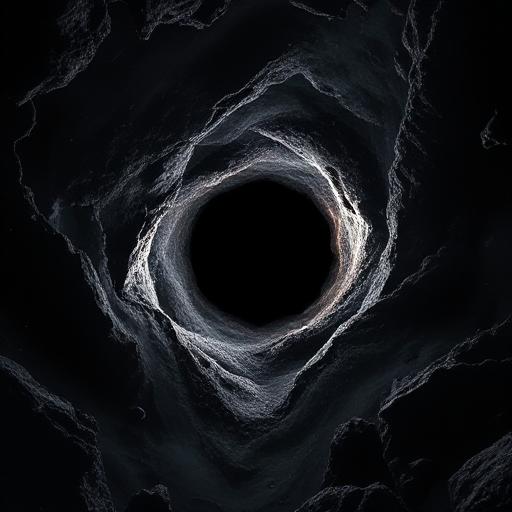
What’s Inside a Black Hole?
Black holes are some of the most mysterious objects in the universe. They form when a massive star collapses under its own gravity, creating a region of space where gravity is so strong that not even light can escape. But the real mystery begins when you ask: what’s inside a black hole?
The surface of a black hole is called the event horizon. This is the boundary beyond which nothing can return. Once you pass this point, all paths—no matter how fast you go—lead inward. But where do they lead?
According to Einstein’s theory of general relativity, all the matter and energy that falls into a black hole is crushed into a single point called the singularity. This is a region where density becomes infinite, space and time cease to behave normally, and our known laws of physics break down. It’s not just that we don’t know what’s there—we can’t know using current science.
The singularity isn’t something you can touch or see. It’s a point where the equations stop working—mathematics collapses, so to speak. In real terms, we don’t know if matter continues to exist in any familiar form once it reaches this center. Is it converted entirely to energy? Does it disappear from our universe altogether? We don’t have answers yet.
Some scientists speculate that black holes could be gateways—possibly to other parts of the universe or even other universes entirely. These ideas often involve theoretical constructs called wormholes, which are solutions to Einstein's equations that could link distant regions of spacetime. But these remain mathematical possibilities, not observable facts.
Another possibility is that the matter never actually reaches the singularity, thanks to quantum effects. Theories of quantum gravity, such as string theory or loop quantum gravity, suggest that space might have a smallest possible unit, preventing true infinite density. But we don’t yet have a working theory that combines general relativity and quantum mechanics in a way that fully explains what happens inside a black hole.
Interestingly, black holes aren't completely black. In 1974, Stephen Hawking showed that they emit a tiny amount of radiation—now called Hawking radiation—which means they can slowly evaporate over time. But what happens to the information about the matter that falls in? That’s called the black hole information paradox, another huge puzzle in physics.
In short, what lies inside a black hole remains unknown. It’s a place where our best physical theories stop making sense, and where new science may one day emerge. Until then, the inside of a black hole remains not just out of reach, but possibly beyond understanding.