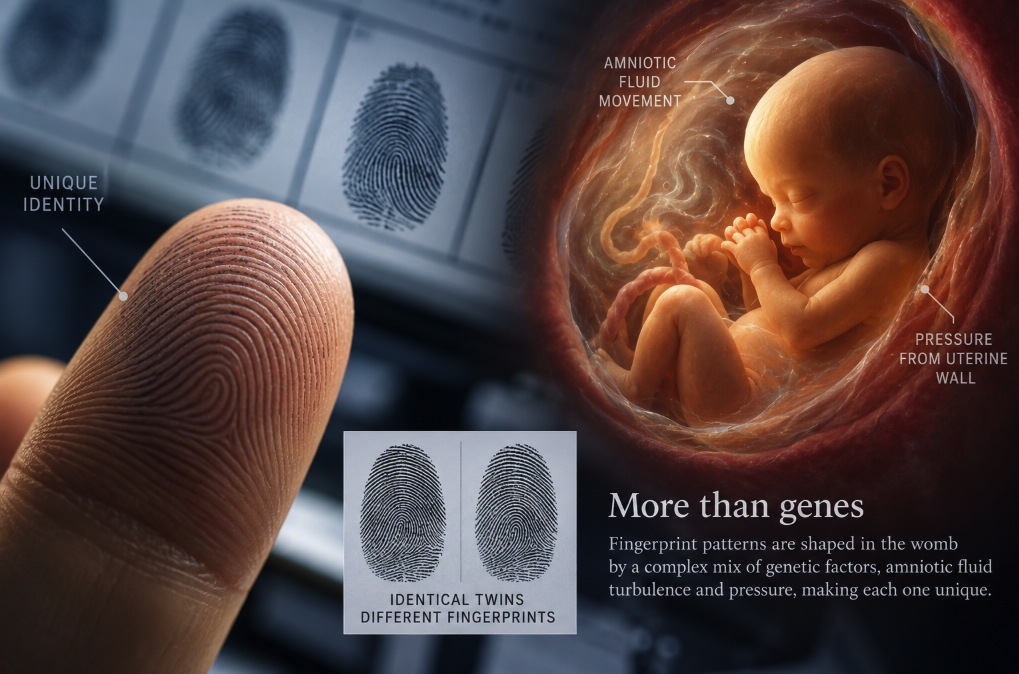
Look closely at the tip of your finger and you are looking at a landscape that began forming months before you were born. Ridges curve, split, stop and rejoin in patterns so detailed that they have become one of humanity’s most familiar tools for identification.
Even identical twins do not have identical fingerprints.
That fact is often explained with a wonderfully vivid story: while a fetus develops, movements in the amniotic fluid and pressure against the wall of the uterus randomly sculpt the skin, creating a pattern that DNA alone cannot dictate. There is an important truth inside that explanation — fingerprints are shaped by more than genes — but the science is more complicated. Researchers have not established “amniotic fluid turbulence” as the single mechanism that makes every print unique.
Instead, fingerprints appear to emerge from an extraordinary interaction between genetics, the changing three-dimensional shape of the fetal fingertip and tiny local variations in growth and mechanical stress. DNA helps design the landscape. Development determines exactly where every ridge runs across it.
Fingerprints begin before birth
The ridges on our fingertips are part of the dermatoglyphic system, the patterned ridges found on the fingers, palms, toes and soles. Their development begins surprisingly early.
During the first trimester, temporary swellings called volar pads form on the fetal fingertips. These pads change shape and gradually regress while the skin is developing above them. Primary epidermal ridges begin taking shape after roughly the tenth week of gestation, and by around the fourteenth week the broad future fingerprint configuration — such as an arch, loop or whorl — is becoming established. Research on prenatal dermatoglyphics indicates that the patterns are permanently configured before about the twentieth week of pregnancy. citeturn0search2turn0search7
The timing matters because the surface is not static while the ridges are forming. The fingertip is growing, the volar pad is changing height and shape, and different tissue layers are expanding at different rates. Fingerprints therefore develop on a moving biological surface rather than being printed onto a finished finger.
One influential biomechanical model proposes that the basal layer of fetal epidermis grows under stress until it buckles, producing ridges. In this model, the geometry of the fingertip, the regression of the volar pad and resistance from existing creases help determine the directions in which the ridges form. Computer simulations based on this idea have reproduced important features of real fingerprint patterns. citeturn0search0
The result resembles a physical pattern-forming process seen elsewhere in nature. Genetics specifies the tissues and their developmental program, but the final fine structure emerges as those tissues grow and interact.
Your genes matter — just not enough to copy a fingerprint
It would be wrong to say fingerprints are random or independent of DNA. Twin studies have long shown substantial genetic influence on features such as ridge counts and broad pattern types. A person’s tendency to develop loops, whorls or arches is partly heritable. citeturn0search3turn0search8
Modern genomics has made that influence much clearer. A large genetic study involving more than 23,000 participants identified numerous genomic regions associated with fingerprint patterns. Surprisingly, many of the implicated genes were connected more strongly with limb development than with skin itself. One important gene, EVI1, is active in developing tissue beneath the fetal fingertip pad before the fingerprint ridges emerge. citeturn0search7
This suggests that genes can influence fingerprints indirectly by helping determine the size, proportions and geometry of fingers and their temporary volar pads. High, rounded pads tend to be associated with different ridge configurations from flatter pads. The genetic program therefore helps establish the initial conditions under which the ridge pattern will develop.
But an initial condition is not a blueprint specifying every microscopic fork and ridge ending.
That distinction is why identical twins provide such a powerful natural experiment.
Identical twins: same genes, different fingertips
Monozygotic twins originate from the same fertilized egg and consequently begin with extremely similar genetic material. Their fingerprints often resemble one another more closely than those of unrelated people. They may have the same broad pattern on corresponding fingers, and studies have found strong similarity in dermatoglyphic characteristics.
Yet place the actual prints side by side and the fine details differ.
Ridges split at different places. Individual ridge endings occur at different coordinates. Distances and orientations vary. These small features, known in forensic work as minutiae, are precisely the details that make fingerprints useful for distinguishing individuals.
Classic twin research shows that environmental variation in dermatoglyphics tends to be local, while studies of monozygotic multiple births have found that greater diversity in the prenatal environment is associated with reduced similarity in fingerprint patterns. citeturn0search1turn0search10
This does not mean one twin necessarily experiences a radically different womb. Tiny developmental differences are enough. The exact timing of volar-pad regression, rates of tissue growth, local stresses and countless microscopic events can diverge even between genetically near-identical fetuses.
Once a ridge begins forming in a slightly different location, subsequent growth occurs around that difference. Small deviations cascade into a pattern that is similar in overall architecture but unique in its details.
What role do pressure and amniotic fluid really play?
Popular explanations often say that fingerprints are produced by the fetus touching the uterine wall or by turbulence in the amniotic fluid. These ideas capture the broader principle that the prenatal environment can influence development, but they should not be presented as a fully established mechanism.
There is evidence that intrauterine conditions contribute to dermatoglyphic variation. Researchers have examined factors such as placental environment, fetal growth and the pressures affecting developing volar pads. Fingerprints can preserve traces of early prenatal conditions precisely because their structure is established during a limited developmental window. citeturn0search2turn0search4
But contemporary models of ridge formation focus strongly on what happens within the growing fingertip itself. Differential growth between tissue layers creates mechanical stresses. The geometry of the volar pad influences how those stresses are distributed. Proposed mechanisms include epidermal buckling and biological signaling systems capable of generating repeating ridge patterns. The complete mechanism is still being investigated. citeturn0search0turn0search7
External mechanical forces may contribute to the local developmental environment, but there is no need to imagine amniotic fluid carving grooves into the skin like water eroding a riverbed. Fingerprint ridges are actively generated by growing tissue.
Why loops, whorls and arches appear
Although every complete fingerprint is distinctive, most can be classified into a small number of broad families. Loops are common, whorls form roughly circular or spiral configurations, and arches sweep across the fingertip without the same central circular structure.
This apparent contradiction — endless individuality built from a few recurring designs — is exactly what we would expect from a developmental pattern-forming system.
The shape of the fetal volar pad appears to influence which large-scale configuration emerges. Research summarized in modern genetic studies notes that high volar pads are often associated with whorl patterns, low pads with arches, and asymmetric or intermediate pads with loops. citeturn0search7
Once that broad geometry is established, however, the microscopic ridge network continues to develop under highly local conditions. Two people can therefore both have loops while differing in dozens of minutiae. Even two fingers on the same person are not copies of each other because each fingertip develops in its own local mechanical and biological environment.
Why fingerprints stay with us
The usefulness of fingerprints depends on another remarkable property: once established, their basic ridge pattern is remarkably persistent.
As a child grows, the fingers become larger, but the ridge arrangement expands with them rather than being redesigned from scratch. Superficial cuts generally heal without permanently altering the pattern because the structures that organize the ridges extend deeper than the outermost skin. Damage deep enough to affect the underlying dermal architecture can create a permanent scar, which then becomes an additional identifying feature.
This combination of prenatal individuality and lifelong persistence is why fingerprints became so valuable in forensic identification. It is not merely the presence of a loop or whorl that identifies someone. Investigators compare the spatial relationships among ridge endings, bifurcations and other detailed characteristics.
A scientific review commissioned by the U.S. National Academies noted that these minutiae arise from nongenetic events during embryonic fingertip development, which is why the fingerprints of identical twins remain distinguishable. citeturn0search24
A biological pattern balanced between order and chance
Fingerprints are often described as either genetic or random, but neither description is sufficient. They are an example of biological development operating between those extremes.
Genes influence the growth of the hand, the shape of the fingertip and the broad tendencies of dermatoglyphic patterns. Physical forces and developmental signaling organize the ridges. Then minute variations in timing, geometry and local tissue conditions determine the details that distinguish one finger from every other finger.
That is why identical twins can look astonishingly alike, share the same broad fingerprint types and still leave distinguishable prints on a glass.
The deeper lesson is that DNA does not contain a microscopic drawing of the finished human body. It contains instructions and regulatory systems that guide development. The final organism emerges through those instructions interacting with physics, chemistry, growth and environment.
Your fingerprints are a permanent record of that process. Their loops and whorls reveal inherited biology, while every tiny fork and ridge ending preserves the irreproducible history of how one particular fingertip grew inside the womb.
Long before anyone took your first photograph, your body had already created an identification mark that no one else would reproduce exactly.