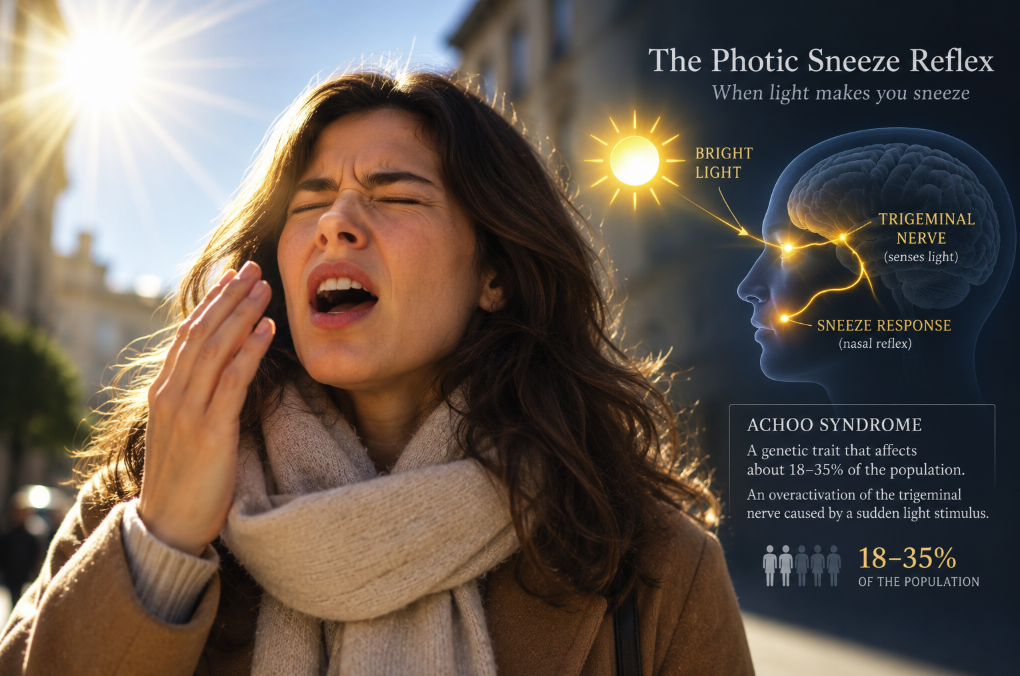
Step out of a dark cinema into brilliant afternoon sunlight and, for some people, the reaction is immediate. The eyes narrow, the nose begins to tingle and within seconds comes an involuntary sneeze — sometimes two or three in rapid succession.
There is no pollen cloud, no pepper and no cold. The trigger is light.
This peculiar response is known as the photic sneeze reflex, sometimes called the solar sneeze reflex or, with a memorable acronym, ACHOO syndrome: Autosomal Dominant Compelling Helio-Ophthalmic Outburst. Older studies have estimated that roughly 18 to 35 percent of people experience it, while a recent scientific review describes a prevalence of around 25 percent. The exact number is uncertain and appears to vary considerably among populations.
The phenomenon is real, common and partly genetic. But one detail often repeated as settled science needs qualification: researchers do not yet know exactly why bright light makes susceptible people sneeze. Crosstalk involving the trigeminal nerve is one of the leading explanations, not a proven final answer.
A sneeze that begins in the eyes
An ordinary sneeze is a protective reflex. Something irritates sensory nerve endings in the nose — dust, an allergen, a chemical or another stimulus — and signals travel through branches of the trigeminal nerve toward neural circuits involved in generating the sneeze response. The result is a coordinated respiratory event designed to expel material from the upper airway.
The photic sneeze reflex begins differently. The nose does not need to encounter an irritant. Instead, the trigger is usually a sudden increase in light intensity, such as moving from a dim interior into strong daylight.
A 2025 review of the stimulus conditions behind photic sneezing concluded that bright natural and artificial light can trigger the reflex in susceptible individuals, typically within a few seconds. Yet surprisingly little is known about the precise light characteristics that matter. Researchers still lack systematic dose-response experiments comparing intensity, wavelength, duration and other variables.
That uncertainty is striking because people have been noticing the phenomenon for centuries. Aristotle discussed the connection between looking toward the sun and sneezing more than two thousand years ago. Modern neuroscience has given the reflex a name and several plausible mechanisms, but the ancient observation has proved harder to explain than it might appear.
The optic-trigeminal crosstalk hypothesis
The most familiar explanation begins with two cranial nerves positioned within densely interconnected sensory systems.
The optic nerve carries visual information from the retina toward the brain. The trigeminal nerve, meanwhile, provides much of the sensory innervation of the face and nasal cavity and participates in the afferent side of the ordinary sneeze reflex.
According to the optic-trigeminal summation hypothesis, an unusually strong burst of visual input after sudden bright light somehow spills into or enhances activity in neural pathways associated with trigeminal sensation. The brain may effectively interpret part of that activity as irritation in the nose. A tickling sensation appears, followed by a sneeze.
A recent review of photic sneezing research describes plausible integration between optic and trigeminal pathways in the brainstem. The same review, however, stresses that this mechanism has not been conclusively demonstrated.
That distinction is important. It is tempting to draw a simple diagram in which the optic nerve accidentally “touches” the trigeminal nerve, but nervous systems rarely behave like crossed electrical wires. Sensory processing involves networks, nuclei, cortical areas and autonomic pathways. The actual mechanism may involve several levels of that system.
Other explanations are still on the table
Scientists have proposed alternatives to direct optic-trigeminal crosstalk. One is parasympathetic generalization. Bright light causes normal autonomic responses in the eye, including pupil constriction. In susceptible people, activation associated with this ocular response might spread to nearby parasympathetic pathways, potentially increasing nasal secretion or sensitivity and helping trigger a sneeze.
Another hypothesis suggests that photic sneezers have unusually excitable sensory processing more generally. Neurophysiological research has reported differences in cortical responses between people who do and do not sneeze in response to light. The NCBI Medical Genetics Summary on ACHOO syndrome notes that over-excitability of the visual cortex and stronger activation of secondary somatosensory areas have been proposed as part of the explanation.
The 2025 review found heightened activity in regions including the insula and secondary somatosensory cortex in susceptible individuals. Interestingly, the familiar “tickle in the nose” reported by photic sneezers has not been matched straightforwardly by measurable electrical activity in the trigeminal-innervated nasal mucosa. That raises the possibility that at least part of the sensation is referred or constructed centrally in the brain rather than generated by actual nasal irritation.
In other words, the nose may feel as though something is bothering it even when the original stimulus entered through the eyes.
Is ACHOO really genetic?
Families have long reported that the tendency to sneeze at bright light seems to run from parent to child. The deliberately comic name ACHOO emphasizes an autosomal dominant pattern, implying that inheriting one relevant genetic variant could be enough to produce the trait.
Modern genetic research supports a heritable component but suggests a more complicated picture than a single “sneeze-at-the-sun gene.”
Genome-wide association studies have identified several genetic loci associated with photic sneezing. A 2019 study of 3,417 people in a Chinese population found the reflex in 25.6 percent of participants and identified associations at chromosome regions 2q22.3 and 3p12.1. The researchers concluded that the evidence supported a polygenic and non-ethnicity-specific basis for the trait.
A separate genome-wide study in more than 11,000 Japanese participants also found genetic associations, including one at 3p12.1. Intriguingly, however, only 3.2 percent of that study population reported the phenotype — a reminder that prevalence estimates depend heavily on population, definition and study method.
So “genetic” is fair. “Controlled by one dominant gene” is probably too simple as a modern summary.
How many people actually have it?
The often-quoted figure of 18 to 35 percent comes from earlier clinical and military literature. One 1993 study examining the potential hazard to combat pilots cited precisely that range, while a clinic survey in the 1990s found self-reported photic sneezing in about one-third of respondents. More recent literature often uses an approximate figure of one person in four.
But the studies are difficult to compare. Some ask whether sunlight has ever triggered a sneeze. Others test participants under particular lighting conditions. Some distinguish people whose sneeze was already “primed” by nasal irritation from those who sneeze purely because of light.
The reflex is also inconsistent within the same person. Someone who sneezes after walking into sunlight today may not necessarily do so tomorrow. In one clinical survey, only a minority of self-described photic sneezers responded consistently every time they encountered sunlight.
The safest conclusion is therefore not that exactly a quarter of humanity has ACHOO syndrome, but that photic sneezing is a surprisingly common human trait whose measured prevalence varies widely.
Why sudden light matters more than staring at the Sun
The name “sun sneeze” can create a dangerous misunderstanding. You do not need to stare directly at the Sun to trigger the reflex, and doing so can injure the retina.
For many susceptible people, what seems important is the transition from relative darkness to bright light. Walking outside can be enough. Artificial lamps can also provoke the response. Older experiments testing different wavelengths did not establish that one particular color of light was responsible, strengthening the idea that a change in intensity may matter more than a special wavelength.
Exactly how intensity, duration and spectral composition interact remains surprisingly under-researched. The 2025 review found only seven relevant studies focusing on stimulus parameters and concluded that no study had yet systematically mapped the relationship between light characteristics and sneeze probability.
For such an everyday phenomenon, there is still plenty of basic science left to do.
A harmless quirk — except at the wrong moment
For most people, the photic sneeze reflex is little more than an amusing personal characteristic. It does not usually indicate disease, and no treatment is normally required.
There are situations, however, in which an involuntary sneeze matters. Military researchers have considered the risk to pilots suddenly exposed to intense light during flight. Drivers emerging from a dark tunnel into bright sunlight can experience the same combination of momentary eye closure, head movement and loss of concentration. Ophthalmologists have also noted the inconvenience when a patient sneezes unexpectedly while the physician is working very close to the eye.
A 1993 study in Military Medicine specifically investigated photic sneezing as a potential hazard to combat pilots. The danger is not the reflex itself so much as the timing: a harmless sneeze can become significant when a fraction of a second of visual or motor disruption matters.
A tiny window into how the brain connects the senses
The photic sneeze reflex is fascinating precisely because it seems so unnecessary. Bright light poses no threat to the nasal passages, so why should the respiratory system respond as if an irritant had arrived?
The answer may lie in the fact that the nervous system is not a collection of completely isolated circuits. Vision, facial sensation, autonomic responses and protective reflexes interact within densely connected neural networks. In most people, sudden brightness produces squinting and pupil constriction. In photic sneezers, some combination of inherited susceptibility and neural excitability appears to recruit the sneeze system as well.
Researchers still do not know exactly where that extra signal enters the circuit. Optic-trigeminal interaction remains a compelling hypothesis, while parasympathetic and cortical mechanisms remain plausible alternatives or contributors. Genetics clearly matters, but several loci rather than one simple gene appear to be involved.
So the next time someone steps into the sunlight and immediately sneezes, the explanation is not that the Sun has irritated their nose. For a few seconds, light entering the eyes has activated a chain of neural events powerful enough to persuade the brain that a sneeze is the appropriate response.
More than two thousand years after Aristotle noticed the effect, science can describe the phenomenon, map some of its genetics and identify the nerves likely to participate. The final connection between the flash of light and the inevitable “achoo,” however, remains an unexpectedly bright little mystery.