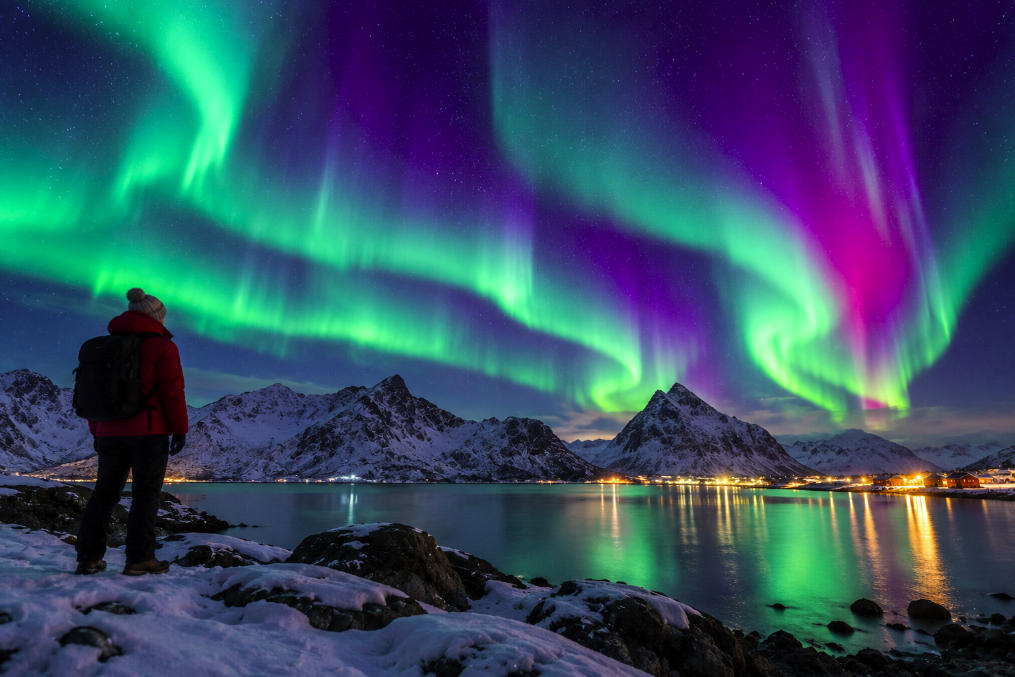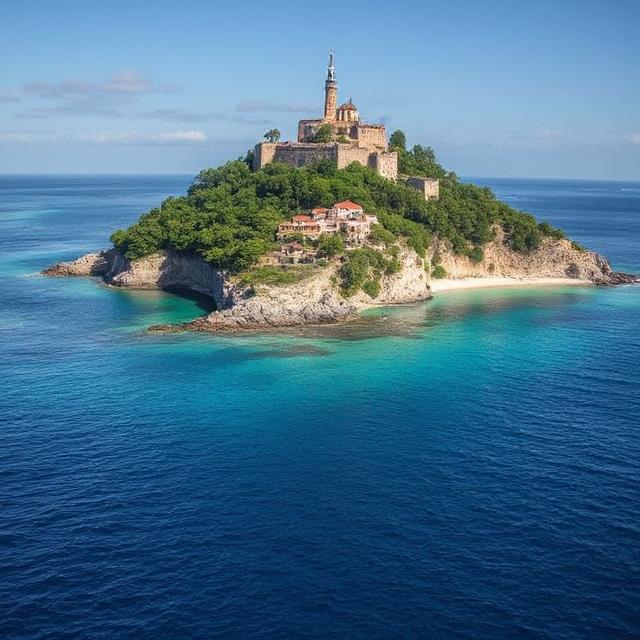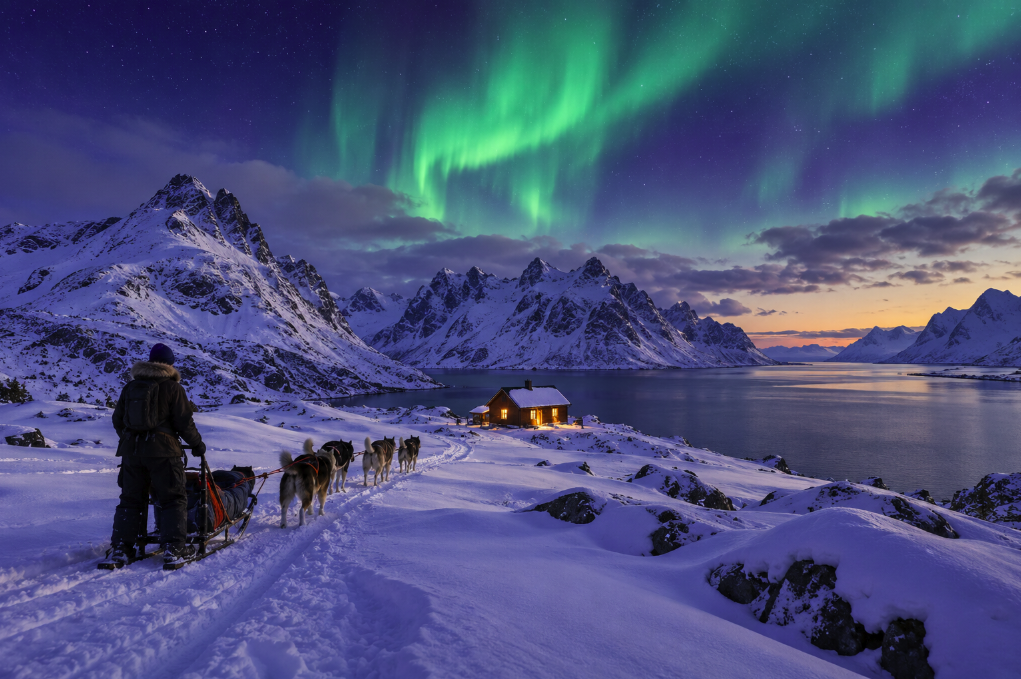
There is a point in an Arctic winter when ordinary ideas about daytime stop being useful. The sun may skim the horizon without properly rising, snow can turn blue in the long twilight, and a clear night can suddenly fill with green light. Traveling north in winter is not simply a colder version of a summer holiday. It is a different way of experiencing landscape, distance and time.
The Arctic is enormous, and no two winter trips feel quite alike. One destination is built around dog teams and sea ice; another combines sophisticated restaurants with reindeer sleds; another offers the possibility of watching polar bears gather beside a frozen bay. These seven journeys stand out because each gives winter a distinct character rather than treating snow as scenery.
1. Longyearbyen, Svalbard: enter the polar night
Few accessible settlements make darkness feel as dramatic as Longyearbyen, on Norway’s Svalbard archipelago. Visit Svalbard defines its Northern Lights Winter as running from October through February, with the deepest polar night from mid-November to late January. During that period the sun remains so far below the horizon that there is no conventional daylight, creating the extraordinary possibility of seeing the aurora in what the clock insists is daytime.
The darkness is not a reason to stay indoors. Guided dog-sledding, snowmobile excursions and ice-cave trips continue through winter, while Longyearbyen itself provides an unexpectedly comfortable base of cafés, restaurants and museums. This is genuine High Arctic country, however, not a place for casual solo wandering beyond town. Conditions can change quickly and excursions into the wilderness require appropriate local guidance.
Best for: travelers who want the strangest and most immersive version of Arctic winter. For more planning details, consult Visit Svalbard’s winter guidance.
2. Tromsø, Norway: Arctic wilderness without giving up city life
Tromsø is one of the easiest places to discover that the Arctic does not have to mean isolation. The city sits beneath the auroral zone and combines museums, bars, restaurants and a university-town atmosphere with mountains and fjords almost immediately beyond its streets. According to the local tourism board, northern lights can normally be seen in the region from late August into early April when darkness, clear skies and solar activity cooperate.
Winter days can include dog sledding, skiing or an encounter with Sámi culture, followed by dinner back in the city and an aurora chase after dark. From late November into January, whales may also be found in northern Norwegian fjords, although wildlife movements vary and should never be treated as guaranteed. Tromsø is particularly good for a first Arctic trip because bad weather does not erase the holiday: there is still a real city to explore while clouds cover the sky.
Best for: first-time Arctic travelers and couples who want adventure with comfortable infrastructure. The official Tromsø winter guide is useful for seasonal planning.
3. Finnish Lapland: sleep beneath the aurora
Finnish Lapland has turned winter accommodation into an art form. Glass-roofed cabins, forest lodges and saunas make it possible to spend a night surrounded by snow without pretending that frostbite is part of the romance. The region offers husky sledding, cross-country skiing, snowshoeing and reindeer experiences, while Rovaniemi adds the unabashed Christmas mythology of Santa Claus.
There is more here than festive fantasy. Northern Finland is part of Sápmi, the traditional homeland of the Sámi people, whose territory stretches across northern Norway, Sweden and Finland and into Russia. Travelers interested in that history can visit institutions such as the Siida Sámi Museum and Nature Centre in Inari rather than treating Indigenous culture as a decorative winter attraction. Visit Finland notes that the aurora season in northern Finland extends from late August to early April.
Best for: families, romantic trips and travelers who want an Arctic experience with a strong comfort factor. Start with Visit Finland’s Lapland guide.
4. Ilulissat and western Greenland: travel by dog sled
In Greenland, a dog sled is not merely a nostalgic tourist prop. It developed as a practical means of winter transportation and remains deeply connected to life in the sled-dog districts north of the Arctic Circle and in East Greenland. Visit Greenland describes February, March and April as especially good months for dog sledding, when snow and returning daylight can make longer journeys possible.
Ilulissat adds one of the planet’s great ice landscapes to the experience. The nearby icefjord is famous for the immense quantities of ice moving from the Greenland Ice Sheet toward Disko Bay. In winter, the combination of sled dogs, frozen terrain, enormous ice formations and aurora gives the place a scale that photographs struggle to communicate. Greenland rewards travelers willing to accept that weather can rearrange schedules and that remoteness is part of the journey rather than an inconvenience to be engineered away.
Best for: experienced travelers who value cultural context, remoteness and traditional Arctic travel. Visit Greenland’s dog-sledding guide explains where and when the activity is practiced.
5. Churchill, Canada: meet the Arctic’s most famous predator
Churchill, Manitoba, sits on the shore of Hudson Bay with no road connecting it to the rest of Canada. Visitors arrive by train or plane, which is an appropriate introduction to a town famous for encounters with polar bears. In October and November, bears gather near the coast while waiting for sea ice to form so they can return to hunting seals. Specialized tundra vehicles allow visitors to observe them while maintaining controlled separation.
Timing matters here. The celebrated polar-bear season is principally autumn moving into early winter, while February and March are promoted for especially strong northern-lights viewing. That means a traveler whose only priority is bears should plan differently from someone dreaming of deep snow and aurora. Either way, Churchill feels less like an Arctic resort than a frontier community where wildlife dictates the calendar.
Best for: wildlife enthusiasts. Travel Manitoba’s official polar-bear information is a sensible starting point before choosing an operator.
6. Abisko and Kiruna, Sweden: chase clear Arctic skies
Abisko has acquired an almost legendary reputation among aurora hunters. The national park lies roughly 200 kilometers inside the Arctic Circle, and Sweden’s national parks service notes that the area receives relatively little precipitation. Winter visitors come for northern lights, polar night, snowshoeing and skiing, with frozen Lake Torneträsk adding another stark element to the landscape.
About 100 kilometers away, Kiruna broadens the trip. Nearby Jukkasjärvi is home to ICEHOTEL, whose winter incarnation is rebuilt from snow and ice while ICEHOTEL 365 preserves frozen rooms throughout the year. Dog sledding and Sámi-led experiences can be combined with a few nights in Abisko, creating a trip that moves between mountain wilderness and one of Scandinavia’s most unusual hotels.
Best for: photographers and travelers whose main goal is aurora watching. Visit Sweden’s northern-lights guide covers the broader season and viewing conditions.
7. Iceland in winter: glaciers, black sand and ice caves
Iceland sits mostly just south of the Arctic Circle, so purists may call it sub-Arctic rather than Arctic. In practical travel terms, however, a winter journey here delivers many of the experiences people seek in the far north with comparatively easy international access. Snow-covered lava fields, frozen waterfalls, geothermal pools and dark skies can all fit into the same trip.
The most distinctive winter experience is entering a naturally formed glacier ice cave with a qualified guide. These environments change as glaciers move and melt, so routes and access vary from season to season. Add the chance of aurora on clear nights and Iceland becomes a particularly strong choice for travelers who want dramatic winter geology as much as northern lights. The crucial rule is flexibility: storms, road closures and rapidly changing conditions can disrupt ambitious itineraries, especially outside the Reykjavík area.
Best for: road-trip lovers, geology enthusiasts and travelers who want a relatively approachable northern winter.
The Arctic trip you remember is rarely the one you planned minute by minute
Every destination on this list comes with uncertainty. Clouds can hide the aurora. Wind can cancel an excursion. Wildlife can simply go somewhere else. In Greenland or Svalbard, weather can change the shape of an entire day. That unpredictability is not a defect in Arctic travel; it is one of the reasons the experience still feels genuinely wild.
Choose Svalbard for darkness, Tromsø for balance, Finnish Lapland for comfort, Greenland for dog-sled culture and immense space, Churchill for wildlife, Abisko for aurora hunting, or Iceland for elemental landscapes. Then leave some room in the itinerary. At high latitudes, the moment you remember for the rest of your life may be the one no brochure could schedule: a sudden clearing of the clouds, the sound of sled runners on hard snow, or a green arc appearing silently above a frozen horizon.