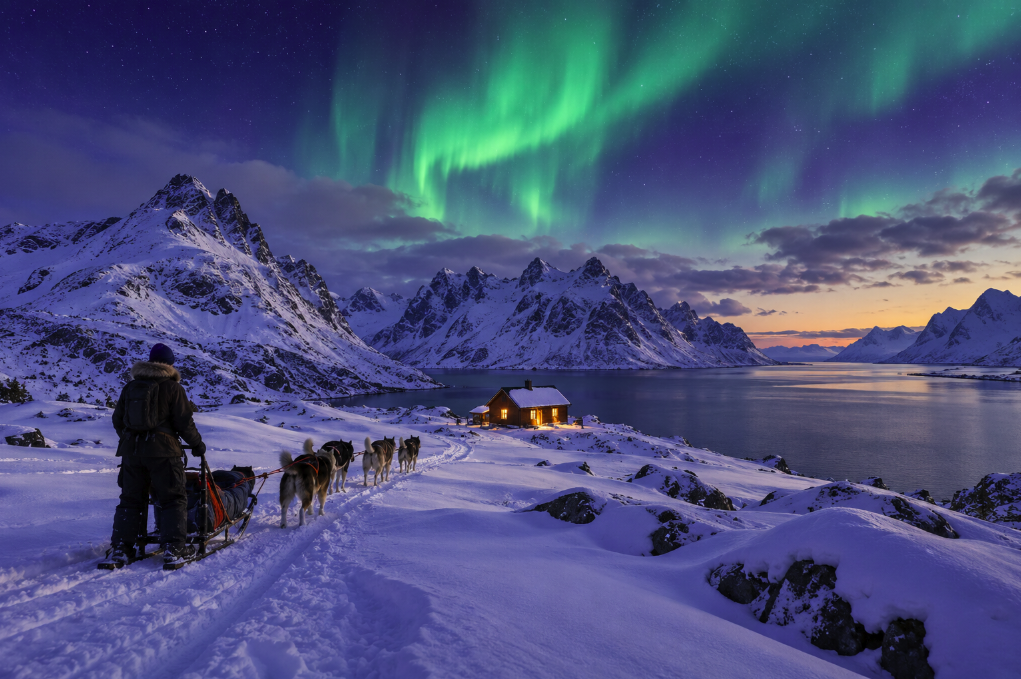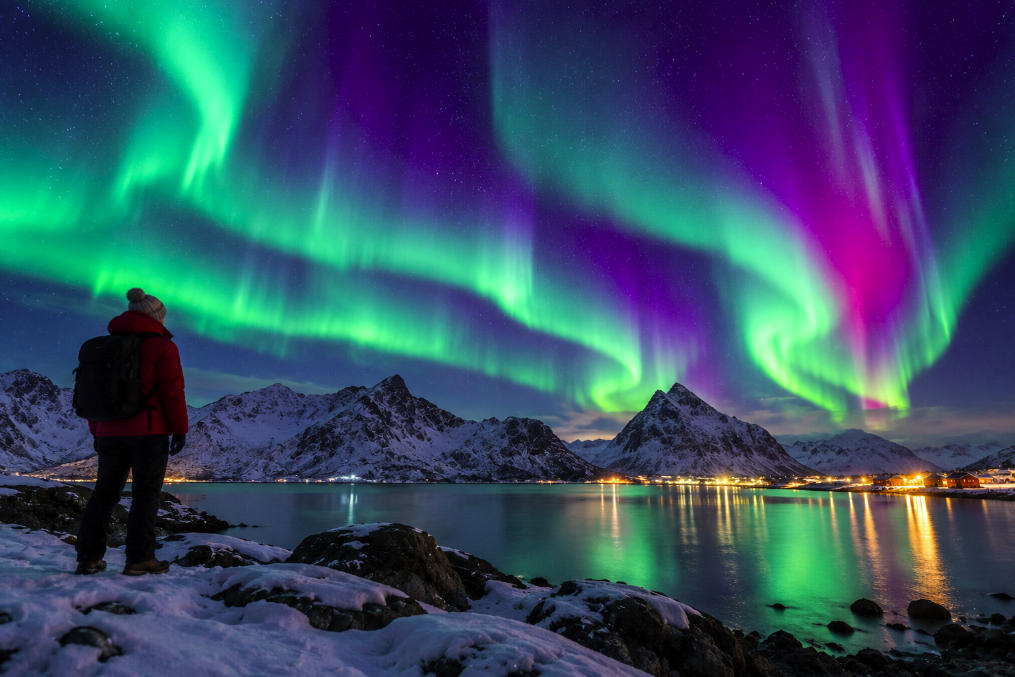
On a clear Arctic night, the sky can begin almost imperceptibly. A pale band appears above the horizon, faint enough to be mistaken for a cloud. Then it brightens. The band folds into curtains, rays climb toward the stars and green light begins moving across the darkness as though the atmosphere itself has become liquid.
The Northern Lights have inspired mythology for centuries, but their real origin is no less extraordinary. The aurora borealis is the visible result of a chain of events connecting the atmosphere above our heads to activity on a star 150 million kilometres away.
It is also unpredictable enough that seeing it remains a genuine encounter rather than a scheduled attraction. You can travel to northern Norway, Iceland, Finnish Lapland or Alaska at exactly the right time of year and still spend a week beneath clouds. On another night, a sufficiently strong geomagnetic disturbance can push auroras far beyond their usual territory and surprise observers thousands of kilometres farther south.
To understand when the Northern Lights appear, it helps to begin not with Earth, but with the Sun.
The aurora begins with an invisible connection to the Sun
The Sun continuously releases a stream of charged particles called the solar wind. Those particles carry magnetic fields through interplanetary space until they encounter Earth’s magnetic environment, the magnetosphere.
Our magnetic field shields the planet from much of what arrives. But the interaction is dynamic rather than perfectly sealed. Energy from the solar wind can be transferred into the magnetosphere and stored there. Through processes including magnetic reconnection, that energy can eventually accelerate charged particles along magnetic field lines toward the upper atmosphere.
There, electrons collide with atoms and molecules of oxygen and nitrogen. The collisions give those atmospheric particles extra energy. When they return to lower-energy states, they release photons — light.
Millions upon millions of these microscopic events become a glowing structure large enough to stretch across the sky.
NASA describes auroras as visible expressions of the interaction between particles, magnetism and Earth’s atmosphere. Far from being a luminous cloud floating just above the landscape, the display commonly occurs roughly 100 kilometres or more above the surface, with different emissions appearing at different altitudes.
This also explains why auroras are closely associated with geomagnetic activity. During a strong geomagnetic storm, much more energy can enter Earth’s magnetic environment and the auroral region can expand dramatically toward lower latitudes. The aurora is therefore one of the most beautiful visible consequences of the same space-weather processes capable of disturbing satellites, radio signals, GPS and electrical infrastructure.
Why are the Northern Lights usually green?
The famous green is largely the signature of atomic oxygen.
Energetic electrons striking oxygen atoms in the upper atmosphere can excite them. As the oxygen releases that energy, it emits light at characteristic wavelengths. One especially strong oxygen emission is green, around 557.7 nanometres, which is also close to a region where human night vision is relatively sensitive.
That combination helps make green the color people most often associate with the aurora.
Red aurora can also come from oxygen, generally at higher altitudes and through a different transition. During intense displays, red can appear above green curtains or spread across large areas of sky. Historically, people living far south of the normal auroral zone sometimes saw only a mysterious red glow on the northern horizon.
Blue, violet and pink shades can involve nitrogen and molecular nitrogen emissions. The final palette depends on altitude, atmospheric composition, the energy of incoming particles and how our eyes or cameras record the light.
This last point explains a common surprise for first-time aurora travelers. A camera may show richer greens and purples than the naked eye perceived at the same moment. Modern sensors can accumulate faint light over an exposure and record colors that human night vision experiences more subtly.
During a strong display, however, the aurora can become bright and visibly colored enough that no camera is needed to understand why generations of observers described it with awe.
Why does the aurora dance?
The Northern Lights are not a static projection painted onto the atmosphere. They trace an evolving electrical and magnetic system.
Earth’s magnetic field stretches far into space, particularly on the night side. Energy from the solar wind can build up in this system before being rapidly released during events called substorms. Magnetic reconnection can accelerate particles toward Earth and produce sudden auroral brightening and motion.
NASA’s THEMIS mission used satellites and ground observatories to investigate this process, helping establish the role of magnetic reconnection in triggering substorms that cause auroral displays to brighten and expand.
To an observer below, these changing flows appear as curtains that ripple, arcs that split, rays that seem to race overhead and immense structures that brighten or disappear in seconds.
Some auroras pulse. Others form relatively quiet arcs. During powerful displays, the entire sky can seem active.
The familiar photographic curtain is therefore only one form of aurora. The phenomenon has an entire visual vocabulary shaped by the physics of near-Earth space.
Why are the Northern Lights usually found near the poles?
Auroras tend to form in broad rings around Earth’s magnetic poles called auroral ovals.
The magnetic geometry of the planet helps guide charged particles toward these high-latitude regions. This is why destinations in northern Scandinavia, Iceland, Greenland, northern Canada and Alaska are famous for aurora tourism.
The oval is not fixed. Its size and position change with geomagnetic conditions.
When activity is relatively quiet, the aurora remains concentrated far north. As geomagnetic activity increases, the oval expands and auroras can become visible at lower latitudes.
This is why a major solar event can produce reports of Northern Lights from places that may go years without a significant display.
The Southern Hemisphere has the same phenomenon: aurora australis, or Southern Lights. Both are expressions of the same Sun-Earth system, although local viewing geography is very different because much of the southern auroral zone lies over ocean and Antarctica.
What the Kp number really tells you
Aurora hunters quickly encounter a number called Kp.
The planetary K index summarizes disturbances in Earth’s magnetic field on a scale from 0 to 9. Higher values generally indicate stronger geomagnetic activity and a greater chance that the auroral oval will expand away from the poles.
NOAA’s Space Weather Prediction Center notes that Kp values from 0 to 2 generally correspond to aurora that is farther north, dimmer and less active. Around Kp 3 to 5, the aurora can move farther from the poles and become brighter and more dynamic. Values of 6 or 7 can push activity farther still.
But Kp is not a magic “aurora percentage.”
If you are already beneath the normal auroral oval in northern Scandinavia, you do not necessarily need a huge geomagnetic storm. In fact, a relatively modest event can produce an excellent display at high latitude. Conversely, someone much farther south may need unusually elevated geomagnetic activity before the aurora reaches the local sky at all.
Cloud cover can defeat the best space-weather forecast. Moonlight and artificial light affect visibility. Local horizons matter. So does timing.
For practical observing, Kp should be treated as one clue among several.
How to improve your chances of seeing the aurora
The first requirement is darkness. At high Arctic latitudes, summer can bring extremely long days or continuous daylight, making aurora viewing impossible even if activity is occurring overhead. Autumn through early spring provides the necessary dark skies.
The second requirement is clear weather. This sounds obvious, but it is often more important to an aurora traveler than the solar forecast. The Northern Lights occur far above ordinary weather clouds; an overcast sky can completely hide an intense display.
Mobility helps. Travelers who can drive from a cloudy coast toward a clearer inland valley may dramatically improve their odds.
Darkness away from streetlights also matters, particularly for faint aurora. Give your eyes time to adapt and scan the entire sky rather than staring only north. At high latitudes, an active aurora can pass directly overhead or even appear toward the south.
NOAA maintains an OVATION-based short-term aurora forecast that estimates the location and intensity of the aurora roughly 30 to 90 minutes ahead. Its experimental aurora dashboard and tonight/tomorrow products provide additional guidance.
Long-range aurora forecasts are inherently less certain because the crucial properties of the solar wind and incoming magnetic field cannot always be known precisely far in advance. A forecast several days out is better treated as an indication of potential than a promise of a show at a particular hour.
Where should you travel?
The most reliable destinations combine high latitude, dark skies, reasonable accessibility and the possibility of escaping clouds.
Northern Norway is famous because places such as Tromsø and the Lofoten region combine dramatic landscapes with a well-developed winter tourism infrastructure. Coastal weather can be variable, however, so inland travel can sometimes provide clearer skies.
Swedish and Finnish Lapland offer broad northern landscapes and often colder, more continental conditions. Abisko in Sweden became particularly famous among aurora travelers because local geography can sometimes favor clearer skies compared with surrounding areas, although no location is cloud-proof.
Iceland offers easy access from Europe and spectacular foregrounds — waterfalls, volcanic landscapes, black beaches and mountains — but Atlantic weather can change quickly.
Fairbanks, Alaska, lies under a favorable part of the auroral zone and offers long winter nights. Northern Canada provides enormous dark-sky territory, with Yellowknife among the best-known bases.
The “best” place is therefore not simply the northernmost point on a map. Weather, darkness, accessibility and the auroral oval all matter.
A connection between travel and space weather
The Northern Lights sit at an unusual intersection of tourism and astrophysics. A traveler can spend the afternoon checking terrestrial cloud forecasts and the evening watching measurements of solar-wind speed and interplanetary magnetic fields arriving from spacecraft positioned far upstream of Earth.
Then, sometimes without warning, an almost invisible gray arc turns green.
The spectacle feels close enough to touch, but its cause spans the solar system. Energy left the Sun, crossed interplanetary space, interacted with Earth’s magnetic field and accelerated particles into an atmosphere that converted those collisions into visible photons.
Every green curtain is therefore more than beautiful weather in the sky. It is evidence that Earth is magnetically connected to its star.
That is why the Northern Lights become especially widespread during strong geomagnetic activity — and why understanding aurora naturally leads to the larger science of solar storms, the magnetosphere and space weather.
For most travelers, none of that physics diminishes the mystery. It does the opposite.
You can know exactly why oxygen glows green, understand magnetic reconnection and watch a NOAA forecast on your phone. Then the sky begins moving above a silent snowy landscape, and the experience still feels impossible.