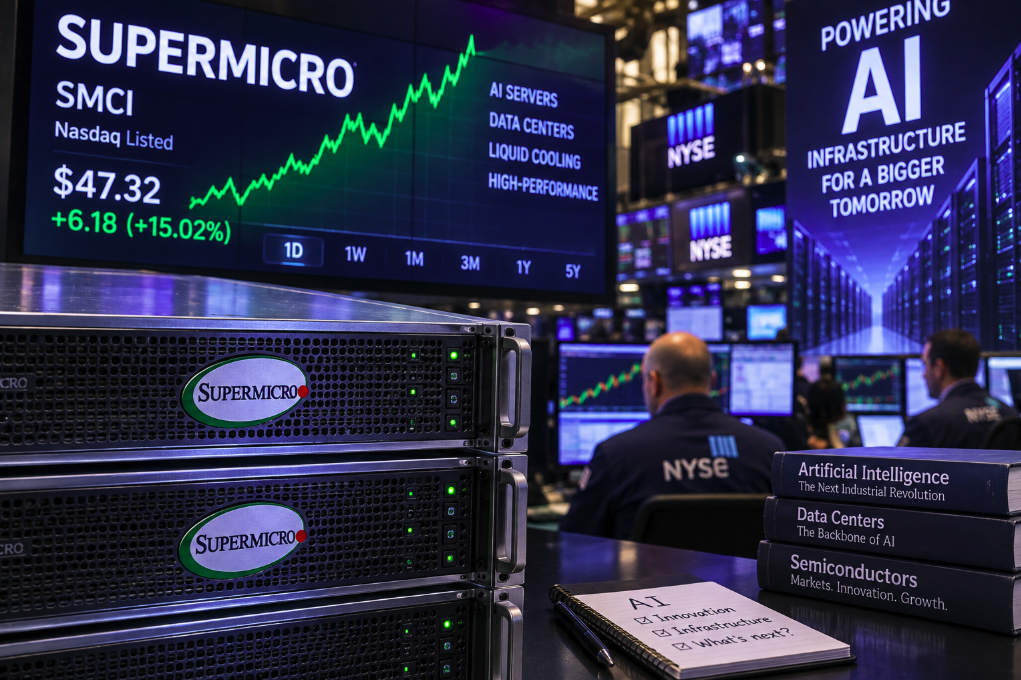
When artificial-intelligence stocks surge, most attention goes to the companies designing the chips. Nvidia became the emblem of the AI boom because its GPUs perform much of the enormous parallel computation behind modern AI models. But a chip sitting on a table cannot train a model. It needs memory, networking, power, cooling, storage, processors, cables, software and a physical server system engineered to keep all of those components working together.
That less glamorous layer of the AI boom is where Super Micro Computer—better known as Supermicro and traded on Nasdaq as SMCI—became one of the market's most closely watched companies.
Supermicro does not primarily compete by inventing frontier AI models. Nor is it simply another semiconductor designer. Its business is closer to building the machines and increasingly the complete data-center infrastructure in which AI chips actually operate. That position helps explain both its extraordinary growth and why the stock can move so violently when investors change their assumptions about AI spending, margins, supply chains or execution.
What does Supermicro actually sell?
At the simplest level, Supermicro builds servers. In practice, the modern business extends far beyond the beige-box image that the word “server” might suggest.
An AI server can contain extremely expensive accelerators, high-performance CPUs, large quantities of memory, networking equipment and specialized cooling. Multiple servers are assembled into racks. Racks must then be connected, powered and cooled inside a data center. For the largest AI deployments, customers may need thousands of accelerators working together.
Supermicro designs systems around processors and accelerators from major semiconductor companies and offers them in configurations tailored to AI training, AI inference, cloud computing, enterprise workloads, storage and edge computing. The company increasingly describes itself as a total IT solutions and data-center infrastructure provider rather than merely a server vendor.
Its strategy emphasizes modular “building block” designs. Instead of starting every new server generation from zero, components and system architectures can be adapted rapidly as new CPUs, GPUs, networking technologies and cooling systems become available.
That speed matters enormously in AI. If a cloud provider has secured a large allocation of the newest accelerator, waiting months for the rest of the server infrastructure means expensive chips are not producing useful work.
Why liquid cooling suddenly matters
AI computing has created an old engineering problem at a new scale: heat.
High-performance accelerators consume enormous amounts of electricity, and much of that energy ultimately becomes heat that must be removed. Traditional data centers have relied heavily on moving chilled air through server rooms. As rack power density rises, cooling everything efficiently with air becomes increasingly difficult.
Liquid cooling brings coolant much closer to heat-producing components and can remove heat more effectively in dense systems. Supermicro has made liquid-cooled racks and broader data-center deployment a major part of its AI infrastructure pitch.
This illustrates why the AI investment story extends beyond chip designers. A new generation of accelerators can trigger demand for power equipment, cooling systems, optical networking, memory, storage and construction. The AI “factory” is an ecosystem, not one component.
The numbers show how quickly the business expanded
Supermicro's fiscal 2026 results demonstrate the scale of the infrastructure buildout. According to the company's August 2026 financial results, full-year net sales reached $39.1 billion, up from $22.0 billion in fiscal 2025.
In the fourth quarter alone, net sales were $11.1 billion, compared with $5.8 billion in the same quarter a year earlier. Quarterly net income reached $1.178 billion, while gross margin was 17.5 percent.
Management also said the company had generated more than $60 billion in new orders during the year and entered fiscal 2027 with record backlog.
Those figures explain why investors treat SMCI as a relatively direct way to express a view about AI infrastructure spending. If companies keep building enormous clusters, Supermicro can potentially sell more of the systems surrounding the chips. If deployment schedules slip, customers delay purchases or competition pressures prices, the same operating exposure can work in reverse.
Why can SMCI jump or fall so much in a single day?
A volatile stock is usually a volatile argument about the future. In Supermicro's case, investors are trying to estimate several variables that can change quickly.
The first is AI demand. Large technology companies and specialized cloud operators are spending heavily on data centers. Any evidence that this spending is accelerating can lift expectations for server suppliers. Signs that customers are slowing capital expenditure can have the opposite effect.
The second is the product cycle. Server demand is tied to the availability of new processors and accelerators. If an important GPU platform is delayed, the servers built around it may also be delayed. When supply suddenly improves, revenue can move between quarters very quickly.
The third is margins. Selling billions of dollars of servers does not automatically guarantee extraordinary profitability. Hardware is competitive. Customers buying enormous volumes have negotiating power, and the expensive components inside a system can account for much of its selling price. Investors therefore watch gross margin almost as closely as revenue growth.
The fourth is execution. Supermicro has expanded at remarkable speed, which requires working capital, inventory, manufacturing capacity, logistics and compliance systems to grow with it. Fast-growing infrastructure companies can consume large amounts of cash while acquiring components and building systems before customers pay.
Finally, the company has faced intense scrutiny around accounting, governance and compliance in recent years. In August 2026, Supermicro announced the completion of an independent-board investigation connected to the March indictment of three individuals who had been associated with the company and said it was continuing to strengthen its export-compliance program. For investors, such issues can add a risk premium even when demand for the underlying products is strong.
Supermicro is part of a much bigger AI infrastructure trade
The current market fascination with “AI stocks” can make the sector sound like a single bet. It is actually a chain of businesses with different economics.
At one end are companies creating frontier AI models and software. Beneath them sit cloud platforms that rent computing capacity. Semiconductor companies design GPUs, custom accelerators, CPUs, memory and networking chips. Foundries manufacture many of those chips. Equipment companies supply the factories. Server companies integrate the components. Data centers then require electricity, transformers, cooling, fiber connections and physical buildings.
Recent industry developments show how quickly that chain is expanding. In September 2026, Qualcomm announced a long-term agreement under which Amazon could purchase up to $60 billion of AI data-center chips and related products, part of Qualcomm's attempt to expand beyond smartphones into AI infrastructure. Days later, chip startup d-Matrix said it would use Nvidia's NVLink Fusion technology to connect its inference processors directly into Nvidia-compatible server systems.
Meanwhile, demand for high-speed optical connections and memory is increasing because AI clusters need to move enormous quantities of data between processors. In other words, the bottleneck can migrate. One year the market worries about GPU availability; the next constraint may be advanced memory, networking, electrical power or cooling.
Why Nvidia matters to Supermicro without being the same investment
Supermicro has benefited enormously from demand for systems built around Nvidia accelerators, but the two companies occupy different layers of the stack.
Nvidia designs the GPUs and a growing collection of networking, interconnect and software technologies surrounding them. Its CUDA software ecosystem has been particularly important in establishing its position in accelerated computing. Supermicro integrates processors and related components into deployable server and rack systems.
That means the economics differ. A dominant chip architecture can command unusually high margins because intellectual property and software create barriers to competition. Server manufacturing and integration tend to be more exposed to component costs, customer concentration and price competition.
At the same time, server vendors can work with multiple processor ecosystems. Supermicro offers systems based on technologies from Nvidia, AMD, Intel and other suppliers. That flexibility can become valuable as customers experiment with different accelerators for training and inference.
What should someone actually watch in an AI infrastructure company?
A stock chart alone cannot explain whether the underlying business is strengthening. For a company such as Supermicro, revenue growth needs to be considered alongside gross margin, operating cash flow, inventory, backlog quality and customer concentration. Guidance can matter as much as the quarter that just ended because the market is valuing future AI demand rather than yesterday's shipments.
Investors also need to distinguish an industry trend from an individual company's competitive position. “AI spending is growing” does not automatically mean every AI-related stock will rise. A company can operate in a booming market and still lose share, price products badly, struggle with costs or disappoint expectations that were already embedded in its valuation.
The reverse is also true. A share price can fall even after a company reports growth if investors expected still more growth. Markets react to the gap between reality and expectations, not simply to whether a headline number is positive.
The physical side of artificial intelligence
The most revealing thing about Supermicro may be what it teaches us about AI itself. Generative AI often feels weightless: type a sentence into a browser and an answer appears seconds later. Behind that experience is an intensely physical industrial system.
There are silicon wafers fabricated in billion-dollar plants, memory modules, optical links, server racks, pumps carrying coolant, transformers delivering electricity and warehouses of machines consuming megawatts of power. AI software depends on hardware infrastructure at a scale that increasingly resembles heavy industry.
SMCI became a market symbol because it sits directly inside that transformation. When its shares soar, investors are often expressing confidence that the construction of AI infrastructure will continue at enormous scale. When they fall, the market may be questioning demand, profitability, execution or simply how much optimism was already priced in.
That makes Supermicro an interesting company to understand even for someone who never intends to buy the stock. It is a window into the machinery behind the AI boom—and a reminder that the intelligence appearing on our screens ultimately runs inside very real buildings filled with very hot computers.