Every September, the technology calendar suddenly becomes crowded. New phones appear within days of one another. Operating systems move from summer previews to public releases. Chipmakers announce processors that will power the next year of devices. Artificial-intelligence features that were demonstrated months earlier finally arrive in products people can buy.
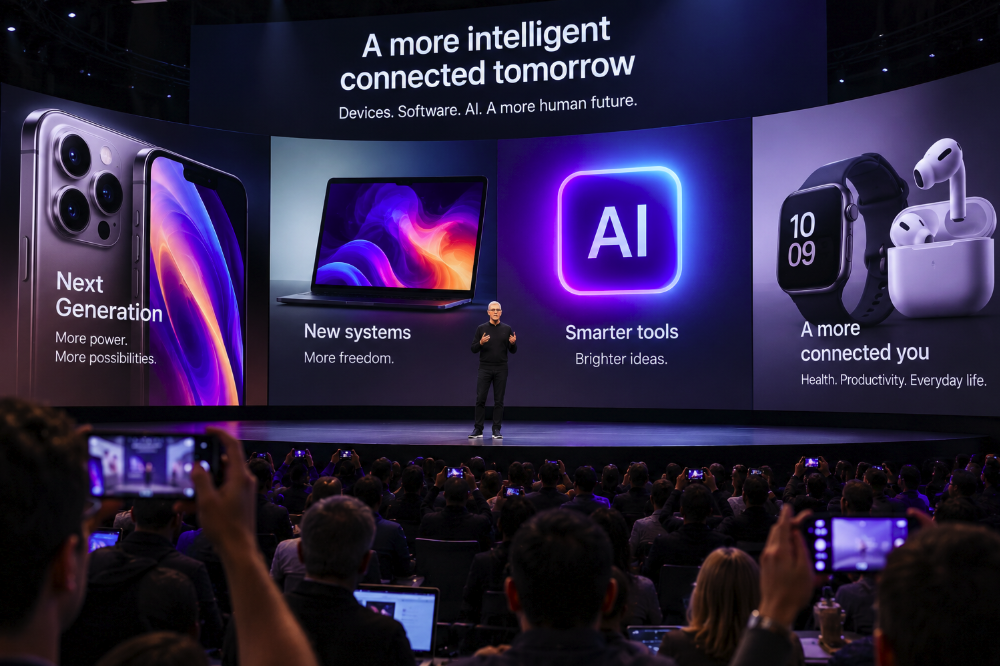
In 2026, that familiar autumn rush is unusually visible. On September 9, Apple unveiled its first foldable iPhone, the iPhone Duo, alongside the iPhone 18 Pro line, new Apple Watches and AirPods. Elsewhere, smartphone manufacturers are preparing or releasing their own flagships, while software companies are pushing AI deeper into phones, computers and everyday applications.
The result is sometimes nicknamed “Techtember,” but the concentration is not just marketing tradition. September sits at a strategic intersection of manufacturing cycles, holiday shopping, software development and the annual smartphone upgrade rhythm.
Why September became launch season
For consumer technology companies, autumn is valuable because it arrives just before the most important retail quarter of the year. A device unveiled in September can reach stores with enough time to build awareness before Black Friday, holiday shopping and year-end gift buying. It also gives manufacturers several months of sales inside the calendar year.
Apple helped make the September product event a global technology ritual. The first iPhone debuted in January 2007, but the company's smartphone launches eventually settled into an autumn rhythm. Once one of the world's most closely watched technology companies established September as its flagship window, competitors, accessory makers, app developers and telecommunications carriers had another reason to organize their own calendars around it.
The timing also fits the software cycle. Major operating-system updates are often previewed at developer conferences in spring or early summer. Developers then spend months testing applications against beta versions. By September, the software is mature enough for public release and can arrive alongside new hardware designed specifically to exploit its capabilities.
That relationship matters more than ever because a modern smartphone launch is no longer primarily about the physical phone. The device, operating system, cloud services and AI models increasingly arrive as one interconnected product.
Apple’s 2026 event made the hardware shift impossible to miss
At its September 9 event, Apple announced a particularly significant addition to the iPhone family. The iPhone Duo is Apple's first foldable iPhone, with a 7.6-inch inner display and a smaller outer screen for use when the device is closed.
The significance is not simply that another foldable phone exists. Foldable Android devices have been sold for years. What matters is that Apple, after waiting while rivals developed the category, has now decided the form factor is mature enough to become part of the iPhone ecosystem.
Apple's official event page also lists the iPhone 18 Pro, Apple Watch Series 12, Apple Watch Ultra 4 and AirPods 5 among the September announcements. The company describes the Duo as having the largest display ever offered on an iPhone, while the new Pro phones continue the more familiar annual pattern of faster processors, camera improvements and software capabilities.
This creates two different kinds of technology launch in one event. One is evolutionary: improve the device millions of people already recognize. The other is experimental: change the physical shape of the product and ask users to reconsider how a phone should work.
The smartphone race is becoming a form-factor race again
For much of the last decade, flagship smartphones converged on a remarkably stable design: a large rectangular touchscreen with several cameras on the back. Improvements happened inside that rectangle—better displays, processors, batteries and computational photography—but the basic object changed very little.
Foldables reopened the question of shape. A phone can become a small tablet, fold vertically into a more compact object or, in experimental designs, use multiple hinges. The engineering challenge is considerable because flexible displays, hinges, batteries, cameras and water resistance all have to coexist inside a device that users open and close thousands of times.
September 2026 is therefore interesting not because every new phone is revolutionary, but because manufacturers are exploring several answers to the same problem: what comes after the mature slab smartphone?
At the same time, conventional phones remain enormously important. Most buyers still prioritize price, battery life, camera quality, durability and software support over novelty. A spectacular folding mechanism can attract attention at a launch event, but long-term success depends on whether it solves a problem people actually have.
Operating systems have become launch events of their own
A new phone used to provide the obvious visual excitement while its software played a supporting role. That distinction is fading. Operating-system updates can now change how millions of existing devices behave overnight.
Apple's 2026 software cycle illustrates the shift. At WWDC in June, the company highlighted a new generation of Siri AI powered by Apple Intelligence alongside updates across its platforms. The September hardware event then placed those software capabilities in the context of new devices.
This hardware-software sequence is deliberate. A feature shown at a developer conference gives app makers time to prepare. The consumer launch explains why an ordinary user might care. The public software release then brings at least some of those capabilities to the installed base, not only to people buying a new phone.
That is why searches for operating-system compatibility spike around launch season. Consumers increasingly want to know not merely “What is the new phone?” but “Will my current phone get the new feature?” A software update can postpone a hardware upgrade if it makes an older device feel new again—or encourage one if the most attractive capabilities require newer chips.
AI is becoming the connective tissue
Artificial intelligence has changed the language of technology launches. A few years ago, companies emphasized camera megapixels, processor speeds and display brightness. Those specifications still matter, but launch presentations now devote enormous attention to what a device can understand, generate, summarize, translate, recognize or automate.
This is partly because AI gives manufacturers a way to turn invisible computing improvements into visible experiences. A faster neural-processing unit means little to most consumers by itself. A phone that can translate a conversation, identify an object, edit a photograph, summarize notifications or understand a more natural voice request is easier to demonstrate.
It also changes the competitive battlefield. Smartphone makers are no longer competing only over hardware components. They are competing over models, cloud infrastructure, privacy architecture, developer ecosystems and the ability to integrate AI without making ordinary tasks slower or more confusing.
The most important question is increasingly not whether a product “has AI.” That phrase is becoming almost meaningless because AI appears in everything from camera processing to keyboards. The useful questions are what the AI actually does, whether it works reliably, what information leaves the device, what requires a subscription and whether the feature remains useful after the launch demonstration ends.
Why launch events produce such enormous search spikes
A technology keynote compresses uncertainty into a few hours. Before the event, people search rumors, expected prices and release dates. During the presentation, they search unfamiliar product names and specifications. Immediately afterward come comparisons: old model versus new model, Pro versus standard, Android versus iPhone, foldable versus conventional.
Then purchasing questions take over. When can it be preordered? Which storage option makes sense? Will an existing case fit? What does a trade-in offer? Which devices support the new operating system?
That cycle makes launch-day search traffic unusually intense because the information changes rapidly. An article written from leaks the morning before an event can become obsolete before lunch. For major launches, official product pages should therefore be the first place to verify names, specifications, prices and availability. Apple's current event page, for example, provides the confirmed list of products announced at its September 2026 presentation.
The real launch happens after the keynote
Product presentations are designed to show technology under ideal conditions. Reviewers and ordinary buyers discover the compromises later. Battery life has to survive real days rather than controlled tests. A foldable hinge has to live in pockets with dust and keys. AI assistants have to understand accents, ambiguous requests and bad network connections. New operating systems have to coexist with millions of third-party apps.
This is why the most useful judgment often comes weeks after the applause. A dramatic hardware redesign can turn out to be genuinely transformative or merely impressive on stage. An AI feature can become part of daily life or disappear into a settings menu. A software redesign can feel intuitive after three days—or annoy users for an entire year.
September is therefore less a finish line than the beginning of a mass experiment. Technology companies reveal what they believe people will want next; millions of users then test that belief in public.
That is the deeper reason autumn tech launches generate such fascination. The products are not simply new objects. They are competing proposals for how we will communicate, work, photograph, navigate and interact with machines over the next several years. The keynote lasts an hour or two. The consequences of the choices introduced onstage can last much longer.