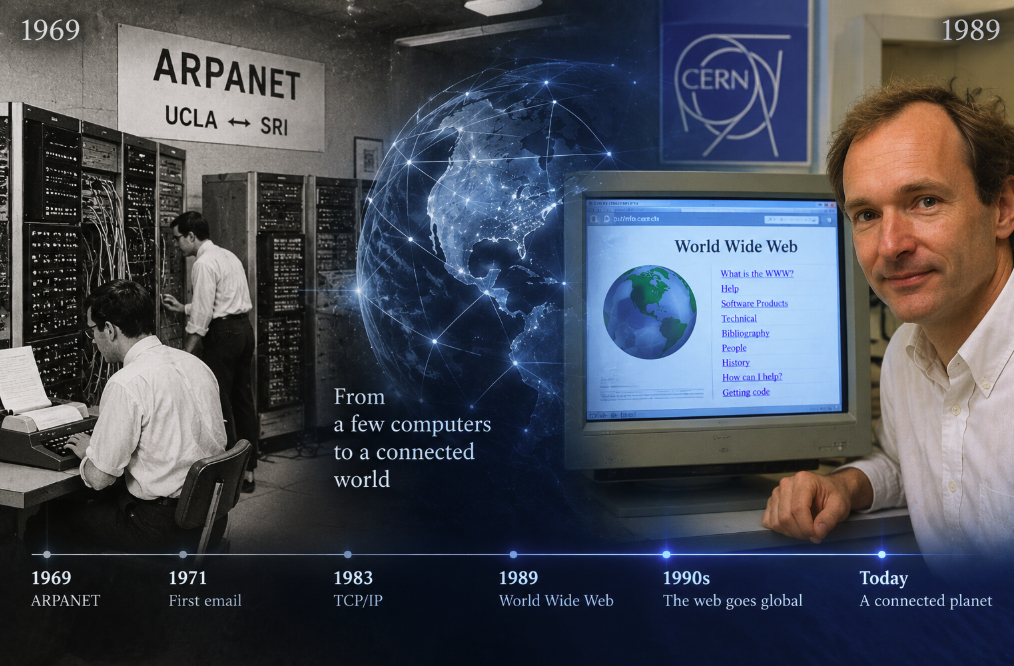
On the evening of October 29, 1969, a student programmer at UCLA began typing a word into a computer. The machine was connected over a network to another computer at the Stanford Research Institute, hundreds of kilometres away. The intended message was simple: LOGIN.
Only two letters made it.
The remote computer received “L” and “O” before the system crashed. About an hour later, the connection was restored and the complete word was transmitted. The tiny failure has become one of technology history’s most memorable beginnings: “LO” was the first message sent over ARPANET, a pioneering network that helped lay the foundations of the modern Internet.
Yet saying that ARPANET “invented the Internet” misses what makes the story so remarkable. The Internet was not one invention, and there was no single moment when somebody switched it on. It emerged from decades of ideas about sharing computers, dividing information into packets, connecting incompatible networks and creating common rules that allowed machines to communicate.
Then, twenty years after that first ARPANET transmission, a British scientist at CERN proposed another system. Tim Berners-Lee did not invent the Internet. He invented the World Wide Web — the technology that would make the Internet dramatically easier for ordinary people to navigate, publish on and understand.
The distinction between those two inventions is the key to the whole story.
Before the Internet, computers were islands
Computers of the early 1960s were enormous, expensive machines generally operated by universities, corporations and government institutions. Researchers often had to travel physically to use specialized computing resources. Connecting distant machines so that scientists could share programs and information was therefore an increasingly attractive idea.
One of the influential early visionaries was psychologist and computer scientist J.C.R. Licklider. While leading computer research at the U.S. Advanced Research Projects Agency, then known as ARPA, Licklider promoted the idea of interconnected computers through which people could access information and programs from different locations. The Internet Society’s history of the Internet traces this vision to Licklider’s early-1960s writings about a globally connected computing environment.
Another essential idea was packet switching. Traditional telephone networks established a dedicated circuit between two callers. Computer communication did not necessarily need such a continuous connection. Information could instead be divided into smaller blocks — packets — transmitted through a network and reassembled at the destination.
Researchers including Paul Baran in the United States, Donald Davies in Britain and Leonard Kleinrock contributed important ideas to the development of packet-switched networking. Their work arose in different contexts and should not be compressed into the myth of a single inventor. What mattered was the emerging realization that packet switching could make digital networks flexible and efficient.
ARPANET goes live
In 1968, ARPA contracted the technology company Bolt Beranek and Newman to build specialized machines called Interface Message Processors, or IMPs. They performed a role analogous to early packet routers, linking host computers to the network.
By late 1969, the first four ARPANET nodes were operating at UCLA, the Stanford Research Institute, the University of California, Santa Barbara, and the University of Utah. DARPA’s official history records the first computer-to-computer transmission between UCLA and SRI on October 29, 1969.
The network was funded by a U.S. defense research agency, but describing it simply as a military communications system built to survive nuclear war is misleading. Resilience was important to packet-network thinking, particularly in related research by Paul Baran, but ARPANET itself was created primarily to advance computer networking and allow geographically separated research institutions to share computing resources.
It grew quickly. More universities, laboratories and government facilities joined. Researchers discovered that one of the most compelling uses of networking was not remotely operating expensive computers but communicating with other people.
Email became a major application in the early 1970s. Ray Tomlinson, working at BBN, developed network email software and adopted the @ symbol to separate a user’s name from the host computer. A character that had existed for centuries suddenly acquired a new identity.
But ARPANET still had a fundamental limitation. It was one network. The future would require many different networks to communicate with one another.
The breakthrough was a network of networks
During the 1970s, new kinds of packet networks appeared, including radio and satellite systems. They did not necessarily operate in the same way. The central challenge became how to connect fundamentally different networks without forcing every one of them to adopt identical internal technology.
Robert Kahn and Vinton Cerf developed a new architecture for this problem. Their work led to the protocol family eventually known as TCP/IP — Transmission Control Protocol and Internet Protocol.
The idea was enormously powerful. Individual networks could retain their own internal designs while gateways passed packets between them. IP provided a common addressing and routing framework across interconnected networks, while TCP could provide reliable end-to-end transmission for applications that needed it.
This concept of “internetworking” is where the Internet truly begins to distinguish itself from ARPANET. The Internet was not supposed to be one enormous homogeneous network. It was a system that allowed many independent networks to behave as parts of a larger whole.
The Internet Society’s history by Vint Cerf dates DARPA’s Internetting research program to 1973 and explains how its communication protocols evolved into the TCP/IP suite.
A decisive transition came on January 1, 1983. ARPANET hosts were required to move from their older Network Control Protocol to TCP/IP. The Internet Society describes it as a “flag-day” conversion: machines had to adopt the new protocols or lose normal communication with those that had.
January 1, 1983 is sometimes called the birthday of the Internet. Like most technological birthdays, the label is convenient rather than absolute. But the TCP/IP transition did establish the protocol architecture that remains fundamental to Internet communication today.
The Internet grows beyond ARPANET
During the 1980s, the network landscape expanded far beyond the original ARPA project. Universities wanted connectivity, scientific institutions built networks, personal computers proliferated and local-area networking technologies such as Ethernet spread.
The U.S. National Science Foundation created NSFNET in the mid-1980s to connect supercomputing centres and academic institutions. It became an important backbone for the expanding research Internet and helped extend high-speed networking to universities across the United States.
Meanwhile, the Domain Name System introduced a more human-friendly way to identify computers. People no longer had to rely entirely on numerical network addresses; hierarchical names such as domains ending in .com, .edu and .org could be translated into IP addresses.
By the end of the decade, ARPANET was no longer the centre of the networking universe it had helped create. DARPA records its termination in 1989. The seed had effectively disappeared into the much larger ecosystem that grew from it.
And in 1989, another invention was about to transform what people did on that Internet.
Tim Berners-Lee did not invent the Internet
This is perhaps the most persistent confusion in popular technology history. Tim Berners-Lee invented the World Wide Web, not the Internet.
The difference is easiest to understand by thinking of the Internet as infrastructure. It is the global network of networks and the protocols that allow computers to exchange data. Email, file transfer, online games, messaging and many other services can operate over the Internet without being part of the Web.
The Web is one service built on top of that infrastructure. It organizes information into linked documents and resources that can be requested from servers and displayed in browsers.
Berners-Lee was working at CERN, the European particle-physics laboratory near Geneva, where thousands of scientists from institutions around the world needed to exchange information. CERN’s computing environment contained many incompatible machines, documentation systems and databases. Keeping track of who knew what — and where information lived — was difficult.
In March 1989, Berners-Lee submitted a proposal for a distributed hypertext information system. His supervisor, Mike Sendall, famously described the proposal as “vague but exciting.” The basic insight was to combine existing technologies — computer networking, hypertext and the Internet — into a universal information space.
CERN’s history of the Web records that Berners-Lee wrote the first proposal in March 1989 and, together with Belgian engineer Robert Cailliau, formalized it in a management proposal in November 1990.
The three technologies that made the Web work
Berners-Lee’s achievement was not simply the abstract idea of linking documents. Hypertext already existed, and Douglas Engelbart had publicly demonstrated linked digital information and other revolutionary interface concepts in his famous 1968 “Mother of All Demos.” What Berners-Lee created was a practical, open system capable of linking information across the Internet.
Three core technologies became central to the Web. URLs provided addresses for resources. HTTP defined a method for browsers and servers to request and transfer Web resources. HTML provided a simple markup language for structuring documents and creating hyperlinks.
By the end of 1990, Berners-Lee had built the first Web server and the first browser/editor on a NeXT computer at CERN. The machine carried a handwritten warning telling colleagues not to switch it off because it was a server.
The world’s first website, hosted at info.cern.ch, explained the World Wide Web project itself. It described how to create servers, how hypertext worked and how users could find other information online. The first website was, fittingly, a manual for creating more of the Web.
At first, almost nobody outside a specialist community knew it existed.
The decision that helped the Web conquer the world
A technically brilliant system does not automatically become a global standard. The Web’s explosive expansion depended partly on a crucial institutional choice.
On April 30, 1993, CERN made the World Wide Web software available on a royalty-free basis. That meant developers and organizations could implement and extend Web technology without paying CERN licensing fees. The laboratory later issued the software under an open licence.
The consequences were enormous. Developers could build servers and browsers freely. Universities, companies and individuals could create websites. Competing browsers appeared, most famously NCSA Mosaic in 1993, which helped make the Web visually accessible to a much wider audience.
CERN reports that by late 1993 more than 500 Web servers were known to exist. By the end of 1994 there were around 10,000, including roughly 2,000 commercial servers, and the estimated number of Web users had reached about 10 million.
Berners-Lee moved to MIT in 1994 and founded the World Wide Web Consortium, or W3C, to develop open Web standards and resist fragmentation into incompatible proprietary systems.
No single person invented the Internet
The temptation to name an inventor is understandable. The telephone is associated with Alexander Graham Bell; the World Wide Web has Tim Berners-Lee. The Internet does not fit that model.
Its history includes Licklider’s vision of interactive networked computing, packet-switching work by Kleinrock, Baran and Davies, ARPANET leadership and engineering by Lawrence Roberts and many others, the IMP builders at BBN, Steve Crocker and the early Request for Comments community, Ray Tomlinson’s network email, Kahn and Cerf’s internetworking architecture, and countless researchers who created routing systems, naming services, applications and standards.
Even the culture of Internet engineering became part of the invention. In 1969 Steve Crocker wrote the first Request for Comments, or RFC, as an informal way for network researchers to exchange technical ideas. The RFC series evolved into one of the principal documentary foundations of Internet standards. The Internet Society describes the open exchange embodied by RFCs as a defining element of how the network developed.
The Internet succeeded because it was designed less like a single machine and more like an agreement: different machines and networks could communicate as long as they followed shared protocols.
From two letters to billions of connected people
The journey from ARPANET to the Web is sometimes presented as a straight line: military network, Internet, website. The real history is richer. ARPANET demonstrated packet networking between research computers. TCP/IP made it possible to interconnect different networks. Academic and government infrastructure expanded the Internet. The Web then gave people a simple system for publishing and following information across it.
Each layer depended on what came before without being identical to it.
That is why October 1969 and March 1989 mark two different revolutions. The first showed that distant computers could communicate over a packet network. The second proposed a way for human knowledge itself to become interconnected through clickable links.
When the UCLA system crashed after transmitting “LO” in 1969, nobody was watching the birth of a finished Internet. There was no Web, no search engine, no social media, no streaming video and no smartphone. There was only a fragile experimental connection between two expensive computers.
Twenty years later, Berners-Lee looked at an already growing Internet and imagined documents connected across it without regard to the type of computer on which they lived. His Web turned that network infrastructure into an information space that ordinary users could explore.
The modern online world emerged when those two ideas met: computers connected to computers, and information connected to information.