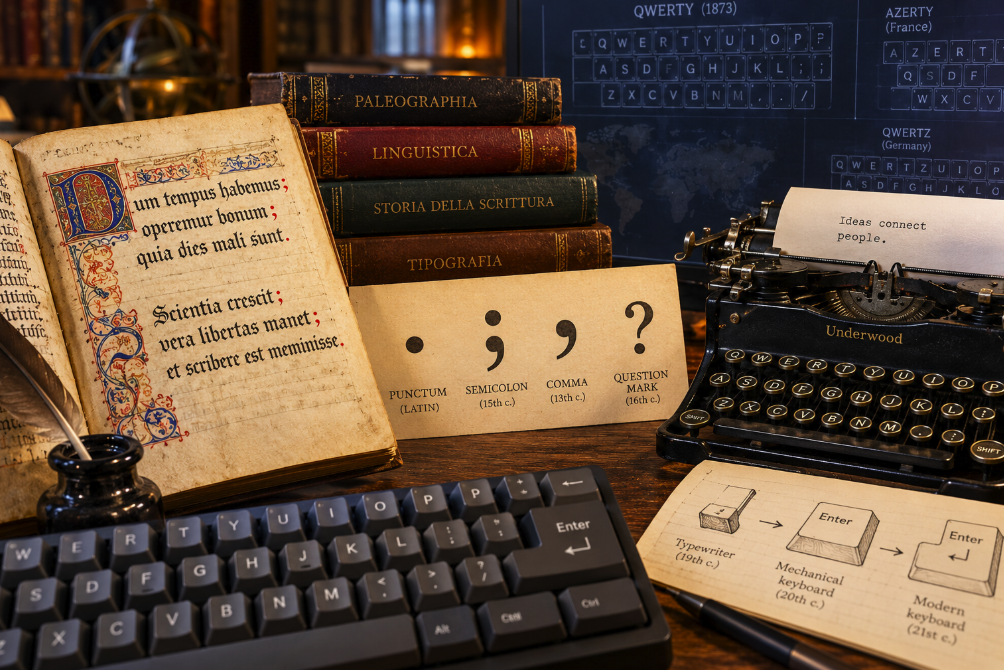
Look down at a computer keyboard and you are looking at a museum whose exhibits still work. Some keys preserve decisions made by nineteenth-century typewriter manufacturers. Others carry symbols whose history stretches back to Renaissance printers and medieval scribes. The Enter key is the digital descendant of a mechanical operation that once moved a heavy carriage across a typewriter. QWERTY survives from an era of metal type bars. Even punctuation marks that now occupy tiny corners of the keyboard were once technological innovations in their own right.
We tend to think of writing as language and the keyboard as merely the tool used to enter it. Historically, however, the two evolved together. Every new writing technology — manuscript, movable type, typewriter, teletype and computer — inherited conventions from the previous one while adding its own. The result is that a modern keyboard contains layers of history separated by centuries.
Before punctuation became standardized
Ancient and medieval writing did not always separate words and sentences in ways a modern reader would recognize. Systems of points and other marks developed gradually, and scribal practices varied enormously by language, period and place. Punctuation was not simply a collection of grammatical rules. It was also a technology for making text easier to read, recite and interpret.
The arrival of printing in fifteenth-century Europe created new pressure for consistency. A manuscript could reflect the habits of one scribe or workshop. A printed book might produce hundreds of nearly identical copies, giving printers unusual power to stabilize spelling, letterforms and punctuation.
One of the figures most closely associated with that transformation was the Venetian printer Aldus Manutius. His press, established in Venice in the 1490s, became famous for elegant editions of classical texts, portable books and typographic innovation. The semicolon is strongly associated with the circle of Manutius and the humanist Pietro Bembo. It is attested in Bembo's De Aetna, printed by Aldus in the 1490s.
The mark filled a useful space between comma and full stop. It could signal a division stronger than a comma without completely closing the thought. That sounds obvious to us because centuries of typography have made the semicolon visually ordinary. At the time, however, punctuation itself was still being regularized through the new industrial technology of print.
There is a pleasing irony here: a symbol that modern writers sometimes consider fussy or old-fashioned was once an innovation designed to make complicated prose easier to navigate.
When marks became machinery
For most of writing history, a writer could make almost any mark the hand was capable of drawing. Mechanical writing imposed a different constraint. A typewriter needed a physical key, lever and piece of type for each available character. Every symbol occupied engineering space.
Attempts to mechanize writing appeared long before the familiar office typewriter, but the decisive commercial breakthrough came in the nineteenth century. Christopher Latham Sholes, Carlos Glidden and Samuel Soule received a U.S. patent for a writing machine in 1868. Sholes and Glidden continued developing the design, and E. Remington & Sons eventually manufactured the machine commercially.
The Smithsonian's surviving Sholes & Glidden Type Writer represents the first Remington model placed on the market in 1874. It could type only capital letters. The Remington No. 2, introduced a few years later, allowed both upper- and lowercase characters by using a shift mechanism. The word “Shift” on today's keyboards is therefore not an abstract computer term: it descends from physically shifting part of the typewriter mechanism so the same key could print another character.
This mechanical economy shaped punctuation too. Because keyboard space was limited, manufacturers had to decide which marks deserved dedicated positions and which functions could be combined. The keyboard turned the repertoire of written symbols into hardware.
Why QWERTY refuses to die
The most famous inheritance is the sequence Q-W-E-R-T-Y. Sholes's earliest experimental keyboards did not begin with the layout we know. The arrangement evolved during development, and by the time Remington's machine entered the market, QWERTY was becoming embedded in commercial typing.
The usual story says QWERTY was deliberately designed to slow typists down so adjacent metal arms would not collide. The history is more complicated. The Smithsonian's account of QWERTY's origins notes that historians continue to debate exactly why the arrangement developed. Avoiding clashes between type bars is one explanation; research has also suggested that feedback from telegraph operators, who needed to transcribe Morse messages efficiently, influenced the layout.
What is certain is that Remington's commercial success mattered enormously. Once offices bought QWERTY machines and workers trained to use them, changing layouts became expensive. A keyboard is not only hardware; it becomes muscle memory. Standards create their own momentum.
Alternative arrangements have repeatedly appeared. August Dvorak and William Dealey patented the Dvorak Simplified Keyboard in the twentieth century, designed around different ideas about typing efficiency. Other countries developed national variants such as AZERTY in France and QWERTZ across parts of Central Europe. Yet the basic QWERTY family survived the death of the mechanical problem that helped shape it.
That survival is a classic example of technological path dependence. Once millions of people, schools, manufacturers and businesses coordinate around one system, a theoretically superior replacement has to overcome the enormous value of compatibility with what already exists.
The strange ancestry of Enter
No key demonstrates technological inheritance better than Enter. On a modern computer it can submit a web form, send a message, execute a command, confirm a dialog box or begin a new paragraph. Those actions seem purely digital, but the key's ancestry is physical.
On a manual typewriter, typing caused the carriage holding the paper to move progressively as characters were struck. At the end of a line, the typist had to return the mechanism to the beginning and advance the paper so typing could continue on the next line. This was the carriage return and line-feed operation.
The language survived when communication became electrical. Teleprinters and early computer systems represented carriage return and line feed as control operations. Their mechanical meaning was straightforward: return the printing position horizontally, then move vertically to the next line.
Computing inherited both the concept and, eventually, the key. Depending on the machine and era, keyboards used labels such as Return, Enter or both. Their meanings overlapped but were not always identical. “Return” naturally referred to the typewriter's carriage-return heritage. “Enter” emphasized a newer computational function: entering data or confirming an instruction.
The distinction is still visible today. Some keyboards label the main key Return, some Enter, and full-size keyboards often have a separate Enter key on the numeric keypad. The familiar bent arrow printed on many Return keys visually echoes the idea of going down and back toward the beginning of a new line.
The persistence of these concepts has even left traces inside software. Text files still encode line endings, and historically different operating systems have represented them differently using carriage-return and line-feed control characters. A physical motion performed by nineteenth-century machinery survived as invisible data.
From type bars to electronic switches
The twentieth century gradually severed the connection between a key and a specific metal character. Electric typewriters transformed the mechanism, and computers completed the separation: pressing a key became an electrical event that software could interpret.
IBM's Selectric typewriter, introduced in 1961, was an important step in this transition. Instead of the traditional basket of individual type bars, the IBM Selectric used a spherical typing element often nicknamed the “golf ball.” The design eliminated type-bar jams and allowed users to change typefaces by replacing the element. IBM says more than 13 million Selectrics were eventually sold.
Computer keyboards no longer needed to arrange letters around mechanical levers, yet manufacturers retained familiar layouts because users already knew them. The physical reason for QWERTY weakened while the social reason became stronger.
The same process happened with many individual keys. Shift no longer physically shifts a carriage. Return does not return one. Tab originated in tabulation mechanisms but now moves a cursor, changes focus in software or indents code. Backspace once moved a typing position backward; today it usually deletes information. The names became linguistic fossils.
A keyboard is a negotiated standard
Modern keyboards may look obvious only because decades of standardization have made their design familiar. International standards now describe keyboard sections, key positions and principles for placing characters. The current ISO/IEC 9995-1:2026 standard, for example, specifies general principles governing layouts for text and office systems, including keyboard sections and the relative placement of keys.
But no single universal keyboard exists. Languages need different accented letters and writing systems. Countries have their own conventions. Laptop manufacturers compress layouts to save space. Programmers care intensely about the accessibility of brackets, slashes and punctuation that ordinary prose rarely uses. Smartphone keyboards go further, replacing fixed physical positions with software surfaces that can change according to context.
Even so, the old metaphors remain remarkably resistant. A touchscreen keyboard on a device with no moving carriage can still display Shift, Backspace and Return. A child can learn these words without ever seeing the machinery that gave them meaning.
The archaeology beneath our fingertips
Writing technologies rarely begin from zero. New systems inherit familiar features because familiarity makes them easier to adopt. Printers standardized marks used by scribes. Typewriter makers turned those marks into keys. Computer designers inherited the typewriter keyboard. Software retained terminology from mechanical devices long after the mechanisms vanished.
That is why the semicolon and Enter key belong in the same history. One emerged from the effort to organize meaning on the printed page; the other from the physical problem of moving paper through a machine. Both became conventions so useful — or simply so deeply established — that later technologies carried them forward.
The next time you press Enter after typing a semicolon, two histories briefly meet under your fingers. One reaches back to Renaissance Venice and the typographers who refined punctuation for printed books. The other passes through nineteenth-century typewriters, moving carriages, teleprinters and early computers. The keyboard may be electronic, but much of its vocabulary is centuries old.