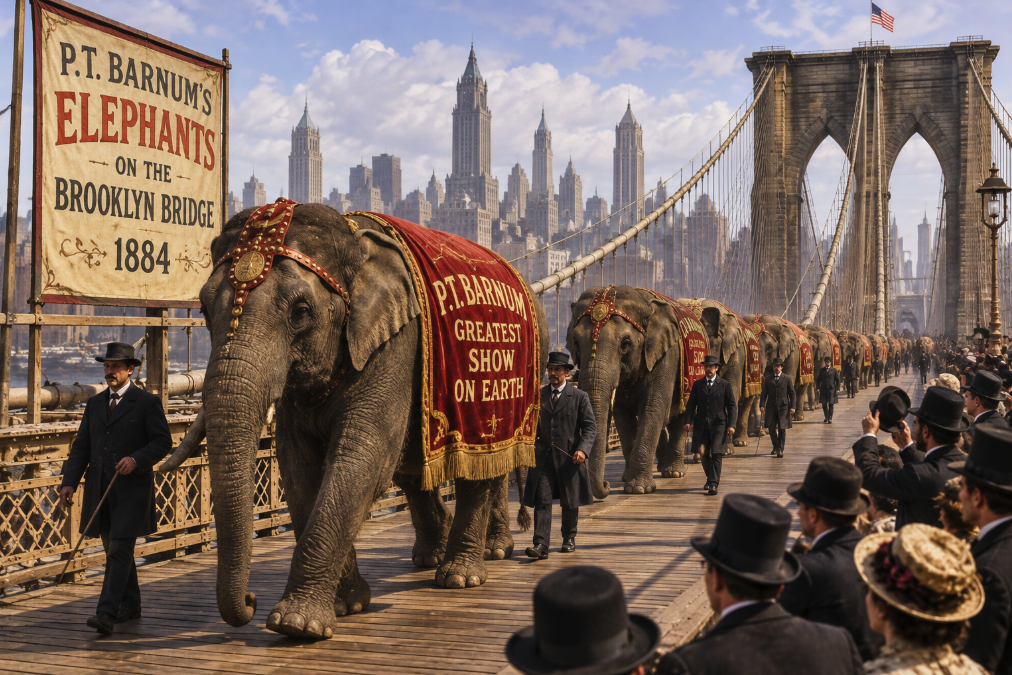
On the evening of May 17, 1884, New Yorkers witnessed a sight strange enough to compete with the bridge beneath it. A procession of circus animals moved across the East River from Manhattan toward Brooklyn: camels, elephants and, among them, the celebrity animal of the age, Jumbo. In all, contemporary accounts and later historical sources put the parade at 21 elephants and 17 camels.
The story is often retold as an eccentric engineering experiment: the Brooklyn Bridge was new, people feared it might collapse, so P.T. Barnum supposedly sent his elephants across to prove its strength. The essential event is true, but calling it a scientific “test” gives Barnum too much credit as an engineer and not enough as a showman. The bridge had already been designed, calculated, built, inspected and carrying enormous volumes of traffic. Barnum’s elephants performed something different and perhaps more culturally powerful: a public demonstration that ordinary people could understand at a glance.
A bridge that looked almost impossible
When the Brooklyn Bridge officially opened on May 24, 1883, it was unlike anything most visitors had ever seen. Its main span stretched 1,595.5 feet across the East River, making it the world’s longest suspension bridge at the time. Its immense stone towers rose above two cities that were still politically separate — Brooklyn would not become part of New York City until 1898 — while steel cables supported a roadway seemingly suspended over open water.
The achievement had taken roughly 14 years and an extraordinary human toll. Designer John A. Roebling died before construction properly got underway after an accident led to tetanus. His son Washington Roebling took over as chief engineer but became seriously ill after working around the pneumatic caissons used to construct the bridge’s foundations. The illness, now understood as decompression sickness, left him unable to supervise the project normally.
Emily Warren Roebling then became indispensable. She studied technical subjects, communicated Washington’s instructions, dealt with contractors and officials and helped keep the enormous project moving. The American Society of Civil Engineers credits her with taking on duties so extensive that the bridge might not have been completed without her efforts. When the bridge opened, Emily was among the first to cross it ceremonially.
For engineers, the finished structure represented years of calculations, materials testing and construction experience. For a member of the public standing beneath its cables in 1883, however, the Brooklyn Bridge could look almost supernatural. Suspension bridges also carried memories of previous failures. Confidence in a new technology does not always arrive at the same moment as the technology itself.
The opening celebrations were enormous. President Chester A. Arthur attended, ships filled the harbor and fireworks illuminated the new landmark. The following day alone, more than 150,000 pedestrians and around 1,800 vehicles reportedly crossed it. Yet within a week, celebration gave way to tragedy.
The panic that made fear much worse
On May 30, 1883, crowds packed the pedestrian promenade. A panic erupted near a staircase on the Manhattan side. Accounts differ on the exact spark, but people began to believe that something was wrong — including rumors that the bridge was collapsing. The resulting crush killed 12 people and injured many more.
The bridge itself had not failed. The disaster was a crowd panic, not a structural collapse. But psychologically, the distinction was devastating. A bridge that already seemed audacious had now become associated with a fatal scene only days after opening.
This is where Phineas Taylor Barnum entered the story.
Barnum understood publicity better than almost anyone in nineteenth-century America. By the 1880s he was already famous for museums, exhibitions, sensational promotions and the traveling circus enterprise he had joined with James Bailey. He had also acquired Jumbo, the enormous African elephant whose transfer from the London Zoological Society to Barnum in 1882 had generated international attention.
Even before the fatal panic, Barnum had recognized the promotional possibilities of the new bridge. Historical accounts say he offered $5,000 for the privilege of taking his elephants across it. Bridge officials initially rejected the proposal. After the 1883 disaster, however, a spectacle that associated the bridge with enormous weight suddenly had obvious public-relations value.
Enter Jumbo — and 20 other elephants
Nearly a year after the panic, Barnum got his procession. On May 17, 1884, 21 elephants and 17 camels crossed the Brooklyn Bridge while crowds watched. Jumbo, Barnum’s star attraction and one of the most famous animals in the world, was part of the parade.
The spectacle worked because it translated engineering confidence into an image anyone could understand. An equation describing cable tension meant little to most pedestrians. Twenty-one elephants walking across the span was another matter entirely.
There is an important historical nuance here. The elephants did not constitute a rigorous structural load test in the modern engineering sense. The Brooklyn Bridge was already operating, and its designers had not been waiting for Barnum’s circus to certify their calculations. The parade was theater, reassurance and advertising rolled into one extraordinary event.
And it was brilliant advertising. Barnum could present his animals before thousands of New Yorkers without buying a conventional stage. The bridge received a vivid demonstration of public confidence, while Barnum’s circus became part of one of the city’s biggest stories. Each side benefited from the other’s fame.
The New York Public Library records the event as a publicity stunt that helped quiet doubts about the bridge’s stability. Later accounts describe Jumbo at the rear of the procession and emphasize how the mass of animals reassured spectators that the span could bear substantial weight.
Curiously, the event that today seems made for photography left no famous photographic record comparable to the images we might expect from a modern publicity stunt. Night photography was technically difficult in the 1880s, particularly for moving subjects, and later illustrations and reconstructions have helped shape the popular visual memory of the parade.
The elephant test was really a test of public trust
The episode reveals something larger about the history of technology. Engineering does not succeed only when a structure works. People also have to believe that it works.
The Brooklyn Bridge was a radical object in the landscape. Its steel-wire suspension system, immense scale and Gothic towers represented a new kind of urban infrastructure. The public could not personally verify Washington Roebling’s calculations or inspect the anchorage and cables. Trust had to be built through experience, authority and symbols.
Barnum supplied the perfect symbol. Elephants were culturally synonymous with enormous weight, and Jumbo was advertised as an animal of almost unbelievable proportions. If the bridge could casually accommodate an entire circus procession, the reasoning went, perhaps an ordinary pedestrian had little to fear.
Of course, 21 elephants were only a fraction of the loads the bridge would handle during its long life. Trains crossed it, horse-drawn vehicles crowded its roadway, automobiles eventually replaced much of that traffic, and generations of commuters have used the span ever since. The bridge survives today not because Barnum proved its strength, but because the Roeblings and thousands of workers created an extraordinarily durable piece of engineering.
Still, the elephants earned their place in its history. The stunt joined two great nineteenth-century American obsessions: monumental engineering and monumental showmanship. One promised that modern technology could conquer distance; the other knew how to turn almost anything into a spectacle.
More than 140 years later, the image remains irresistible: one of the world’s newest engineering wonders filled with elephants, camels and spectators, while Jumbo walks over the East River. It was not the bridge’s real safety test. It may have been something Barnum understood even better — a test of whether a frightened public could be persuaded by a spectacle too enormous to forget.