There is a moment at almost every birthday party when the room changes. The lights dim, a cake appears, tiny flames tremble above the icing and everyone waits while one person silently makes a wish. Then comes the breath, the smoke and the applause. We repeat the ritual so automatically that its strangest detail is easy to overlook: why are we setting fire to dessert in the first place?
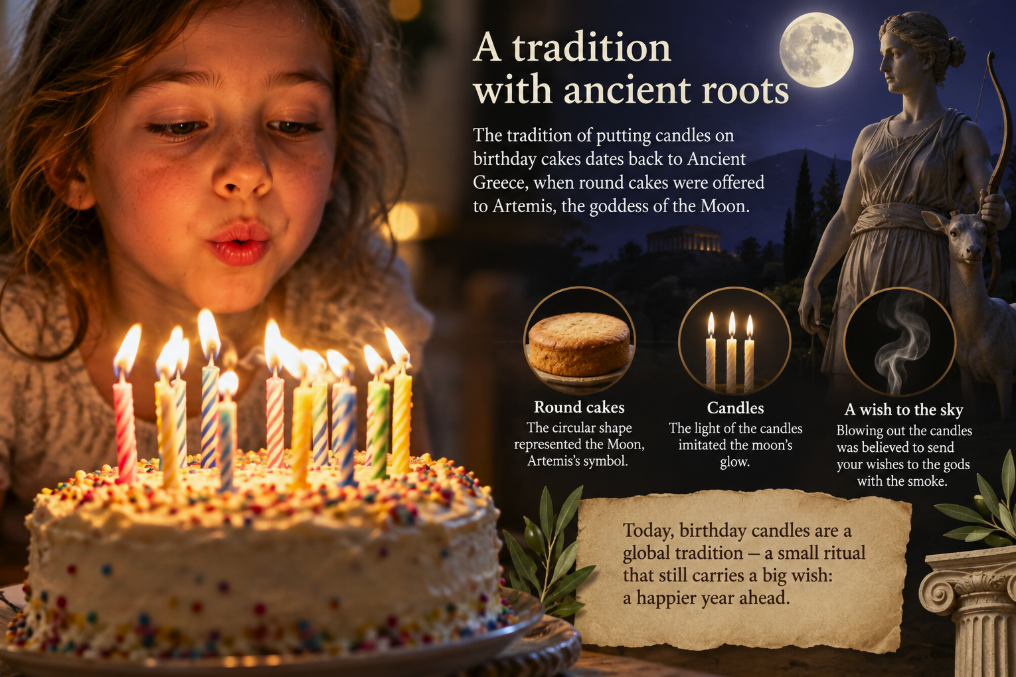
The most popular explanation travels all the way back to ancient Greece. According to the familiar story, worshippers offered round cakes to Artemis, a goddess associated with the moon, and placed flames on them so that they glowed like the lunar disk. The smoke supposedly carried prayers toward the gods. It is a beautiful origin story — and it may preserve echoes of ancient ritual — but historians cannot draw a straight documented line from those Greek offerings to the candles on a modern birthday cake.
The evidence becomes much firmer centuries later in Germany. The birthday ritual we recognize today, with candles representing a person's years of life, is closely associated with German birthday celebrations and the children's tradition known as Kinderfest. Our modern custom appears to be the product of several layers of history rather than a single ancient invention.
The irresistible Artemis story
Artemis occupied a complicated place in Greek religion. She was associated with hunting, wilderness, childbirth and young women, and later Greek tradition strongly linked her with the moon. Ancient worshippers did make food offerings to deities, and archaeological evidence from the Artemision at Ephesus includes round cakes used as votive offerings.
From there comes the familiar reconstruction: round cakes symbolized the moon, while small flames recreated its glow. Smoke rising from the offering could symbolically carry prayers upward. Versions of this story are repeated so often that they are frequently described as the literal birth of the birthday candle.
The difficulty is the documentary gap. A 2025 National Geographic investigation into the history of birthday candles notes that, despite the widespread claim, there is no direct historical record proving that ancient Greeks placed candles on cakes to honor Artemis in the way modern retellings describe. Archaeological evidence supports round votive cakes; the candlelit moon-cake scenario is a plausible later interpretation rather than an uninterrupted, securely documented tradition.
That distinction matters because ancient Greece did not have the modern personal birthday ritual we know today. Even if fire, cakes, lunar symbolism and prayer intersected in the worship of Artemis, that does not prove that someone in classical Athens made a private wish and blew out a row of birthday candles.
The famous detail about smoke carrying wishes to heaven is similarly difficult to pin to one moment of invention. Smoke has carried prayers, offerings and symbolic messages in many religious traditions. Connecting that ancient symbolism directly to today's secret birthday wish makes a compelling story, but the historical bridge is uncertain.
Germany gives us a clearer trail
For recognizable birthday candles, the evidence becomes considerably stronger in early modern Germany. By the 18th century, children's birthday celebrations known as Kinderfeste featured cakes and candles. The number of flames could correspond to the child's age, sometimes with an additional candle representing another year of life or hope for the future.
One often cited early written description comes from 1746, when Count Ludwig von Zinzendorf celebrated his birthday with a cake bearing candles corresponding to his age. By the later 18th century, the practice was established enough to appear in descriptions of German birthday celebrations.
The German tradition also helps explain why candles became more than decoration. Light had long carried religious and protective symbolism in Europe, and some accounts describe birthday flames as a defense against misfortune or harmful spirits. Other interpretations emphasize the candle as a “light of life.” Over time, the symbolism became increasingly personal: each flame could stand for a year already lived.
This is much closer to what happens on birthday cakes now. We count years with candles, gather around one person, extinguish the flames and attach a wish to the act. The modern ritual therefore has a clearer documentary relationship with German birthday culture than with a specific ancient Greek ceremony.
When did blowing them out become part of the ritual?
Lighting candles is only half of the modern tradition. The birthday person is expected to extinguish them — preferably all at once — while keeping a wish secret. The exact origin of that rule is even harder to trace.
By the 19th century, descriptions of birthday celebrations show candles being deliberately blown out. An 1881 account from Switzerland, often cited in histories of the custom, describes candles corresponding to years of life being extinguished individually. The familiar one-breath challenge and the superstition that revealing your wish prevents it from coming true developed within the broader folklore surrounding birthday celebrations.
The symbolism almost writes itself. A flame marks life and passing time; breath extinguishes it; smoke rises and disappears. Whether or not modern people consciously think about any of this, the ritual turns something invisible — another year of life — into something visible that can be counted, watched and ceremonially ended.
It also explains why birthday candles survived even as birthday cakes changed dramatically. Cakes became larger, sweeter and more elaborate as refined sugar and industrial baking became cheaper. Candles became mass-produced and colorful. Yet the essential choreography remained remarkably stable: flames, wish, breath, smoke.
A tradition assembled from many histories
Popular customs rarely have the tidy origin stories we want them to have. Birthday candles are a good example. The ancient Greek connection is culturally plausible and supported by evidence of votive cakes associated with Artemis, but the familiar claim that Greeks definitively invented today's candle-on-cake birthday ritual goes beyond what historians can prove.
The German evidence is less romantic but more concrete. Children's birthday celebrations in the 18th century clearly used candles on cakes, linked the flames with age and life, and helped establish the ritual from which the modern custom developed. As birthday celebrations spread and became increasingly commercialized in the 19th and 20th centuries, the cake-and-candle combination traveled with them.
Today almost all of the old religious meaning has disappeared. Most people lighting birthday candles are not invoking Artemis, protecting a child from spirits or thinking about the theology of fire. Yet the ceremony still contains something ancient in spirit: a small flame represents time, a private hope is attached to it, and smoke carries the moment away.
So why do we put candles on birthday cakes? Not because we can confidently point to one Greek ritual and declare the mystery solved. The custom seems to combine old associations between fire, offerings and wishes with a much better documented German tradition of marking a person's years with candles. The story is messier than the legend — but perhaps that is appropriate for a ritual that has crossed centuries while remaining simple enough for a child to understand: count the flames, make a wish, and blow.