For many Americans, Labor Day means a three-day weekend, backyard cookouts, crowded beaches, college football and the unofficial end of summer. Retailers turn it into a sales event, swimming pools prepare to close, and families squeeze in one last warm-weather trip before autumn routines take over.
That relaxed modern identity can obscure the holiday's much more combative origin. Labor Day emerged from the American labor movement in the late nineteenth century, when industrial workers were organizing publicly for greater political power, shorter hours, better pay and safer conditions. Its earliest celebrations were not invented by retailers or presidents. They were organized by workers themselves.
The story begins in New York City in 1882, with a parade that nearly failed before it started.
The first Labor Day was a workers' demonstration
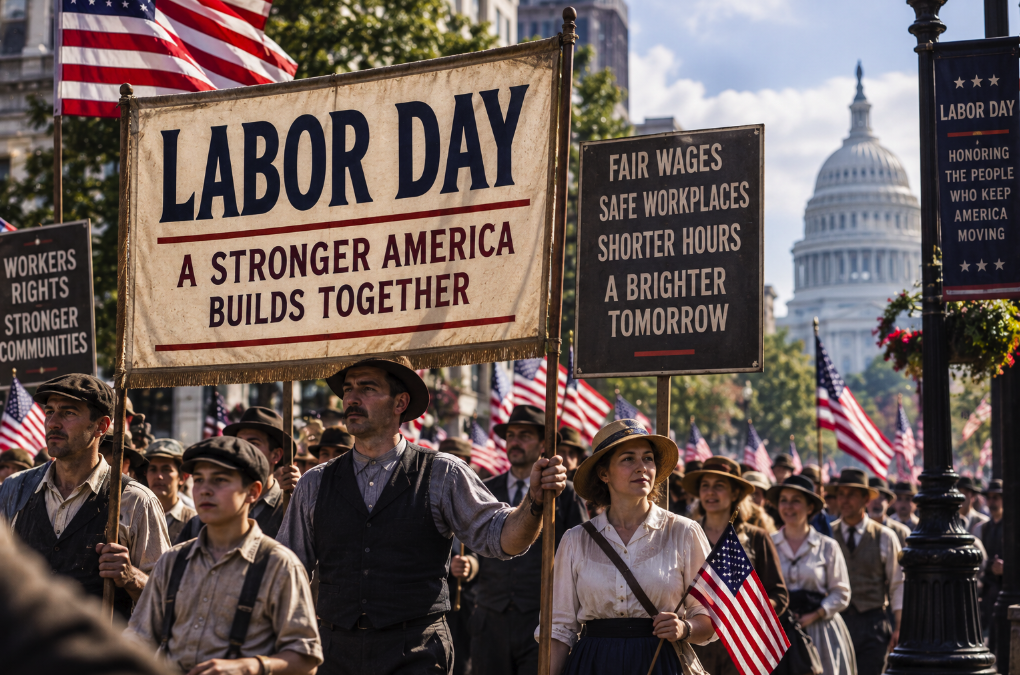
On Tuesday, September 5, 1882, workers gathered in lower Manhattan for what is generally recognized as the first Labor Day celebration in the United States. The event was organized by New York's Central Labor Union, a coalition representing local labor organizations.
According to the Library of Congress, about 10,000 workers ultimately participated. They marched from the City Hall area through Manhattan, passing Union Square before continuing uptown. Workers and their families later gathered for a picnic, music and speeches.
The polished historical image of a grand inaugural parade hides how uncertain the morning actually was. The U.S. Department of Labor recounts that spectators and police were waiting before many marchers had arrived. Organizers lacked a band, and the parade appeared in danger of becoming an embarrassment. Then a contingent of jewelers from Newark arrived with musicians, the procession began, and more workers joined along the route.
Contemporary estimates of the number of marchers varied, but the spectacle clearly succeeded. The format—public procession followed by recreation and speeches—became the model for later Labor Day celebrations.
The symbolism was deliberate. A parade made organized labor visible. Workers from different trades could demonstrate publicly that they were not isolated employees negotiating individually with powerful employers; they belonged to organizations capable of acting collectively.
Who invented Labor Day? History has two Maguires
The seemingly simple question “Who founded Labor Day?” has an unusually inconvenient answer: historians are not certain.
For many years, credit commonly went to Peter J. McGuire, a carpenter, union leader and later co-founder of the American Federation of Labor. According to one version of events, McGuire proposed a general holiday for working people in 1882, envisioning a street parade that would display the strength and solidarity of trade organizations, followed by festivities for workers and their families.
But another labor leader had an almost identical surname: Matthew Maguire, a machinist who served as secretary of New York's Central Labor Union. Evidence examined by historians suggests that Matthew Maguire may actually have proposed the holiday while holding that position in 1882.
The U.S. Department of Labor's history of Labor Day now presents both claims rather than declaring an undisputed founder. It notes that later reporting in New Jersey called Matthew Maguire the author of the holiday and that both men participated in the first Labor Day parade.
The uncertainty is historically revealing. Labor Day did not really spring from a presidential proclamation or one famous individual's inspiration. It grew out of an organized movement in which many workers and union leaders were trying to establish labor as a visible civic force.
Why American workers wanted their own holiday
The United States of the 1880s was industrializing rapidly. Railroads connected vast regions, factories expanded, cities grew and mass production transformed economic life. The wealth generated by that transformation was enormous, but working life could be harsh.
Long working days were common, workplace protections were limited by modern standards, and unions were fighting for legitimacy and bargaining power. The eight-hour workday became one of the movement's defining demands. Strikes could produce confrontations with employers, private security forces, police or government authorities.
A workers' holiday therefore had a purpose beyond leisure. It celebrated the economic contribution of labor while also giving unions a recurring public platform. Early Labor Day events could combine celebration, political organizing, speeches and demonstrations of solidarity.
The date itself was useful. September fell in a long stretch between Independence Day and Thanksgiving and offered generally pleasant weather for outdoor parades and festivals. Unlike May Day, which later became strongly associated internationally with socialist and revolutionary labor movements, the American Labor Day tradition settled on September.
How a union celebration became a legal holiday
The New York event spread. Labor organizations in other cities began holding similar celebrations, and states gradually gave the holiday legal recognition.
New York introduced an early Labor Day bill, but Oregon became the first state to enact a Labor Day law, on February 21, 1887. Colorado, Massachusetts, New Jersey and New York followed that same year. Connecticut, Nebraska and Pennsylvania joined them before the decade ended.
By 1894, the movement was already well established. That timing matters because Labor Day's creation is sometimes described as though President Grover Cleveland suddenly invented the holiday in response to one famous strike. He did not. Workers had been celebrating Labor Day for more than a decade, and numerous states had already recognized it.
What happened in 1894, however, dramatically changed the political context in which Washington acted.
The Pullman Strike and Grover Cleveland
In the spring of 1894, workers at the Pullman Palace Car Company near Chicago went on strike amid conflict over wages and conditions. The American Railway Union, led by Eugene V. Debs, became involved, and the dispute spread through the nation's rail system.
The federal government obtained an injunction and President Grover Cleveland sent federal troops into Chicago. Violence followed, and the confrontation became one of the defining labor conflicts of the era.
Against this explosive backdrop, Congress moved legislation establishing Labor Day as a legal federal holiday. Cleveland signed it on June 28, 1894, designating the first Monday in September.
It is tempting to describe the law simply as Cleveland's peace offering to organized labor after the Pullman crisis. The timing clearly connected federal recognition to a period of extraordinary labor tension, and historians frequently discuss the two together. But the deeper origin belongs to the worker-led movement that had been building the holiday since 1882.
Federal legislation recognized something unions and states had already created.
Why isn't U.S. Labor Day on May 1?
This question becomes especially interesting because International Workers' Day, or May Day, is observed on May 1 in many countries—and its history has important American roots.
The international May Day tradition developed partly from the campaign for an eight-hour working day and the labor upheavals surrounding Chicago's Haymarket affair in 1886. Yet the United States' established Labor Day tradition had already begun four years earlier with the September 1882 New York parade.
Over time, May Day became associated more strongly with socialist, communist and revolutionary labor movements internationally, while the first Monday in September became the mainstream American civic holiday honoring workers.
The result is one of history's ironies: much of the world marks labor on a date deeply connected to events in the United States, while the United States celebrates its official labor holiday in September.
How Labor Day changed meaning
Early Labor Day celebrations were explicitly connected to organized labor. Parades displayed union strength, and speeches addressed wages, hours, political influence and the dignity of work.
The holiday gradually became broader and less confrontational. The Department of Labor describes it today as an annual celebration of the social and economic achievements of American workers. Parades continue in some cities, but for many people the weekend is now defined more by travel, picnics, sports and the symbolic end of summer than by union politics.
That transformation is not unusual. National holidays accumulate meanings that their founders could not fully control. Memorial observances become vacation weekends; civic rituals become shopping events; political anniversaries become family traditions.
Yet the original Labor Day remains visible beneath the modern one. The three-day weekend itself is a reminder of a world in which leisure time had to be fought for. Ideas that now seem ordinary—limits on working hours, weekends, workplace safety rules and collective bargaining—were once subjects of intense political and industrial conflict.
Labor Day began because workers wanted the country to see them. On September 5, 1882, they marched through New York with banners, music and trade insignia to make labor publicly impossible to ignore. More than a century later, the parades may be smaller and the barbecues more prominent, but the holiday still carries the same basic message: the American economy was not built only by inventors, financiers and presidents. It was also built, day after day, by people who went to work.