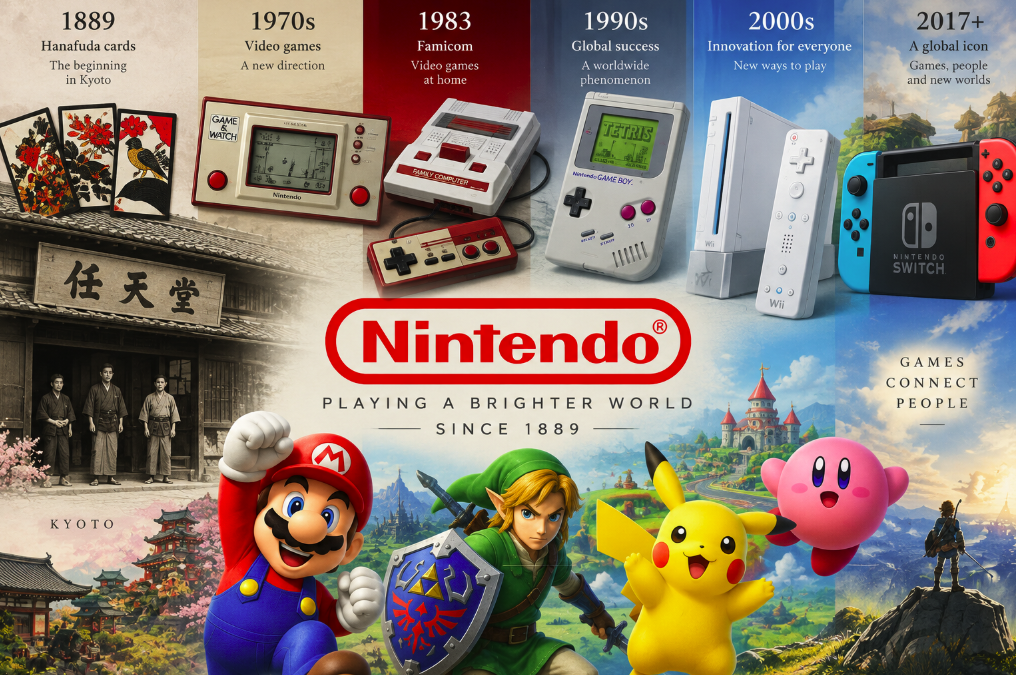
Long before Mario jumped over his first barrel, before the Game Boy disappeared into millions of backpacks and before families swung Wii Remotes in front of television screens, Nintendo sold pieces of decorated cardboard.
The company’s story begins in Kyoto in 1889, more than eighty years before the first commercially successful home video-game consoles appeared. Fusajiro Yamauchi began manufacturing Japanese hanafuda, or “flower cards,” at a time when Japan itself was undergoing rapid modernization. From that modest card business emerged a company that would survive world wars, technological revolutions, spectacular successes and expensive failures.
Nintendo’s history is therefore not simply the history of a video-game manufacturer. It is the history of repeated reinvention. The product changed from cards to toys, from toys to electronic games and from electronic games to interconnected entertainment systems, but one underlying idea remained remarkably persistent: Nintendo wanted to manufacture ways for people to play.
Kyoto, 1889: Nintendo before electricity
According to Nintendo’s official corporate history, Fusajiro Yamauchi began manufacturing hanafuda playing cards in Kyoto in 1889. Hanafuda decks use illustrated cards representing flowers and seasonal imagery rather than the suits and numbers familiar from Western playing cards.
The business expanded. In 1902, Yamauchi began producing Western-style playing cards, initially intended for export but ultimately popular in Japan as well. The company evolved through several legal and organizational forms, becoming Yamauchi Nintendo & Co. in 1933.
The famous name itself has generated decades of speculation. Nintendo is written with three Japanese characters, and popular accounts often translate it with phrases involving leaving luck or fortune to heaven. Linguists and company historians have cautioned that the original intended meaning is uncertain. There is no surviving statement from Fusajiro Yamauchi definitively explaining why he chose the name, so the elegant translations commonly repeated online are better treated as interpretations than settled fact.
The decisive figure in Nintendo’s twentieth-century transformation was Fusajiro’s great-grandson Hiroshi Yamauchi. He became president while still a young man in 1949 and would lead the company for more than half a century.
Under Yamauchi, Nintendo modernized its traditional business. In 1953 it became the first Japanese company to mass-produce plastic playing cards, and in 1959 it began selling cards featuring Walt Disney characters. The licensing agreement helped Nintendo reach children and families beyond the traditional card-playing market.
But Yamauchi understood a dangerous truth: playing cards alone offered limited room for a company with larger ambitions.
The strange years when Nintendo tried almost everything
In 1963 the company adopted its current name, Nintendo Co., Ltd., deliberately dropping “Playing Card” from its corporate identity. Nintendo’s own chronology says that it began manufacturing games in addition to cards.
This period has acquired a mythology of its own. Popular histories describe Nintendo experimenting with a range of unrelated businesses, some of which were short-lived. What mattered strategically was the search for a larger entertainment market.
By the late 1960s, toys were becoming central. One employee would prove especially important: Gunpei Yokoi.
Yokoi had joined Nintendo as an engineer. His early success came with the Ultra Hand, an extendable grabbing toy that became a commercial hit. He went on to work on numerous mechanical and electronic toys, establishing an approach that later became strongly associated with Nintendo: instead of always pursuing the newest possible technology, find inexpensive, mature technology and use it in an unexpectedly entertaining way.
Nintendo moved increasingly toward electronics. Its official history records the Beam Gun series in 1970, using optoelectronic technology in toys, followed by laser shooting attractions and arcade systems. In 1977 the company released Color TV-Game machines for the Japanese home market in cooperation with Mitsubishi Electric.
Nintendo was no longer merely experimenting around the edges of electronic entertainment. It was becoming a video-game company.
Game & Watch, Donkey Kong and the birth of modern Nintendo
Two developments around 1980 changed the company’s future.
The first was Game & Watch. These compact LCD games, designed under Gunpei Yokoi, combined a clock with a simple electronic game. Nintendo’s historical interviews state that 59 Game & Watch titles were released between 1980 and 1984 and sold 43.4 million units worldwide. The series also introduced an invention that would outlive the devices themselves: the cross-shaped directional pad, or D-pad, which became a standard element of video-game controllers.
The second development came from a young artist named Shigeru Miyamoto.
Nintendo was attempting to expand its arcade business in North America when an unsuccessful machine left the company with cabinets it needed to repurpose. Miyamoto was given the opportunity to create a new game. The result was Donkey Kong, released in 1981.
The premise was immediately readable: a giant ape had captured a woman, and a small hero had to climb a construction site while avoiding barrels. That hero was initially known as Jumpman. He would soon become Mario.
Donkey Kong was an international success and helped establish something that would become one of Nintendo’s greatest strengths: memorable characters were not decoration added to a game after the mechanics were finished. Personality, movement, visual design and play could be built together.
Miyamoto would later create or shape franchises including Super Mario and The Legend of Zelda, becoming one of the most influential designers in the history of the medium.
The Famicom changes the living room
Nintendo’s next gamble was much larger. Hiroshi Yamauchi wanted a home console powerful enough to reproduce compelling arcade-style games but inexpensive enough to reach a mass audience.
The Family Computer — better known as the Famicom — launched in Japan in 1983. Nintendo’s official history describes it as a home system built around custom processing hardware. Early technical problems led to a product recall, but after those issues were addressed, the machine became a phenomenon.
Then came the challenge of America.
The U.S. video-game business had suffered a dramatic market collapse in the early 1980s. Retailers were wary of another game console. Nintendo redesigned the Famicom for Western markets as the Nintendo Entertainment System, or NES, giving it a more restrained appearance and tightly controlling which software could be released for the machine.
Super Mario Bros., released in Japan in 1985, demonstrated what the hardware could do. Its scrolling landscapes, responsive controls and carefully structured levels made Mario an international icon. Nintendo followed with franchises including The Legend of Zelda, Metroid and others that remain active decades later.
The company that had once depended on flower cards now controlled one of the most important entertainment platforms in the world.
Game Boy proves that power is not everything
In 1989 Nintendo introduced the Game Boy in Japan. Technically, it was less impressive in some respects than rival handheld machines. Its screen was monochrome rather than color. Yet it offered crucial advantages: relatively modest cost, long battery life, durability and a strong library of games.
Gunpei Yokoi’s philosophy was visible again. Nintendo did not need the most advanced screen if older technology produced a better portable product overall.
The inclusion of Tetris turned out to be particularly important. The Soviet-designed puzzle game appealed far beyond Nintendo’s traditional audience and made the Game Boy attractive to adults as well as children.
Later in the 1990s, another phenomenon transformed Nintendo’s handheld business. Pokémon Red and Pokémon Green debuted in Japan in 1996. Trading creatures between Game Boys made the physical link between consoles part of the game’s central idea. Pokémon grew into a vast media franchise encompassing games, cards, animation, films and merchandise.
By then, Nintendo had demonstrated a pattern that competitors repeatedly underestimated: technical specifications mattered, but they were not the same thing as fun.
From Super Nintendo to Nintendo 64
Nintendo entered the 16-bit era with the Super Famicom in Japan in 1990, known internationally as the Super Nintendo Entertainment System. Games such as Super Mario World, The Legend of Zelda: A Link to the Past and Super Metroid refined genres the company had helped establish.
The transition to three-dimensional gaming brought the Nintendo 64 in 1996. Its analog stick was particularly suited to controlling characters in 3D space, and Super Mario 64 became a landmark in three-dimensional game design. The Legend of Zelda: Ocarina of Time followed with another influential model for navigating and fighting within 3D worlds.
Yet Nintendo was no longer dominant in the way it had been during the NES era. Sony’s PlayStation became an enormous competitor, and Nintendo’s decision to continue using cartridges on Nintendo 64 had both advantages and drawbacks. Cartridges loaded quickly but were more expensive and held less data than compact discs, influencing some publishers to develop elsewhere.
The GameCube generation that followed produced acclaimed games but again faced formidable competition from Sony and Microsoft.
Nintendo needed another reinvention.
DS and Wii: Nintendo stops competing on the obvious battlefield
The Nintendo DS, released in 2004, looked strange. It had two screens, one of them touch-sensitive, and came with a stylus. Rather than simply offering a more powerful Game Boy, Nintendo created new ways to interact with games.
The strategy worked spectacularly. Titles such as Nintendogs, Brain Age, Mario Kart DS and the continuing Pokémon series attracted audiences well beyond traditional console players.
The Wii, launched in 2006, extended the idea into the living room. While Sony and Microsoft competed with increasingly powerful hardware, Nintendo offered a motion-sensitive remote that could be swung like a tennis racket or pointed at a television.
Wii Sports made the concept understandable within seconds. People who had never learned combinations of controller buttons could imitate a bowling motion and immediately see the result on screen.
The machine became a cultural phenomenon. Retirement homes, family gatherings and physical-therapy settings joined bedrooms and gaming rooms as places where Nintendo hardware appeared.
It was classic Nintendo: use technology not merely to make existing games look better, but to change who might want to play them.
Failure, then another transformation
Success was not permanent. The Wii U, released in 2012, struggled commercially. Its tablet-like GamePad offered interesting possibilities, but consumers often misunderstood what the product was, and software arrived too slowly to create the momentum Nintendo needed.
The failure was serious enough to force another strategic rethink.
Nintendo’s answer was Switch.
Released in 2017, the Nintendo Switch erased the traditional boundary between home and portable consoles. It could sit in a dock connected to a television, then be lifted out and used as a handheld machine. Its detachable Joy-Con controllers allowed several configurations and made local multiplayer unusually easy to carry anywhere.
The concept united two areas in which Nintendo had spent decades building expertise: handheld gaming and home consoles.
The Legend of Zelda: Breath of the Wild accompanied the launch and radically rethought Nintendo’s approach to open-world design. Later successes such as Mario Kart 8 Deluxe, Super Mario Odyssey, Animal Crossing: New Horizons and The Legend of Zelda: Tears of the Kingdom helped turn Switch into one of the most successful platforms in the company’s history.
Nintendo has since entered the Switch 2 era, continuing the hybrid concept rather than abandoning it for another completely different hardware philosophy. In its September 2026 corporate material, Nintendo states that it has sold more than 6.1 billion video games and over 870 million hardware units globally since entering the electronic-game business.
How did a card company survive for more than a century?
Nintendo’s longevity becomes easier to understand when its history is viewed as a series of controlled identity changes rather than a straight technological progression.
The company did not spend 137 years trying to perfect one product. It abandoned assumptions repeatedly. Playing cards became toys. Mechanical toys absorbed electronics. Arcade games led to home consoles. Handheld machines became a parallel empire. Touchscreens and motion controls expanded the audience. A hybrid device eventually merged portable and television gaming.
Even its failures became part of the pattern. Virtual Boy, GameCube’s limited market position and Wii U all demonstrated that Nintendo’s experiments could go badly wrong. But the company retained characters, design expertise and intellectual property strong enough to survive unsuccessful hardware generations.
Mario may be the most visible symbol of that continuity, but the deeper continuity is the company’s obsession with the relationship between a player and an object. Nintendo itself has described its integrated hardware-software philosophy as stretching conceptually back to the tactile experience of hanafuda cards: the way a device feels in the hands matters alongside what appears on the screen.
That connection makes the company’s origin less strange than it first seems.
In 1889, Fusajiro Yamauchi sold objects designed to bring people together around rules, chance, competition and imagination. More than a century later, Nintendo sells extraordinarily sophisticated electronic descendants of the same basic idea.
The technology changed beyond anything its founder could have imagined. The business of play did not.