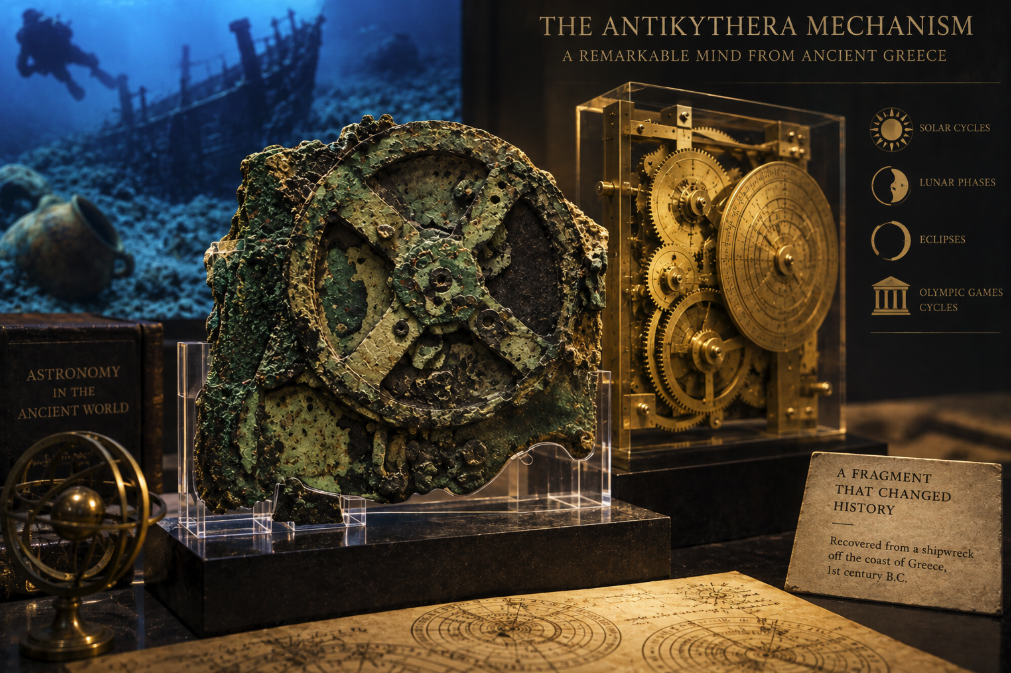
In 1901, divers working an ancient shipwreck near the Greek island of Antikythera recovered statues, ceramics, glass and a badly corroded mass of bronze. The wreck had carried valuable cargo across the Mediterranean during the final centuries of the Hellenistic world, and at first the unremarkable green-brown fragments seemed far less important than its sculptures.
Then a gear appeared inside one of them.
More gears followed. Some had finely cut triangular teeth. Others were nested into trains whose ratios seemed deliberate. Faint Greek inscriptions covered surviving surfaces. The object was not a decorative artifact or a simple instrument. It was the remains of a machine.
Today the Antikythera Mechanism is often called the world's oldest known analog computer. More than 2,000 years ago, its bronze gears mechanically represented astronomical cycles: the motion and phases of the Moon, calendars, eclipse patterns and the schedule of major Greek athletic festivals. Evidence from surviving inscriptions also suggests that its missing front display represented the planets known to ancient astronomers.
Nothing else remotely as complex survives from the ancient world.
That is what makes the mechanism so unsettling. The mystery is no longer whether the Greeks could build such a machine. We are holding the proof. The mystery is how much other technology disappeared without leaving anything comparable behind.
The wreck that preserved an impossible machine
The Antikythera wreck lies off the island that gives the mechanism its modern name, between Crete and the Peloponnese. Sponge divers from Symi discovered the site around Easter 1900, and Greek authorities organized a major recovery operation.
The ship appears to have sunk during the first century BCE. The mechanism itself may be somewhat older. Dating remains a subject of scholarly discussion, but research generally places its manufacture somewhere in the second to early first century BCE.
That distinction matters because the phrase “first-century BCE artifact” can make the wreck date and construction date sound identical. They need not be. The machine may already have been decades old when it disappeared beneath the sea.
In 1902, archaeologist Valerios Stais recognized a gear wheel in one of the corroded fragments held by the National Archaeological Museum in Athens. The observation opened a puzzle that would occupy historians, astronomers, engineers and physicists for the next century.
The National Archaeological Museum's Antikythera Mechanism project now documents the long sequence of investigations that transformed the fragments from archaeological curiosities into one of the best-studied technological objects of antiquity.
What made it a computer?
The word computer invites the wrong comparison if it makes us imagine keyboards, stored programs or electronic logic.
The Antikythera Mechanism was analog. Its calculations were embodied in physical relationships between moving parts.
A pair of meshing gears converts rotation according to the number of teeth on each wheel. If a 60-tooth gear drives a 30-tooth gear, the second rotates twice for every revolution of the first. Ancient engineers could combine many such ratios to reproduce numerical relationships found in astronomy.
Turn the mechanism's input and the gear trains advance through time. Pointers move across scales. Cycles measured in months and years unfold mechanically.
In that sense, the bronze teeth function like mathematical instructions frozen into hardware. The machine does not merely display a table prepared by an astronomer; its internal geometry performs the relationships required to generate the display.
Researchers have identified at least 30 surviving gears, while the complete device contained additional components that are now missing. The original mechanism was housed in a wooden case roughly the size of a large book or small box.
For an object built more than two millennia ago, its information density is extraordinary.
The Moon exposed the machine's sophistication
A basic astronomical clock could make the Moon circle at constant speed. The real Moon does not cooperate.
Because its orbit is not a perfect circle, its apparent speed against the stars changes over the course of a month. Greek astronomers had developed geometrical models to describe this irregularity.
The mechanism translated that astronomical knowledge into engineering.
In 2006, researchers using advanced X-ray tomography reported in Nature that a surviving pin-and-slot arrangement allowed the lunar gearing to vary its output. The ingenious mechanism reproduced an approximation of the Moon's changing orbital speed.
The front display also included an indication of lunar phase. As the machine advanced through the month, a small rotating indicator could represent the changing illuminated fraction of the Moon.
This detail alone reveals why the device is more than an elaborate calendar. Its maker was trying to reproduce the behavior of the sky, including departures from simple uniform motion.
A spiral dial for predicting eclipses
The back of the machine contained two large spiral scales whose functions are now comparatively well understood.
One represented the Metonic cycle. Ancient astronomers knew that 235 lunar months are close to 19 solar years. This relationship allowed lunar months to be reconciled with a solar calendar. The mechanism encoded the 235 months on a five-turn spiral.
Another spiral represented the Saros, a cycle of 223 lunar months associated with the recurrence of eclipses.
Glyphs placed in cells on the Saros dial indicated months in which solar or lunar eclipses could occur. Some surviving inscriptions gave additional information such as timing and characteristics.
The mechanism therefore “predicted” eclipses, but not in the way a modern numerical astronomy program does. It did not calculate the gravitational trajectories of the Sun, Earth and Moon from physical laws. Instead, it used the observed recurrence of eclipse cycles.
That was still an extraordinary computational achievement. A user could select a date and inspect mechanically organized information about possible eclipses many years into the future.
Knowledge accumulated by generations of astronomers had become a portable machine.
The Games dial connected the cosmos to Greek society
For years, one small dial on the back of the mechanism was misunderstood. Improved imaging eventually revealed inscriptions identifying major Greek festivals.
A 2008 Nature paper showed that the dial tracked a four-year cycle associated with Panhellenic Games. Its inscriptions included Olympia, Nemea, Isthmia and Pythia, along with other festival names.
The discovery is often summarized by saying the mechanism calculated the Olympic Games. That is broadly understandable but incomplete. It tracked a cycle of important Greek athletic and religious festivals, of which the Olympic Games were the most famous.
This function reveals how astronomy and civic life overlapped in antiquity. Calendars were not abstract mathematical conveniences. They determined religious observances, festivals and public events.
The same machine that displayed the rhythm of eclipses also kept track of rhythms in human society.
The missing front may have been even more remarkable
Much of the mechanism's front is lost. This is where modern reconstruction becomes both exciting and dangerous.
Surviving inscriptions contain references to the planets known in antiquity: Mercury, Venus, Mars, Jupiter and Saturn. Researchers therefore have strong reasons to think the complete device displayed planetary motion as well as the Sun and Moon.
Exactly how it did so remains less certain.
Planetary motion presents a mechanical challenge because planets sometimes appear to slow, stop and move backward against the stars before resuming their normal direction. This apparent retrograde motion was explained by ancient Greek astronomers using combinations of circular motions.
Several modern reconstructions show how elaborate gear trains could reproduce those models. They demonstrate that such a system is mechanically plausible and compatible with parts of the surviving evidence.
But a beautiful modern reconstruction is not the same thing as an excavated ancient machine. Too many front gears are missing to know every detail with certainty.
The responsible distinction is simple: the evidence strongly supports a planetary display, while its complete mechanical architecture remains reconstructed rather than preserved.
X-rays found an instruction manual inside the corrosion
The sea did not treat the mechanism gently. Bronze corroded, wooden components disappeared, and many pieces fused into mineralized masses. For decades, researchers could inspect only a fraction of the information hidden inside.
Modern imaging changed everything.
In the early twenty-first century, the Antikythera Mechanism Research Project used high-resolution X-ray computed tomography and advanced surface imaging to examine the fragments. The scans revealed gear teeth buried inside corrosion and Greek inscriptions invisible from the exterior.
Thousands of characters emerged.
Those texts contain descriptions associated with the astronomical displays and helped researchers identify functions that could not be inferred from gears alone. In effect, parts of the machine's operating instructions had survived on its own plates and covers.
This is one reason understanding Antikythera requires an unusually broad collaboration. Epigraphers decipher ancient Greek letters. Astronomers reconstruct historical models. Mechanical engineers calculate gear ratios. Archaeologists examine manufacturing techniques. Imaging specialists peer inside objects that cannot simply be dismantled.
The machine has become a puzzle solved across disciplines.
Was Archimedes involved?
The sophistication of the mechanism inevitably raises famous names.
Ancient authors describe Archimedes constructing mechanical models of celestial motion. Cicero later wrote about devices associated with Archimedes that represented movements of the Sun, Moon and planets.
But Archimedes died in 212 BCE, probably decades before the surviving Antikythera Mechanism was made. There is no evidence that he personally designed this object.
His relevance is more interesting than a simple attribution. Literary evidence suggests that mechanical models of the heavens existed as an intellectual tradition before the Antikythera device was manufactured.
The mechanism may therefore be a surviving descendant of a broader Hellenistic tradition rather than an isolated miracle invented by one unknown genius.
If so, the archaeological record has preserved one machine from a technological family that is otherwise almost completely lost.
Why did nothing similar survive?
Bronze is excellent material for gears and terrible material for archaeological survival.
It is valuable.
Across centuries, old bronze objects were routinely melted down and recast. A broken astronomical instrument could become coins, tools, weapons or decorative metal. Wooden cases rotted. Fine mechanical components were vulnerable to damage. Political upheaval and changing intellectual traditions did the rest.
A shipwreck can preserve what civilization itself destroys. Once the Antikythera vessel sank beyond easy reach, its cargo escaped recycling for nearly 2,000 years.
This creates a profound bias in our picture of ancient technology. Historians can study only what survived, and survival does not necessarily correspond to what was once common, important or sophisticated.
The Antikythera Mechanism does not prove that ancient Greece was filled with mechanical computers. But its existence proves that at least one community of astronomers and craftspeople possessed the knowledge required to build one.
That alone changes the history of technology.
A machine made from theories of the sky
The most impressive thing about the Antikythera Mechanism is not any individual gear.
It is the chain of ideas required to produce it.
Astronomers first had to observe repeating celestial patterns over long periods. Mathematicians had to express those patterns as numerical cycles and geometrical models. A designer then had to translate abstract ratios into gear counts. Craftspeople had to manufacture small bronze wheels accurately enough to mesh inside a compact case. Finally, inscriptions had to tell the user how to interpret what the pointers displayed.
Observation became mathematics. Mathematics became mechanics. Mechanics became information.
That is why “analog computer” remains such a useful modern description despite being historically anachronistic.
The machine did something deeply familiar to us: it transformed a model of reality into a device capable of producing answers.
Today we ask software to calculate the next eclipse. Two thousand years ago, an unknown Greek engineer could turn a handle and make bronze gears do the mathematics.
The sea preserved only fragments. Yet those fragments are enough to reveal that the history of computing did not begin with electricity — and that some of the ancient world's most sophisticated technologies may have vanished so completely that only a shipwreck allowed us to discover they existed at all.