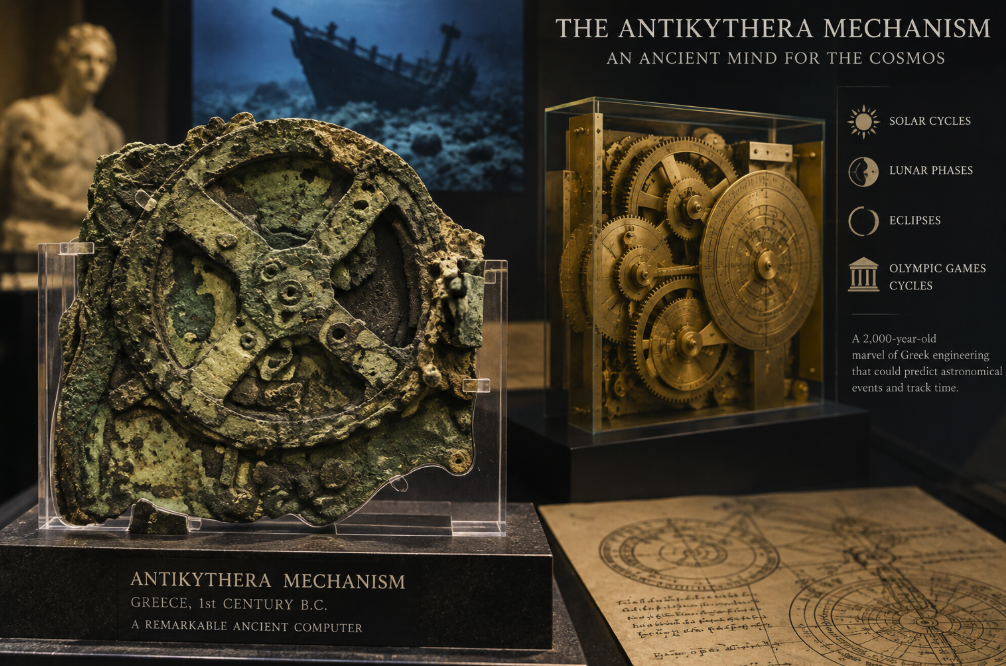
When sponge divers found an ancient shipwreck off the small Greek island of Antikythera around 1900, they brought up the kinds of objects archaeologists expected from a wealthy vessel of the ancient Mediterranean: statues, pottery, glassware and other cargo.
Among them was an ugly, corroded lump of bronze and wood.
At first it attracted little attention. Then the mass cracked apart, exposing something nobody expected to find inside a 2,000-year-old artifact: gear wheels.
Not one or two crude cogs, but the remains of a densely organized mechanical system containing dozens of precisely arranged bronze gears and inscriptions describing astronomical cycles. Over the following century, X-rays, computed tomography, surface imaging and painstaking epigraphy gradually revealed what the object had once done.
The Antikythera Mechanism was a portable mechanical calculator of the heavens. By turning an input, its user could move through time while pointers and dials displayed calendrical and astronomical information. It represented the motion and phases of the Moon, tracked solar and lunar calendars, indicated possible eclipses and even followed the four-year cycle associated with the great Panhellenic athletic festivals.
Modern researchers often call it the world's oldest known analog computer. The phrase is anachronistic — no ancient Greek would have called it a computer — but it captures something essential. The machine encoded mathematical models of astronomical cycles into physical hardware.
More than two millennia ago, someone turned equations into gears.
A machine that should not have survived
The ship carrying the mechanism sank near Antikythera, between the Peloponnese and Crete. The National Archaeological Museum of Greece dates the wreck approximately to 60–50 BCE, although its cargo included objects made over several centuries.
The mechanism itself was older than the wreck. The museum's dedicated research timeline places its construction broadly between 150 and 100 BCE. A major 2006 Nature study likewise described it as having been constructed around the end of the second century BCE.
This distinction is important. Calling it simply a “first-century BCE machine” reflects the period in which it was lost, but the instrument may have been built decades earlier.
The wreck lay at a depth of roughly 50 to 60 meters. Sponge divers from the island of Symi discovered it, and the recovery operation of 1900–1901 became a landmark in underwater archaeology. The mechanism reached the National Archaeological Museum in Athens as badly corroded fragments.
Its true nature began to emerge in 1902, when Greek archaeologist Valerios Stais noticed a gear wheel among the remains.
That observation created a historical problem. Ancient Greek writers described sophisticated mechanical devices, but nothing remotely comparable to the Antikythera Mechanism had survived from antiquity. Its gear trains looked more like technology associated with much later astronomical clocks.
The object seemed to have arrived from the wrong century.
What does it mean to call it a computer?
The Antikythera Mechanism was not programmable like a modern digital computer. It had no electronic components, memory chips or software. It did not perform arbitrary calculations.
It was an analog computing device.
An analog computer represents mathematical relationships through physical quantities. In the Antikythera Mechanism, gear ratios embodied astronomical periods. If one wheel had a certain number of teeth and drove another with a different number, their relative rotation reproduced a numerical ratio.
Combine enough carefully selected ratios and a mechanism can model cycles that unfold over years or decades.
The surviving device contains at least 30 known bronze gears. Researchers have proposed additional lost gears in reconstructions of missing functions. The largest surviving wheels span much of the mechanism's original case, while some smaller components are less than a centimeter across.
The machine appears to have been operated by turning an input mechanism. As the gears rotated, pointers moved across graduated scales. The user was effectively moving the mechanical universe forward or backward through time.
A 2018 review in Nature Astronomy called the Antikythera Mechanism the oldest known mechanical calculator and emphasized that modern imaging has established broad agreement about its fundamental solar and lunar functions, even though important questions about its complete design remain unresolved.
The Moon was harder to model than a simple circle
One of the mechanism's most impressive features concerns the Moon.
A simple gear could represent a body moving uniformly around a circle. But the Moon does not move across the sky at a perfectly constant apparent speed. Its orbit is elliptical, so its observed motion varies.
Greek astronomers knew about this irregularity. Hipparchus, active in the second century BCE, developed geometrical methods for describing lunar motion.
The Antikythera Mechanism appears to embody this sophistication mechanically. The 2006 Nature reconstruction identified a pin-and-slot gearing arrangement that varied the Moon pointer's motion, producing an approximation to the changing speed associated with the lunar orbit.
The mechanism also displayed the Moon's phase. A small rotating sphere or similar indicator could show the changing illuminated appearance as the Moon progressed through its monthly cycle.
This was not merely a calendar with gears attached. It was a physical astronomical model.
It could forecast eclipse possibilities decades ahead
The back of the mechanism contained two remarkable spiral displays.
One was based on the Metonic cycle. Nineteen solar years are close to 235 lunar months, a relationship used in ancient calendars to reconcile the lunar month with the solar year. The Antikythera Mechanism encoded this 19-year relationship on a five-turn spiral dial.
The second major spiral used the Saros cycle, an eclipse cycle of 223 lunar months — a little more than 18 years.
Ancient Babylonian astronomers had recognized that eclipses recur in patterns. Greek designers incorporated this numerical knowledge into the mechanism. Glyphs around the Saros dial marked months in which solar or lunar eclipses were possible and included information about their characteristics.
This requires an important qualification. The mechanism was not predicting eclipses by numerically integrating celestial orbits in the modern sense. It was exploiting repeating astronomical cycles. As Tony Freeth's later research explains, its Saros dial predicted eclipse possibilities based on the 223-month cycle.
Even so, the sophistication is extraordinary. A user could rotate the mechanism to a future date and consult mechanically generated information about eclipses that might occur.
The rear inscriptions functioned almost like an instruction manual engraved directly onto the instrument.
It also tracked the Olympic cycle — but not only the Olympics
One of the most surprising discoveries arrived after high-resolution imaging made previously unreadable inscriptions visible.
A small subsidiary dial once thought to represent a 76-year astronomical cycle turned out to track the four-year Olympiad cycle.
The discovery was reported in Nature in 2008. The dial contained names associated with the great Panhellenic Games, including Olympia, Nemea, Isthmia and Pythia, as well as other festivals.
So the mechanism did not merely connect gears to the sky. It connected celestial time to human time.
Ancient calendars regulated religious festivals, agriculture and civic life. Athletic festivals were scheduled within these calendrical systems. The Antikythera Mechanism compressed both kinds of cycle into one device: eclipses in the heavens and games in the stadium.
The National Archaeological Museum describes the surviving Games dial as displaying the four-year Olympiad cycle and names including Isthmia, Olympia, Nemea and Pythia.
Calling it simply an “Olympic Games calculator” is therefore too narrow. The dial represented a cycle of several important Greek festivals.
Could it display the planets too?
This is where the mechanism moves from established reconstruction into a fascinating area of incomplete evidence.
The front of the machine is badly damaged, and many of the gears that would have occupied this region are missing. Yet surviving inscriptions refer to planetary phenomena, and researchers increasingly agree that the original mechanism probably displayed the positions of the five planets known to the ancient Greeks: Mercury, Venus, Mars, Jupiter and Saturn.
The engineering problem is formidable because planets appear to reverse direction against the background stars during retrograde motion. A mechanical representation therefore needs more elaborate gearing than a simple constant-speed pointer.
Modern teams have proposed reconstructions capable of reproducing these motions using ancient Greek astronomical models and plausible gear systems. But a reconstructed front mechanism should not be mistaken for a fully preserved blueprint.
The surviving evidence tells us the original machine was extraordinarily complex. It does not preserve every gear needed to settle every detail of its architecture.
Modern X-rays revealed writing hidden for 2,000 years
The Antikythera Mechanism spent roughly two millennia underwater. Corrosion fused metal together, destroyed components and concealed inscriptions beneath mineral deposits.
For much of the twentieth century, researchers could study only what was visible on the surfaces or accessible through conventional radiography.
That changed dramatically in the early 2000s.
The Antikythera Mechanism Research Project used high-resolution X-ray computed tomography and advanced surface imaging to look inside the fragments. The scans exposed gear teeth, mechanical relationships and thousands of previously hidden Greek characters.
These inscriptions transformed the investigation. They revealed month names, eclipse information, references to planetary motions and instructions associated with the displays. In effect, the corroded machine had preserved parts of its own documentation.
The National Archaeological Museum's digital project traces how successive generations of historians, physicists, astronomers, computer scientists and epigraphers gradually reconstructed the artifact's functions.
Few archaeological objects require such an unusual team. To understand the mechanism, researchers need to read ancient Greek, model astronomical cycles, inspect metalworking, reconstruct gear trains and interpret X-ray tomography.
Who built it?
No surviving inscription gives us the maker's signature.
That absence has encouraged speculation. The mechanism's sophistication naturally evokes Archimedes, the celebrated mathematician and engineer of Syracuse who died in 212 BCE. Ancient literary sources describe mechanical celestial models associated with Archimedes, and some calendrical evidence from the Antikythera device points toward Corinthian cultural connections; Syracuse was a Corinthian colony.
But there is no evidence that Archimedes personally built the surviving mechanism. Its likely construction date is decades after his death.
A more cautious possibility is intellectual inheritance. The device may represent a technological tradition descended from the kinds of mathematical astronomy and mechanical craftsmanship practiced by Hellenistic scholars, including traditions associated with Archimedes and Hipparchus.
That possibility raises an even larger mystery.
If one workshop could build the Antikythera Mechanism, where are the others?
A technology with almost no surviving family tree
The mechanism is often described as being a thousand years ahead of its time. That phrase can be misleading because technology does not literally jump forward in time. The machine belonged to its own Hellenistic scientific culture.
The real puzzle is preservation.
Bronze was valuable and routinely recycled. Complex devices were fragile. Wood cases decayed. Gears could be melted down and turned into weapons, coins, statues or tools. Shipwrecks sometimes preserve objects precisely because they remove them from centuries of human reuse.
The Antikythera Mechanism may therefore look unique because nearly all comparable machines disappeared.
Ancient texts describe geared devices, automata and celestial models, suggesting that sophisticated mechanics did not begin and end with this one artifact. But no other surviving Hellenistic mechanism approaches its known complexity.
As Nature observed when modern tomography transformed the field, nothing comparably sophisticated survives for many centuries afterward.
That does not prove there was a forgotten ancient industrial revolution. It does show that the technological history preserved in museums is only a fraction of the technological history that actually existed.
The real mystery is not what the mechanism predicted
We now know far more about the Antikythera Mechanism than the archaeologists who first saw its corroded fragments.
It modeled lunar and solar cycles. It incorporated the 19-year Metonic calendar. It used the 223-month Saros cycle to indicate eclipse possibilities. It represented the Moon's varying motion and phases. It tracked the four-year cycle of major Greek games. Its inscriptions strongly indicate that planetary displays formed part of the original design.
Calling it the first analog computer is a modern analogy, but a remarkably appropriate one. Its designer took mathematical relationships observed in the heavens and encoded them into the tooth counts and interactions of bronze wheels.
The deeper mystery is cultural.
Someone had to calculate those ratios. Someone had to design the gear trains. Craftspeople had to cut dozens of small bronze teeth accurately enough for the machine to work. Astronomical knowledge from Greek and Babylonian traditions had to be translated into mechanical form. And someone considered the finished object useful or valuable enough to transport aboard a ship carrying luxury goods across the Mediterranean.
Then the ship sank, and that entire technological world almost vanished with it.
Two thousand years later, the sea returned a handful of corroded fragments. Inside them was evidence that the ancient Greeks had done something historians once did not know was possible: they had built a machine that turned the cosmos into clockwork.