For 73 years, the Titanic existed in two places at once: in history, where the details of its final night were argued over in inquiries, newspapers and survivor testimony, and somewhere in the darkness of the North Atlantic, where no human being knew exactly what remained of the ship.
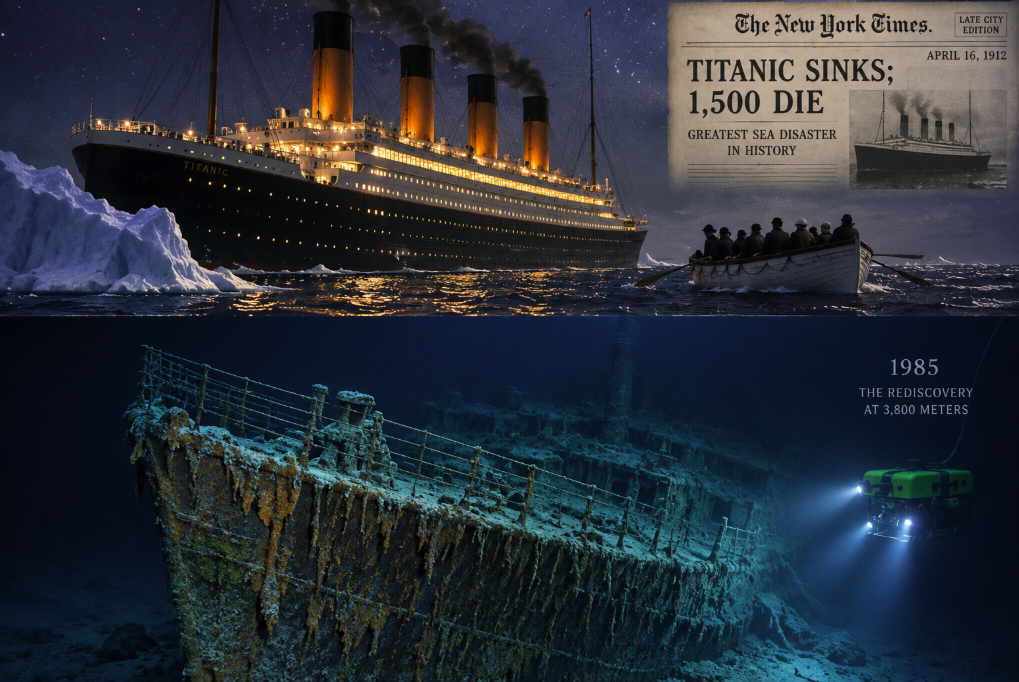
Then, shortly after 1 a.m. on September 1, 1985, scientists aboard the research vessel Knorr saw something unmistakably artificial appear on their deep-sea video screens. It was a boiler.
The discovery ended one mystery and overturned another. The wreck revealed that Titanic had broken apart before reaching the seabed, contradicting a version of the sinking that had persisted for decades. But the story of how the ship was found is almost as remarkable as the disaster itself. It involved a French-American expedition, experimental deep-ocean technology, a new way of searching for shipwrecks and — in a chapter that remained largely unknown to the public for years — work connected to secret U.S. Navy missions.
To understand why finding Titanic was such an achievement, it is worth returning to the cold April night when the world’s most famous ship disappeared.
The ship that represented a new age
RMS Titanic left Southampton for New York on April 10, 1912, on its maiden voyage. Built in Belfast for the White Star Line, it was one of the largest and most luxurious passenger ships ever constructed. Its first-class spaces advertised a world of electric lighting, elaborate dining rooms and unprecedented comfort, while below decks hundreds of emigrants were crossing the Atlantic toward new lives in North America.
The ship is often said to have been officially declared “unsinkable.” The historical reality is less theatrical. Titanic’s design, including a system of watertight compartments, inspired enormous confidence, and contemporary publicity sometimes described ships of its class in terms that suggested practical unsinkability. But the famous phrase later became inseparable from the disaster, transforming technological confidence into dramatic hubris.
At 11:40 p.m. ship’s time on April 14, lookouts spotted an iceberg ahead. Titanic turned, but not enough. The iceberg scraped along the starboard side, damaging the hull across several compartments. The ship could remain afloat with a limited number of forward compartments flooded; too many had been opened to the sea.
The mathematics was now fatal.
Titanic carried 20 lifeboats. Crucially, this was not an illegal shortage: the ship actually met the British regulations then in force. The regulations, however, had failed to keep pace with the enormous size of modern liners. The boats could accommodate only about half the people aboard. Worse, several left the ship without being filled to their tested capacity during the confused evacuation.
According to records summarized by the U.S. National Archives, Titanic sank less than three hours after the iceberg was sighted. More than 1,500 people died. The Cunard liner Carpathia, which raced through dangerous ice toward Titanic’s distress calls, rescued just over 700 survivors from the lifeboats.
The disaster produced investigations on both sides of the Atlantic and helped drive major changes in maritime safety, including improved lifeboat requirements, continuous radio watches and the establishment in 1914 of the International Ice Patrol.
But one crucial witness remained inaccessible: the ship itself.
Why Titanic was so difficult to find
The approximate position of the sinking was known, but that did not mean the wreck could simply be visited. Titanic had gone down hundreds of kilometres southeast of Newfoundland in water roughly 3,800 metres deep. At that depth, sunlight is absent, temperatures hover near freezing and pressure is hundreds of times greater than at the surface.
In 1912, locating and photographing a wreck at such depths was beyond available technology. Even decades later, searching the abyssal seabed was painfully slow. The ocean floor could not be surveyed with the effortless precision of a modern online map. Searchers had to tow instruments over large areas while trying to reconstruct where a ship sinking through kilometres of water might actually have landed.
Several expeditions tried and failed. By the late 1970s and early 1980s, improvements in sonar and deep-towed equipment made the search more realistic. American oilman Jack Grimm financed three highly publicized attempts between 1980 and 1983, but Titanic remained hidden.
The breakthrough came from a collaboration between the Woods Hole Oceanographic Institution in the United States and the French oceanographic institution IFREMER. The French phase, led by engineer Jean-Louis Michel aboard Le Suroît, used the SAR side-scan sonar system to methodically survey a large search area in the summer of 1985. The team covered most of its assigned zone without identifying the wreck.
Robert Ballard and the WHOI team then took over aboard Knorr. They had little time left. Rather than simply continue searching for one enormous ship-shaped target, Ballard pursued a different strategy.
He searched for Titanic’s trail of destruction.
The secret mission behind the technology
For years, the public story of the expedition focused naturally on Titanic. But Ballard later discussed an extraordinary backdrop to the search: his deep-sea work had also been connected to classified U.S. Navy missions examining the wrecks of two nuclear submarines, USS Thresher and USS Scorpion, which had been lost in the 1960s.
The significance was technological as well as strategic. Deep-sea investigators learned that a large vessel breaking apart during its descent could scatter debris over a considerable distance. Finding the debris field could therefore be easier than finding the main wreck itself.
That insight shaped the Titanic search. WHOI’s newly developed Argo system — a deep-towed platform equipped with sonar and low-light video cameras — could remain relatively close to the seabed while transmitting images to scientists on the ship above. Another camera system, ANGUS, supplied still photography.
The Woods Hole Oceanographic Institution’s account of the discovery explains that the team deliberately searched for scattered debris rather than concentrating only on Titanic’s massive hull. It was a gamble, but an intelligent one: thousands of objects from a disintegrating ship could create a much larger target than the ship itself.
For days, watch teams stared at monotonous images of sediment passing beneath Argo. Then, around midnight on August 31, unnatural objects began appearing. The debris grew more convincing. Shortly after 1 a.m. on September 1, the cameras encountered a boiler whose design matched Titanic’s.
The ship had been found.
What the cameras revealed at 3,800 metres
Titanic lay approximately 12,500 feet — about 3,800 metres — beneath the North Atlantic, roughly 350 nautical miles from Newfoundland, according to WHOI’s account of the discovery and NOAA’s historical summary.
The first survey delivered a revelation. Titanic was not resting intact on the seabed. The bow and stern were separated, with a broad debris field between them. The ship had broken apart during the sinking.
This mattered because survivor testimony on the breakup had been contradictory. Some witnesses had insisted that Titanic split in two at the surface, while others believed it sank whole. The wreck supplied physical evidence unavailable to the 1912 investigators.
The bow was surprisingly recognizable, embedded in the sediment but retaining much of the ship’s form. The stern had suffered far more violent destruction, probably because of the way it descended and imploded as trapped air spaces failed under pressure. Between the two sections lay personal possessions, machinery, structural fragments and countless pieces of the ship.
The discovery team did not recover artifacts. Ballard became a strong advocate for treating the wreck as a memorial and grave site rather than a treasure chest.
In July 1986, WHOI returned with the three-person submersible Alvin and a small remotely operated vehicle named Jason Jr. Humans now saw Titanic directly for the first time since 1912. Jason Jr. could leave the submersible and approach spaces too dangerous for Alvin, sending back extraordinary images from the wreck. WHOI has since released footage from those historic dives, describing them as the first time human eyes had seen the ship in nearly 75 years.
The wreck is not frozen in time
The discovery created a new misconception: that Titanic was a perfectly preserved time capsule resting unchanged in the darkness. It is not.
The wreck is an active biological and chemical environment. Iron-eating microbial communities contribute to the formation of delicate structures known as rusticles, which hang from the steel like reddish-brown icicles. Over decades, decks have weakened, walls have collapsed and recognizable features have disappeared.
NOAA’s work at the Titanic site has documented this deterioration and treated the wreck not only as a maritime memorial but also as a scientific laboratory for understanding how metal shipwrecks decay in the deep ocean.
The site has also become the focus of a long ethical argument. Expeditions beginning in 1987 recovered thousands of artifacts from the debris field, while Ballard and others advocated a “look, don’t touch” approach. The question is unusually sensitive because Titanic is simultaneously an archaeological site, a historical monument and the final resting place associated with more than 1,500 deaths.
The Titanic story did not end in 1912
The sinking is usually told as a single night: an iceberg appears, a ship founders, lifeboats drift in freezing darkness and Carpathia arrives after dawn. But the full story stretches across more than a century.
The disaster changed maritime regulation. The testimony of survivors became an archive through which historians could reconstruct class, evacuation, communication failures and acts of extraordinary courage. The wreck then remained unreachable for generations, allowing myths to harden in the absence of physical evidence.
Its rediscovery in 1985 was not the work of one lone explorer suddenly stumbling upon a ship. It was the culmination of French and American collaboration, years of deep-ocean engineering and a search strategy refined through experience with other wrecks. Jean-Louis Michel and the IFREMER team narrowed the search area; Robert Ballard and the WHOI team used Argo to follow the debris trail to Titanic. The technology developed around these expeditions helped open a new era of deep-sea exploration.
Perhaps the most haunting moment came after the boiler appeared on the monitors. Celebration broke out aboard Knorr, but the mood soon changed. Ballard’s team realized that the discovery had occurred close to the anniversary hour of Titanic’s sinking, and they held a small memorial service for those who had died.
At 3,800 metres beneath them, the ship was no longer a legend, a set of coordinates or a story reconstructed from testimony. After 73 years, Titanic had become a physical place again.
And what the cameras found there was more powerful than the myth: a broken ship, a field of human objects and the evidence of a disaster that the deep Atlantic had preserved in darkness since 1912.