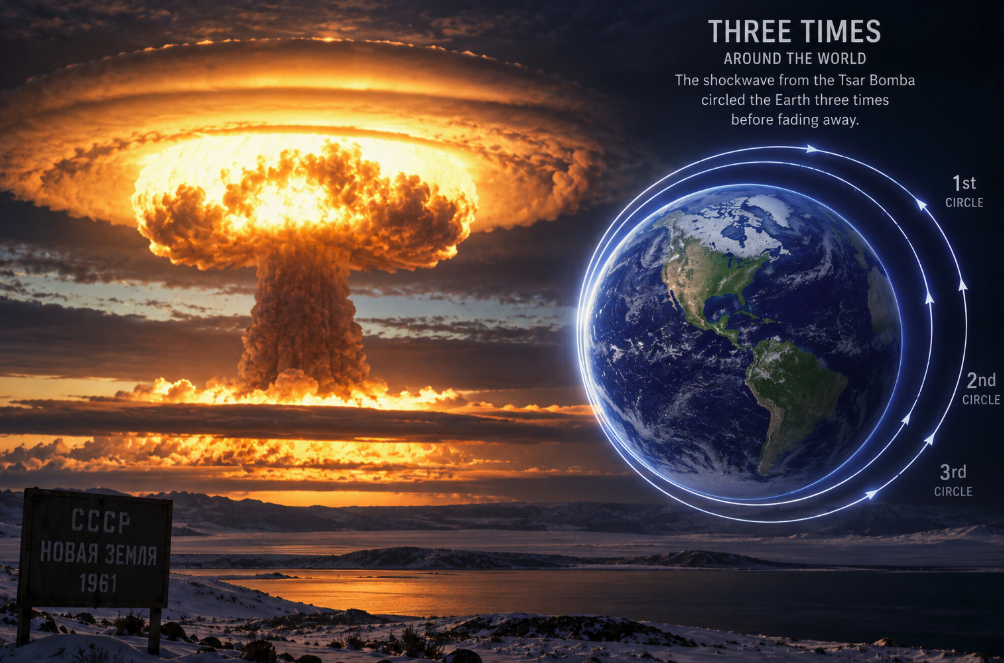
On October 30, 1961, a Soviet Tu-95 bomber crossed the frozen landscape of Novaya Zemlya carrying an object so large that the aircraft had been specially modified to accommodate it. The bomb was released by parachute. The crew turned away and accelerated, attempting to put as much distance as possible between themselves and what was about to happen.
At roughly four kilometers above the Arctic test range, the device detonated.
The explosion was the most powerful nuclear test ever conducted. Its yield is generally given as about 50 megatons of TNT — more than 3,000 times the explosive yield of the bomb dropped on Hiroshima. The flash could be seen from extraordinary distances, the mushroom cloud climbed through the atmosphere, and the blast generated pressure disturbances detected far beyond the Soviet Arctic.
The weapon became known in the West as Tsar Bomba: the “Tsar of Bombs.”
One detail has become almost as famous as the bomb itself. Countless accounts say its shock wave traveled around the entire planet three times before fading away. The story conveys the almost incomprehensible scale of the test, but it needs a scientific qualification. A destructive nuclear shock front and a far-traveling atmospheric pressure wave are not the same thing, and the exact “three times around Earth” claim is less securely documented than popular retellings suggest.
The verified story is already extraordinary without exaggeration.
A bomb built for the politics of 1961
Tsar Bomba was tested at one of the most dangerous moments of the Cold War.
The United States and Soviet Union had spent the 1950s developing increasingly powerful thermonuclear weapons. Hydrogen bombs used nuclear fusion to release energies far beyond the first generation of fission weapons. By the beginning of the 1960s, both superpowers possessed arsenals capable of devastating cities on a scale that would have been unimaginable only two decades earlier.
The Soviet test was partly a technical demonstration and partly political theater. It showed that Moscow could build a thermonuclear device of unprecedented yield at a time of intense confrontation with the West.
The bomb itself, designated AN602, was enormous. Historical accounts describe a device roughly eight meters long and weighing more than 20 tonnes. It was too large to fit normally inside the Tu-95 bomber selected to carry it, requiring modifications to the aircraft.
The test took place over Novaya Zemlya, the Arctic archipelago used extensively by the Soviet Union for nuclear weapons testing. The device was released under a large parachute, slowing its descent and giving the bomber additional time to escape.
According to historical test records summarized by Atomic Archive, the explosion occurred on October 30, 1961 and produced a yield of approximately 50 megatons. The Comprehensive Nuclear-Test-Ban Treaty Organization likewise identifies the 1961 Soviet Tsar Bomba as a test more than 3,000 times as powerful as the Hiroshima bomb.
It was designed to be even larger
The most startling fact about Tsar Bomba is that the tested version was deliberately reduced in power.
The original concept is widely described as having a potential yield near 100 megatons. Soviet designers reduced the test yield, notably by substituting lead for uranium-238 in parts of the design that could otherwise have produced additional fission.
This modification had two consequences. It approximately halved the explosive yield, and it reduced the quantity of radioactive fission products that would have been generated by the test.
Calling the result “clean” would be misleading: it was still a gigantic atmospheric nuclear explosion. But relative to its unprecedented yield, a larger proportion of its energy came from fusion than would have been the case with the more powerful uranium-tampered configuration.
Even at approximately 50 megatons, the device remains unmatched in the history of nuclear testing. CTBTO material uses a 50-megaton Tsar Bomba as the benchmark for the largest nuclear test ever conducted.
What happens when a 50-megaton weapon explodes in the atmosphere?
For a fraction of a second, the detonation released energy at a rate almost impossible to relate to ordinary experience.
A nuclear fireball forms because bomb materials and the surrounding air are heated to extreme temperatures. The rapidly expanding gases compress the atmosphere ahead of them, creating a shock wave — a sharp front across which pressure rises suddenly.
The classic technical reference The Effects of Nuclear Weapons explains that this shock front initially travels at very high velocity. As it expands outward, however, its overpressure steadily decreases. The farther the wave travels, the more its energy is distributed over an enormous area.
This is important when discussing Tsar Bomba. Near the explosion, “shock wave” means a destructive blast capable of catastrophic mechanical damage. Thousands of kilometers away, instruments are not experiencing that same wall of destructive overpressure. They can instead detect much weaker pressure and acoustic disturbances propagating through the atmosphere.
The two phenomena are connected, but describing both simply as “the shock wave” creates the impression that a city-destroying blast front literally raced around Earth several times. That did not happen.
Did the blast really circle Earth three times?
The famous claim appears in many historical summaries: Tsar Bomba's atmospheric pressure wave supposedly traveled around Earth three times, with barometers recording repeated passages.
There is good reason to believe the test generated globally detectable atmospheric disturbances. An explosion of this magnitude couples enormous energy into the atmosphere, and long-period pressure waves and infrasound can travel extraordinary distances.
But the precise statement that Tsar Bomba's wave completed exactly three global circuits deserves caution.
Modern atmospheric monitoring provides an interesting comparison. The CTBTO's International Monitoring System detects infrasound and other waveform signals from explosions, volcanic eruptions and natural events around the world. Its instruments can distinguish atmospheric acoustic waves from seismic waves traveling through the ground.
In technical discussions of extraordinary pressure waves, CTBTO researchers have highlighted the 1883 Krakatoa eruption and the January 2022 Hunga Tonga–Hunga Ha'apai eruption as the outstanding examples whose atmospheric pressure waves were recorded making multiple circuits of Earth. A 2023 CTBTO scientific presentation described Hunga Tonga as producing the only pressure wave known to have circled Earth's atmosphere multiple times in the 139 years since Krakatoa.
That wording sits awkwardly beside the popular Tsar Bomba story.
It does not mean the Soviet explosion lacked global atmospheric effects. Rather, it suggests that the neat “three times around Earth” formulation should not be repeated as though it were as firmly established as the bomb's date, location and approximate yield. Historical instrumentation, definitions of what counts as a complete passage and later retellings all complicate the claim.
The safest description is that Tsar Bomba generated extraordinarily powerful atmospheric pressure disturbances detected at great distances, while reports of repeated global passages — often summarized as three circuits — remain a famous but less certain part of the story.
The explosion shook more than the air
An atmospheric nuclear test can also generate seismic signals. Part of the energy couples into the ground, creating waves that seismometers can detect far away.
This distinction between atmospheric and seismic signals eventually became crucial to nuclear-test monitoring. Modern verification systems combine seismic, infrasound, hydroacoustic and radionuclide technologies to determine whether suspicious events are natural phenomena or possible nuclear explosions.
The CTBTO International Data Centre now receives waveform information from hundreds of monitoring facilities. Seismic stations record motion through Earth, while infrasound stations detect very low-frequency acoustic waves traveling through the atmosphere. Radionuclide stations search for radioactive particles and gases that can provide evidence of a nuclear event.
Tsar Bomba predates this modern global system by decades, but its scale illustrates why remote monitoring is possible. Gigantic explosions do not remain local events. They write signatures into the atmosphere and solid Earth that instruments thousands of kilometers away can detect.
Why build a bomb too large to be useful?
Tsar Bomba was spectacular, but spectacle is not the same as military practicality.
A weapon weighing more than 20 tonnes and requiring a specially modified bomber is difficult to deploy. Extremely high yields also encounter diminishing strategic returns. Doubling a bomb's explosive yield does not double the radius of every destructive effect. The energy spreads through three-dimensional space, and weapons designers can often achieve broader destruction by deploying several smaller warheads against separate targets rather than one colossal device.
This helps explain why the Cold War did not become a straightforward competition to build 100-megaton or 200-megaton bombs.
As missile technology improved, nuclear arsenals increasingly emphasized deliverability, accuracy, survivability and multiple independently targetable warheads rather than simply maximizing the yield of one explosion.
Tsar Bomba was therefore close to an evolutionary dead end: a technically astonishing device whose principal value was demonstration.
The image that survived the Cold War
The mushroom cloud remains the defining image of the test. Its scale is so visually overwhelming that photographs and film footage can make the explosion appear almost geological — less like a weapon than an artificial volcano forming in seconds.
That appearance can obscure what a nuclear explosion actually is. The cloud is a consequence, not the weapon's primary destructive mechanism. Thermal radiation, blast pressure and ionizing radiation are released on timescales far shorter than the leisurely rise of the mushroom cloud seen in later footage.
Nor should the giant cloud tempt us into treating Tsar Bomba as an engineering curiosity detached from its purpose. It was designed to demonstrate the capacity to destroy on an almost unimaginable scale.
The test occurred less than sixteen years after Hiroshima and Nagasaki. In that short interval, thermonuclear technology had increased the possible yield of a single device by thousands of times.
A pressure wave became a historical metaphor
The story that Tsar Bomba's shock wave circled Earth three times survives because it communicates scale instantly. A blast so powerful that the planet itself seems to ring like a bell is an unforgettable image.
The physics is more nuanced. The destructive shock weakened rapidly with distance. Far-field atmospheric waves could continue propagating long after they ceased to resemble the catastrophic blast near ground zero. And the exact three-circuit claim is less secure than its repetition suggests.
None of that makes the event less extraordinary.
On October 30, 1961, human beings detonated roughly 50 million tonnes of TNT equivalent in a single experiment. Instruments far from Novaya Zemlya detected its effects. The device was powerful enough that its reduced-yield configuration — deliberately cut down from a still larger design — remains the most energetic nuclear explosion ever produced.
Tsar Bomba's real historical significance is not that it proved humanity could make an atmospheric wave travel around the world a particular number of times. It proved something more disturbing: by 1961, humans had learned how to release, in a few moments, energy on a scale that previously belonged almost entirely to nature.