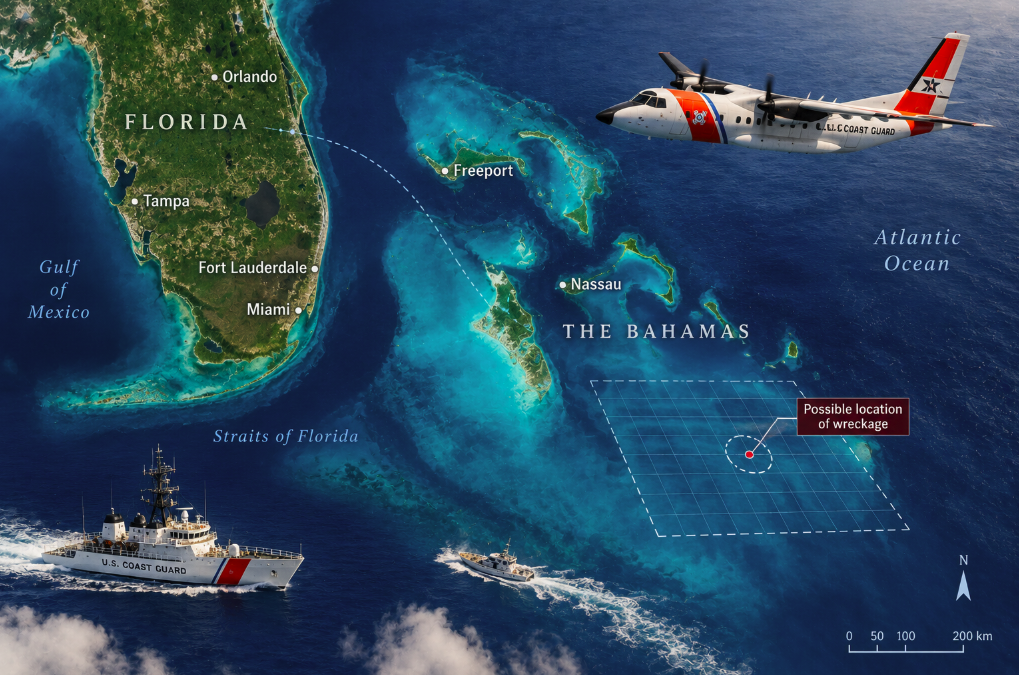
A family flight from the Bahamas to South Florida turned into a frantic international search after a small twin-engine aircraft disappeared over the water west of Andros Island. By the following day, the search had ended in tragedy: a relative said all four people aboard had been found dead.
The aircraft was a Piper PA-34, a light twin-engine airplane, registered as N212ML. It had departed Great Harbour Cay in the Berry Islands on Monday, September 7, 2026, bound for Miami Executive Airport in Miami-Dade County.
On board were pilot Mario Lamar, 80, his wife Lili Lamar, 79, and two of their grandchildren, Sofi Sosa, 28, and Christian Sosa, 22, according to reporting by The Associated Press.
What began as a missing-aircraft alert quickly brought together Bahamian police, local search organizations, family members and the U.S. Coast Guard. Poor weather complicated the initial operation. The family, meanwhile, joined the effort themselves, hoping that the occupants might have survived in the sea.
The tragedy unfolded across one of the most beautiful — and operationally challenging — stretches of water in the western Atlantic.
A routine flight toward Miami
The Piper left Great Harbour Cay late Monday morning. Great Harbour Cay is part of the Berry Islands, an archipelago northwest of Nassau and east of South Florida. For private aircraft, flights between the Bahamas and Florida are common and relatively short compared with long-distance commercial routes.
The destination was Miami Executive Airport, formerly known as Kendall-Tamiami Executive Airport, in southern Miami-Dade County.
According to Bahamian authorities cited in early reports, air traffic control lost contact with the plane when it was approximately 13 miles west of Andros Island. Police on Andros received information that an aircraft might have gone down in waters off Red Bays, on the island’s northwestern side.
At that point, there was no confirmed wreckage and no clear explanation for why the aircraft had disappeared.
Flight-tracking information reported by news organizations appeared to show the aircraft’s path ending near the Bahamian coast, but such data alone cannot establish what happened in the cockpit or why an aircraft went down. Investigators typically need physical evidence, maintenance records, weather information, communications, radar data and other material before determining a probable cause.
As of the reporting reviewed for this article, authorities had not established the cause of the accident.
The U.S. Coast Guard joins the search
Because the aircraft was traveling toward Florida and had apparently gone down over water, the response soon involved both Bahamian and U.S. resources.
The Associated Press reported that Bahamian officials requested U.S. assistance and that the Coast Guard deployed an HC-144 Ocean Sentry aircraft to help search the area.
The HC-144 is designed for maritime patrol and search-and-rescue missions. From the air, crews can cover broad areas of ocean far more rapidly than surface vessels, looking for wreckage, life rafts, debris or other signs of people in distress.
But search-and-rescue operations at sea are heavily dependent on conditions. Clouds, thunderstorms, rough water, wind and limited visibility can restrict aircraft operations and make objects on the ocean surface extraordinarily difficult to detect.
Bad weather disrupted the initial search. Bahamian authorities temporarily suspended operations, while family members publicly appealed for anyone with boats or aircraft in the region to help.
For relatives waiting in Florida, the absence of information left open the possibility they desperately wanted to believe: perhaps the airplane had made an emergency landing on the water and the occupants had managed to escape into a raft.
The family joins the search
Silvia Larrieu, Mario Lamar’s niece, became one of the public voices of the family. In an appeal shared by South Florida media, she asked anyone capable of assisting by air or sea to look for signs of the missing aircraft and its occupants.
Larrieu described her uncle as an experienced pilot. The family had been returning from time spent in the Bahamas when relatives realized the plane had not arrived as expected.
The search then took an unusually personal turn. Family members did not simply wait for official rescue teams. They went out on boats themselves.
On September 8, Larrieu told the Associated Press that the four missing relatives had been found dead. She said family members had located them and that the Coast Guard assisted with recovery.
“We found them,” she told the AP, bringing a devastating conclusion to a search that only hours earlier had still been described publicly as a rescue effort.
The family asked for privacy while mourning.
Why finding a small aircraft at sea can be so difficult
A search area measured in tens of miles may sound limited on a map. From an aircraft or boat, it can be immense.
A small airplane can disappear beneath the surface quickly after impact. Floating debris may be scattered by wind and currents. White wreckage can be difficult to distinguish from breaking waves, while darker material may vanish against deep water. Even brightly colored flotation equipment can become difficult to see from altitude.
Search planners therefore work with more than the aircraft’s last known position. They consider the time elapsed, wind, currents and the probable movement of floating objects. Aircraft search broad patterns from above while boats can investigate possible sightings and recover evidence.
The waters around the Bahamas add another layer of complexity. The archipelago contains vast shallow banks whose brilliant turquoise color is visible from space, but it also borders much deeper ocean. Andros itself sits near the edge of the Great Bahama Bank, with dramatically changing underwater terrain nearby.
The region is heavily traveled by boats and aircraft, yet the sea remains an unforgiving environment when something goes wrong.
Weather was poor, but the cause remains unknown
Reports from the search repeatedly mentioned bad weather. That fact naturally raises a question: did storms cause the crash?
There was not enough verified information to say so.
Poor weather can affect both a flight and the rescue operation that follows, but the presence of storms in a region does not prove that weather caused an accident. Investigators would need to reconstruct the flight and evaluate the conditions encountered by the aircraft, along with mechanical, operational and human factors.
That distinction is particularly important in the hours after an aviation accident, when incomplete flight-tracking images and eyewitness accounts can create an apparently convincing story before investigators have physical evidence.
The aircraft’s disappearance, its final communications and the circumstances of the crash will require formal investigation before a reliable causal explanation can be given.
A tragedy between two closely connected shores
The disappearance drew attention in both the Bahamas and Florida because the route represents a familiar connection between the two places. South Florida lies only a short flight from parts of the Bahamian archipelago, and private aviation forms an important link for residents, visitors and property owners traveling between the islands and the United States.
The family aboard N212ML had expected to complete one of those crossings and arrive in Miami-Dade County. Instead, relatives began checking messages that had not been answered, authorities started searching the waters west of Andros and rescue aircraft took to the sky.
The operation also demonstrated how quickly a local emergency can become international. Bahamian authorities coordinated the response in their territory, the U.S. Coast Guard supplied aerial search capability, volunteer and local rescue organizations became involved, and the family itself joined the search at sea.
For several hours, every aircraft track and every patch of water represented the possibility of a rescue.
By Tuesday, that hope was gone.
Mario and Lili Lamar and their grandchildren Sofi and Christian Sosa were all reported dead. What caused their Piper to disappear on the short journey toward Florida remained unanswered.
That unanswered question is now the work of investigators. For the family, the search has ended with a far simpler and more painful fact: four relatives who left an island together never made it home.