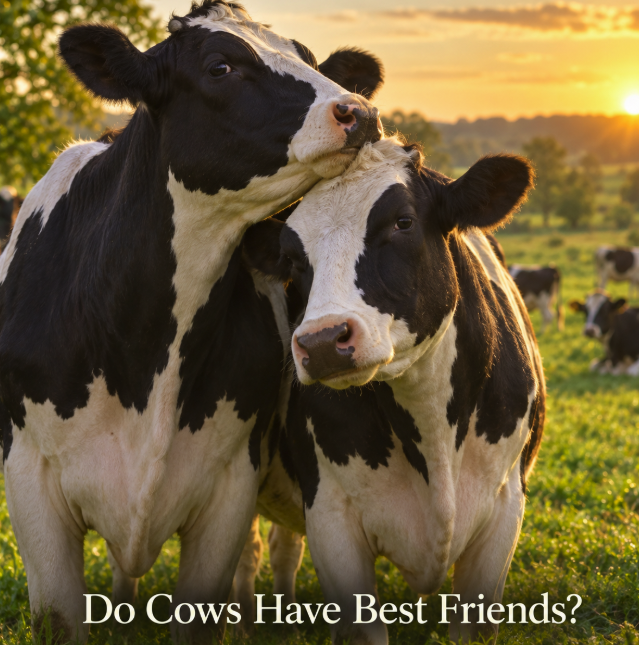
Watch a herd of cows for long enough and the group begins to look less anonymous. Certain animals repeatedly graze near one another, rest side by side or seek each other out. Some lick and groom particular companions more often than others. When the herd is rearranged, those relationships can be disrupted.
This is the behavior behind the popular claim that cows have “best friends.” The phrase is charming, but scientists tend to use more careful language: preferred partners, preferential relationships and social bonds. Research does support the central idea. Cattle do not interact with every herd mate in the same way, and some pairs develop stronger, more persistent relationships than others.
There is even evidence that the presence of a preferred companion can reduce some signs of stress. But the science is more interesting than the viral version of the story, because cattle friendship is not simply a bovine copy of human friendship.
How do scientists know which cows prefer each other?
Researchers cannot ask a cow to name her closest companion, so they look for patterns. Which animals spend time in close proximity? Which ones feed or rest beside each other? How often do they engage in affiliative behaviors such as social grooming? Do those associations occur more frequently than chance would predict?
A 2015 study published in Applied Animal Behaviour Science examined Holstein cows living in a dynamic dairy herd. The researchers recorded neighbors during feeding and resting as well as affiliative and competitive interactions. They found that cows with longer histories of familiarity tended to have stronger social relationships. Shared experience earlier in life could still be reflected in how much time and social effort cows invested in one another later.
The authors concluded that dairy cows appeared to actively maintain valuable dyadic relationships — relationships between particular pairs. Their findings also suggested a practical consequence: keeping well-acquainted cows together could help preserve a stable social structure within a herd.
That does not mean every cow has exactly one inseparable companion. Social networks are messier than that. A cow may have several preferred associates, relationships can differ in strength, and age, familiarity, housing and repeated regrouping can all influence them.
The experiment behind the “cow best friend” story
One of the most frequently cited pieces of evidence comes from animal behavior researcher Krista McLennan’s doctoral work at the University of Northampton. Her 2013 thesis, Social Bonds in Dairy Cattle: The Effect of Dynamic Group Systems on Welfare and Productivity, examined social relationships in a commercial herd of hundreds of Holstein-Friesian cattle.
McLennan first used patterns of association to identify preferred relationships. She then tested what happened during a short separation from the larger herd. A focal animal experienced the isolation challenge alongside either a preferred partner or a familiar but non-preferred animal.
The difference was measurable. During the separation period, cattle had significantly lower heart rates when accompanied by their preferred partners. They also displayed fewer behaviors interpreted as signs of agitation. The result suggested that a particular companion provided social support rather than the animal merely benefiting from the presence of any cow.
This is where headlines about cows becoming calmer around their “best friends” come from, and there is genuine evidence behind them. Still, one detail is often lost in retellings: not every stress measure changed in the same way. McLennan did not find a significant preferred-partner effect on cortisol comparable to the heart-rate result. A recent review of peer social bonds in farm animals consequently describes the evidence for stress modulation by preferred cattle partners as promising but still limited.
In other words, the experiment supports social buffering — the idea that a valued companion can soften a stressful experience — but it does not prove that every cow has one human-like best friend whose presence universally lowers “stress levels.”
Cow society is more complicated than it looks
Cattle are social animals. Herd life provides more than simple protection through numbers; it creates a network of familiar individuals, dominance relationships, affiliative interactions and opportunities for social learning. A cow entering an unfamiliar group is not walking into an interchangeable crowd.
Long-term familiarity appears especially important. The 2015 research on dairy cows found that animals with substantial shared history were more likely to be neighbors while feeding and to show stronger indicators of social relationship. This makes intuitive evolutionary sense. A familiar individual is predictable. Repeated peaceful interactions can reduce uncertainty, while stable companions may provide support during challenging situations.
Social grooming is one visible part of this world. One cow may lick another around areas such as the head and neck, behavior often described as allogrooming. It can serve hygienic functions, but it also occurs within cattle social relationships and is one of the behaviors researchers use when examining affiliation.
Age matters too. McLennan’s work found stronger preferential relationships among younger cattle, with especially strong dyadic relationships during part of juvenile development. In older animals living in commercial systems, repeated regrouping could weaken or disrupt established associations.
That finding has consequences beyond curiosity. Modern dairy herds can be dynamic: animals may be moved between groups according to age, lactation stage, health or management needs. From a human logistical perspective, moving one cow may look like moving a single production animal. From the cow’s perspective, it can also mean altering an existing social environment.
So should we really call it friendship?
“Friendship” is a useful everyday analogy, as long as we remember what it does and does not establish. Scientists can demonstrate that two cows preferentially associate, spend more time together, maintain familiarity and respond differently depending on which companion is present. They cannot establish that the subjective experience is identical to a human friendship.
This caution is not a reason to dismiss the relationship. Animal behavior research routinely relies on measurable evidence rather than requiring human-like labels. The scientifically interesting point is that cattle make social distinctions. Some companions matter more than others, and those preferences can have behavioral and physiological consequences.
The strongest version of the internet claim — that every cow chooses one lifelong “best friend” and becomes dramatically stressed whenever they are apart — goes beyond what the evidence shows. Relationships vary, many associations can be weak or temporary, and management conditions can reshape them. But the opposite image of cows as socially interchangeable herd animals is also misleading.
A better answer is that cows can form preferred social bonds that look, from the outside, remarkably friendship-like. They choose particular company, familiarity can deepen relationships, and at least some cattle cope better with a stressful situation when a preferred partner is beside them.
So when two cows repeatedly seek each other out in a field, calling them best friends may be anthropomorphic. It is not, however, a fantasy invented entirely by sentimental humans. Beneath the nickname is a real feature of cattle social life: in a herd full of familiar faces, some individuals genuinely appear to matter more than others.