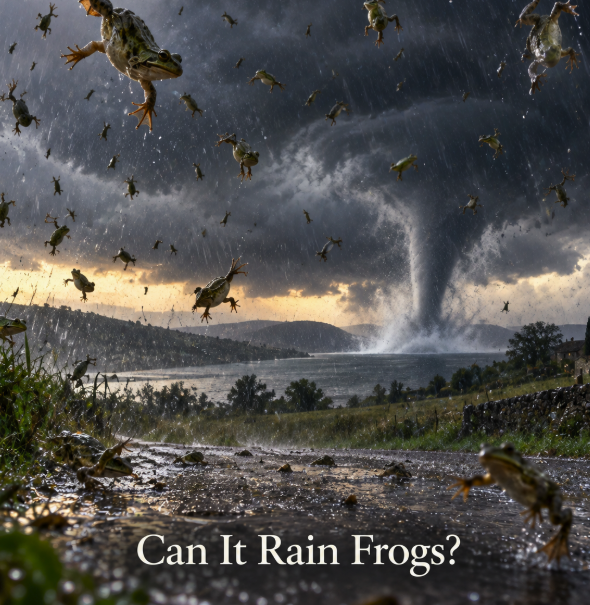
Imagine stepping outside after a thunderstorm and discovering the road covered in frogs. Some are hopping. Others are lying in puddles or on rooftops. Witnesses insist they watched them fall from the sky. It sounds like folklore, a biblical plague or the opening scene of a surreal film, yet reports of frogs and fish falling during storms stretch back centuries.
So can it actually rain frogs? In a literal meteorological sense, no: frogs do not form inside clouds the way raindrops, snowflakes or hailstones do. But small animals can potentially be lifted by violent winds and dropped somewhere else. The Library of Congress Science Reference Section describes waterspouts, tornadoes and powerful storm updrafts as plausible mechanisms behind at least some reports of animal rain.
There is an important catch. The spectacular explanation is scientifically possible, but the complete process — a storm picking up a mass of frogs, transporting them through the air and then depositing them on a town — has not been directly documented by scientists from beginning to end. Animal rain sits in an unusual territory where credible meteorology, eyewitness testimony and centuries of exaggeration overlap.
How could a frog get into the sky?
The leading explanation begins with violently moving air. Tornadoes can lift debris far above the ground, while strong thunderstorms contain powerful updrafts. Over water, rotating columns of air called waterspouts add an especially tempting explanation for reports involving fish, frogs and other small aquatic or semi-aquatic animals.
A waterspout is not a column of seawater magically climbing from the surface into a cloud. The visible funnel develops in the atmosphere, while spray can form around its base where intense circulation disturbs the water. Under sufficiently strong conditions, a vortex or associated winds can entrain lightweight material near the surface.
That material does not have to be inanimate. Small fish near the surface, tadpoles or frogs in shallow water are light enough that violent winds could conceivably carry them along with spray and debris. If the circulation moves inland or the wind weakens, transported objects eventually fall.
This provides a simple model for “frog rain”: pick up many small animals from one location, carry them downwind and release them somewhere unexpected. The animals may fall during ordinary rain produced by the same storm, creating the impression that the frogs themselves came from the cloud.
The Library of Congress also points to powerful thunderstorm updrafts as another possible mechanism. Strong rising air routinely supports hailstones and carries debris. A tornado crossing a pond or wetland could likewise pick up small organisms without requiring a classic waterspout.
Why would only frogs fall?
One of the strangest features of animal-rain stories is their apparent selectivity. Accounts often describe only frogs, only fish or another fairly uniform type of object. If a vortex simply vacuumed up part of a pond, why would it not drop leaves, mud, insects, plants and several animal species at the same time?
There are possible explanations. A dense aggregation of similar animals could be picked up together. Objects with comparable size, shape and mass also behave similarly in moving air. As a storm loses the ability to keep debris aloft, heavier material should tend to fall sooner while lighter material travels farther. Aerodynamic sorting could therefore deposit similar objects in the same area.
But the selectivity problem is also one reason researchers remain cautious. Historical accounts rarely include radar data, direct observations of the animals being lifted or detailed meteorological measurements. A dramatic report can survive for generations even when the original evidence was thin.
There is another possibility that requires no airborne frogs at all. Heavy rain changes animal behavior. Frogs may emerge in large numbers from concealed terrestrial refuges during wet conditions. Floodwater can move fish and other organisms onto roads or fields. Storms can wash animals from nearby habitats. A person who sees hundreds of small frogs suddenly covering a wet street may reasonably assume they arrived with the rain even if none actually fell from above.
Some animal rains have unusually strong eyewitness evidence
Not every report is simply an old legend. One famous case occurred in Marksville, Louisiana, on October 23, 1947. A. D. Bajkov, a biologist working with the Louisiana Department of Wildlife, reported that fish fell across parts of the town. He personally collected specimens from streets and yards and preserved some in formalin for distribution to museums. His account later appeared in the journal Science.
Other modern reports have described frogs or fish apparently falling during storms in locations including Serbia and Australia. Such accounts demonstrate why the subject has never completely disappeared into folklore. Sometimes witnesses do report seeing animals in the act of falling, not merely finding them afterward.
Still, a witnessed fall does not automatically identify the transport mechanism. To establish a waterspout explanation conclusively, researchers would ideally need observations connecting the source, the lifting event, atmospheric transport and the eventual deposition. That is difficult because the phenomenon is rare, short-lived and almost impossible to predict.
How far could the animals travel?
The popular claim that a waterspout can carry frogs or fish for “miles” is plausible in principle, but there is no standard distance for animal rain. Transport would depend on the animal’s size and shape, wind speed, storm structure, altitude and how long the object remained suspended. Light debris can travel considerable distances in severe storms, while heavier objects fall sooner.
The animals would not necessarily remain inside a neat funnel throughout the journey. Once lifted, they could be transferred into broader storm circulation and transported downwind. This is another reason the eventual fall might occur away from an obvious pond, lake or waterspout.
Some animals may even survive. Small frogs are lightweight, and falling objects with low mass can have relatively modest terminal velocities compared with large animals. Waterlogged vegetation, rain and soft ground may also reduce the severity of impact in some cases. But survival is certainly not guaranteed; violent winds, pressure changes, collisions and the fall itself can injure or kill transported animals.
A real phenomenon with an unresolved detective story
The safest scientific answer is therefore more nuanced than either “frog rain is a myth” or “waterspouts definitely suck frogs from lakes.” There are credible historical and modern reports of small animals falling from the sky, and violent storms unquestionably have the power to lift and transport objects. Waterspouts, tornadoes and intense updrafts offer physically reasonable mechanisms.
What is missing is routine direct observation of the entire chain of events. In many cases, the weather mechanism is reconstructed after the animals have fallen. In others, the animals may never have been airborne at all.
That uncertainty does not make the phenomenon less fascinating. It makes each alleged frog rain a meteorological detective story. Investigators have to ask where the nearest population of frogs lived, what the storm was doing, whether witnesses actually saw animals fall, what else landed with them and whether flooding could provide a simpler explanation.
So yes, frogs really can appear to rain from the sky, and there are good physical reasons to think storms can occasionally transport them. They are not produced by clouds, and the familiar waterspout explanation should not be treated as proven in every case. The stranger truth is that the atmosphere is powerful enough to turn ordinary animals into airborne debris — and sometimes deposit them where nobody expects a frog to arrive.