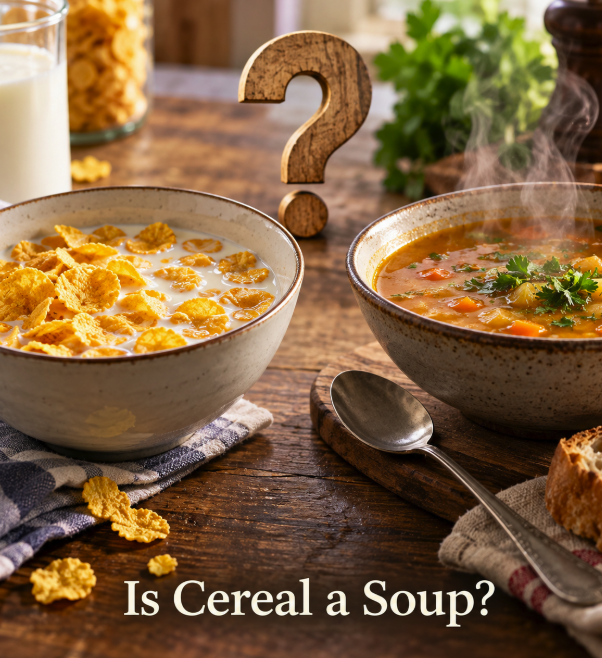
Pour cornflakes into a bowl. Add cold milk. Pick up a spoon. You have made breakfast — unless, according to one of the internet’s most persistent culinary arguments, you have accidentally made soup.
The question “Is cereal a soup?” sounds ridiculous because it is designed to expose how difficult ordinary categories become when someone insists on defining them with mathematical precision. Cereal consists of solid pieces sitting in a liquid and is eaten from a bowl with a spoon. Soup often consists of solid pieces sitting in a liquid and is eaten from a bowl with a spoon. If those are the rules, breakfast cereal seems suspiciously soup-like.
Yet in normal culinary language, cereal with milk is not considered soup. The interesting part is explaining why. There is no single universal law of gastronomy stating that every soup must be cooked or contain broth, and several traditional soups break those supposed rules. The cereal debate is therefore less about discovering an official answer than about how humans decide what foods belong in the same category.
What actually makes something a soup?
Definitions tend to focus on a liquid food containing ingredients such as vegetables, meat, fish or other solids. Encyclopaedia Britannica describes soup broadly as a liquid food prepared by cooking ingredients in water, stock or another liquid, while also recognizing the enormous variety of preparations grouped under the term.
Cooking is certainly central to the history and culinary identity of many soups. Stocks and broths are produced by extracting flavors into liquid; vegetables soften; starches thicken; proteins cook. In dishes from chicken noodle soup to minestrone, the ingredients and liquid are transformed together into something new.
Cereal works differently. The cereal has already been manufactured or cooked before it reaches the bowl, but pouring milk over it is generally assembly rather than soup-making. The milk remains milk. The cornflakes remain cornflakes until they begin to go soggy. There is little of the integration we normally associate with preparing a soup.
That distinction feels persuasive, but it is not an airtight definition. Culinary language is full of exceptions.
The cold-soup problem
If someone argues that cereal cannot be soup because soup must be hot, gazpacho immediately ruins the rule. The Spanish classic is deliberately served chilled. Other cuisines have cold soups based on ingredients such as cucumber, yogurt, fruit or beets.
Nor can we simply say that soup requires meat or vegetable stock. Some soups use milk, cream, fermented dairy or fruit juice as important parts of their liquid base. Sweet soups exist too, particularly in European and Asian culinary traditions. Temperature, sweetness and dairy therefore cannot individually disqualify cereal.
What about cooking? That works better as a culinary guideline, but even here the borders become fuzzy. Some cold soups involve little cooking, and raw preparations can still be conventionally called soup because they descend from an established culinary form. Food categories are shaped by history and culture as much as by ingredient chemistry.
This is the weakness in attempts to solve the cereal question using one clever rule. Whatever definition you invent, someone can usually produce an actual soup that violates it.
Why cereal still does not feel like soup
The strongest argument against cereal being soup is not a laboratory test. It is culinary convention. English speakers already have a well-established category for cornflakes, Cheerios and similar foods served with milk: breakfast cereal. Nobody needs the word “soup” to identify what is in the bowl.
Soup also describes more than the geometry of solids suspended in liquid. It describes a culinary tradition and a method of preparation. Ingredients are commonly simmered, blended, steeped or otherwise combined so that the liquid becomes part of a composed dish. Even when a soup is served cold, it is usually prepared as a unified recipe rather than created by adding an unchanged beverage to a ready-to-eat dry food at the moment of eating.
Milk in a cereal bowl behaves more like an accompaniment. You can pour more in, drink what remains or remove the cereal and still recognize the liquid immediately as milk. In many soups, by contrast, the liquid carries dissolved seasonings, fats, starches and flavors from the other ingredients and is fundamental to the identity of the dish.
There are exceptions, of course. Clear broths with separately prepared garnishes can retain distinct components. That is exactly why this argument never dies: culinary categories have fuzzy edges.
The debate is really about language
Philosophers and linguists have long recognized that many everyday categories do not operate through a perfect checklist of necessary and sufficient conditions. We recognize typical examples and then argue about objects near the boundary.
A robin is obviously a bird. A penguin is also a bird, even though it cannot fly. A chair is easy to recognize until a designer removes the back, changes its height or makes it impossible to sit on. Food behaves the same way. Tomato classification changes depending on whether the conversation is botanical or culinary. A hot dog can trigger arguments about sandwiches because people disagree about which features matter most.
Cereal and soup produce an especially good category puzzle because they share superficial structure. Both can be represented as “solid edible pieces + liquid + bowl + spoon.” But humans do not normally classify meals by an abstract equation. We use context, preparation, tradition, expectations and names inherited from generations of cooking.
Under an extremely broad dictionary-style definition, someone can construct a case for cereal as a kind of cold liquid food containing solid pieces. Under ordinary culinary taxonomy, however, that interpretation strips away too much context to be useful. Calling cornflakes and milk “soup” tells us less about the food than calling it cereal.
So, is cereal a soup?
In everyday culinary terms, no. Cereal with milk belongs to a different established food category and lacks many of the preparation conventions associated with soup. But the common claim that it is “technically impossible” for cereal to be soup because all soup must be cooked, hot or broth-based goes too far. Real soups are diverse enough to defeat those simple rules.
That leaves the internet with exactly the kind of answer it dislikes: the boundary depends on what definition you choose. If “soup” means any food consisting of solids in an edible liquid, cereal can squeeze through. If soup means the culinary family of dishes conventionally prepared and understood as soups, cornflakes stay safely on the breakfast side of the border.
And that is why the argument is more interesting than it first appears. The bowl never changes. Only the definition does.