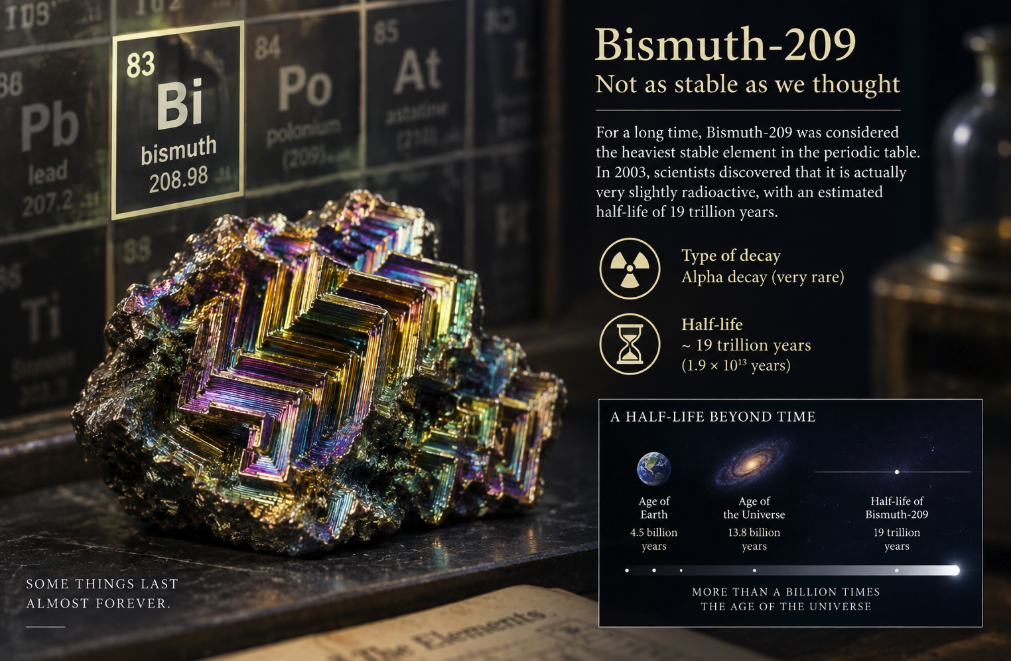
For generations, chemistry books could place bismuth near the end of the periodic table's stable territory. Its naturally occurring isotope, bismuth-209, showed no detectable radioactive decay, even though nuclear theory suggested that its enormous nucleus should not be perfectly immortal.
Then, in 2003, a group of physicists cooled a detector to only a few hundredths of a degree above absolute zero and waited for something extraordinarily unlikely to happen.
It did.
A bismuth-209 nucleus emitted an alpha particle and transformed into thallium-205. The decay was so rare that ordinary radiation detectors had failed to establish it convincingly for decades. The measured half-life was approximately 1.9 × 10¹⁹ years.
That number is easy to misread. It is not 19 trillion years. In modern English numerical terminology, 1019 years is 19 quintillion years — 19,000,000,000,000,000,000 years.
The Universe is about 13.8 billion years old. Bismuth-209's measured half-life is roughly 1.4 billion times longer.
So bismuth is radioactive. It is also, for almost every ordinary human purpose, astonishingly stable.
What does “stable” actually mean?
An atomic nucleus contains protons and neutrons held together by the strong nuclear force while positively charged protons simultaneously repel one another electrically. Whether a particular combination survives indefinitely depends on a delicate balance among these interactions and quantum-mechanical effects.
Some nuclei are obviously unstable. Carbon-14 has a half-life of about 5,730 years. Uranium-238 survives much longer, with a half-life of about 4.5 billion years. Other nuclides have never been observed to decay and are conventionally classified as stable.
But “no decay has ever been observed” and “decay is physically impossible” are not identical statements.
Bismuth-209 occupied precisely this awkward territory.
With 83 protons and 126 neutrons, it is an exceptionally heavy nucleus. The neutron number 126 is a nuclear “magic number,” associated with a closed shell configuration that contributes unusual stability. Yet calculations indicated that alpha decay to thallium-205 was energetically possible.
The problem was probability.
The decay happened so slowly that detecting it required an experiment sensitive enough to see an event whose characteristic timescale dwarfs the history of the cosmos.
The 2003 experiment that changed bismuth's status
Pierre de Marcillac, Noël Coron, Gérard Dambier, Jacques Leblanc and Jean-Pierre Moalic used bismuth germanate crystals, commonly abbreviated BGO, as both the source of bismuth atoms and the detector.
Their experiment operated the crystals as scintillating bolometers at extremely low temperature — about 20 millikelvin, or 0.020 kelvin above absolute zero.
This matters because a bolometer can detect the tiny rise in temperature produced when a particle deposits energy in the crystal. Cooling the detector dramatically reduces thermal noise, making extraordinarily small energy deposits measurable.
The team reported the result in Nature in April 2003. They observed alpha particles from the decay of natural bismuth and measured an energy release of approximately 3,137 keV.
The resulting half-life was (1.9 ± 0.2) × 1019 years.
The authors described bismuth-209 as the only naturally occurring isotope of bismuth and noted that it had commonly been regarded as the heaviest stable isotope. Their experiment provided unambiguous direct evidence that it was instead metastable with respect to alpha decay.
A half-life does not mean one atom waits 19 quintillion years
Radioactive half-life is often misunderstood as a countdown timer attached to each atom.
It is not.
You cannot take one bismuth-209 nucleus and predict that it will decay exactly 19 quintillion years after it is created. Quantum decay is probabilistic. Any particular unstable nucleus has a certain probability of decaying during a given interval.
Half-life describes the statistical behavior of a large population.
If you began with an enormous collection of Bi-209 nuclei and could somehow watch it for 1.9 × 10¹⁹ years, approximately half would be expected to remain undecayed. After another half-life, about half of those survivors would remain, leaving one quarter of the original population.
This exponential behavior continues without requiring individual atoms to possess internal clocks.
For Bi-209, the probability per unit time is simply fantastically small.
How can scientists measure something longer than the age of the Universe?
This sounds paradoxical only if we imagine that scientists must watch a single atom for an entire half-life.
They do not.
A macroscopic sample contains an enormous number of atoms. Even if the probability that any individual nucleus decays during a laboratory experiment is microscopic, multiplying that probability by a vast population can produce a measurable number of events.
The principle is similar to estimating the odds of a rare event by observing millions or billions of opportunities for it to occur.
A gram of bismuth contains on the order of 1021 atoms. With so many nuclei present, a half-life of 1019 years does not imply that a detector must wait 1019 years to see anything. Instead, the experiment looks for the small number of decays occurring among an astronomical number of nuclei during a manageable observation period.
The real challenge is distinguishing those events from natural background radiation, contamination and detector noise.
That is why the cryogenic BGO technique mattered.
What actually happens when bismuth-209 decays?
Bi-209 undergoes alpha decay.
An alpha particle consists of two protons and two neutrons — essentially the nucleus of a helium-4 atom. When bismuth-209 emits one, its atomic number falls from 83 to 81 and its mass number falls from 209 to 205.
The daughter nucleus is thallium-205.
Alpha decay in heavy nuclei can be understood through quantum tunneling. Classically, the alpha particle does not have enough energy simply to climb over the nuclear potential barrier holding it inside. Quantum mechanics, however, gives it a small probability of appearing on the other side of that barrier.
For many alpha emitters, tunneling happens often enough to produce half-lives of days, years or millennia. In bismuth-209, the combination of nuclear structure and the relatively low energy released makes the tunneling probability extraordinarily tiny.
That is why the nucleus can be unstable in principle while behaving almost indistinguishably from a stable isotope on human timescales.
Is bismuth still the heaviest stable element?
This familiar phrase needs careful wording.
An element is defined by its number of protons. An isotope or nuclide specifies a particular nuclear composition.
Bismuth has atomic number 83. Natural bismuth is overwhelmingly composed of Bi-209, so the element was historically treated as stable because its naturally occurring isotope showed no observed decay.
After 2003, Bi-209 could no longer be described as strictly stable in the experimental sense.
Lead, atomic number 82, has multiple stable isotopes and is therefore often described as the heaviest element with stable isotopes. But even here, nuclear terminology can become subtle because predictions of decay do not always coincide with experimentally observed decay.
The broader lesson is that the boundary between “stable” and “radioactive” is partly constrained by measurement. Improve detectors enough and a nucleus once placed in the stable category may reveal an unimaginably slow decay channel.
The Universe is young compared with this nucleus
The most striking way to understand the Bi-209 half-life is through comparison.
Earth is about 4.54 billion years old. The Universe is about 13.8 billion years old. Bismuth-209's measured half-life is around 19 quintillion years.
Divide those numbers and the scale becomes almost absurd.
The half-life is more than four billion times the age of Earth and roughly 1.4 billion times the age of the Universe.
If a hypothetical collection of Bi-209 nuclei had somehow existed since the Big Bang, only a tiny fraction would have decayed by today. The Universe has simply not existed long enough for the exponential decay curve to make a noticeable dent in such a population.
This is why ordinary pieces of bismuth are not rapidly disappearing and why the discovery did not suddenly turn the metal into a practical radiation hazard.
Its radioactivity is real but extraordinarily weak.
Bismuth was suspected before 2003
The discovery did not arrive completely without warning.
Researchers had searched for alpha activity from bismuth for decades. The 2003 Nature paper cites unsuccessful or inconclusive attempts stretching back to the mid-twentieth century, including work published in 1949 and dedicated searches during the 1950s and later.
Theoretical nuclear data also indicated that Bi-209 was energetically capable of alpha decay.
What changed was experimental sensitivity.
The 2003 team did not rewrite the laws of nuclear physics. They finally observed a process that those laws already allowed but that happened too rarely for earlier instruments to isolate convincingly.
Science often advances this way. A phenomenon can sit between theory and observation for decades until technology becomes quiet, cold or precise enough to reveal it.
Almost forever is not forever
Bismuth-209 occupies a fascinating philosophical corner of physics.
On the timescale of a laboratory, a civilization or even the present age of the Universe, it behaves as though it were stable. Yet quantum mechanics assigns its nucleus a nonzero probability of escape through alpha decay.
Give nature enough time and that difference matters.
The 2003 experiment therefore changed more than a label in a table of isotopes. It demonstrated how misleading ordinary intuition becomes when physics stretches across extreme timescales.
Human history is measured in thousands of years. Geological history in billions. Bismuth-209 asks us to think in tens of quintillions.
For centuries, the element looked permanent because every experiment humans could perform was short compared with its nuclear clock. Then a detector cooled to 20 millikelvin heard the faint signature that previous experiments had missed.
Bismuth was never truly immortal.
It was simply very, very patient.