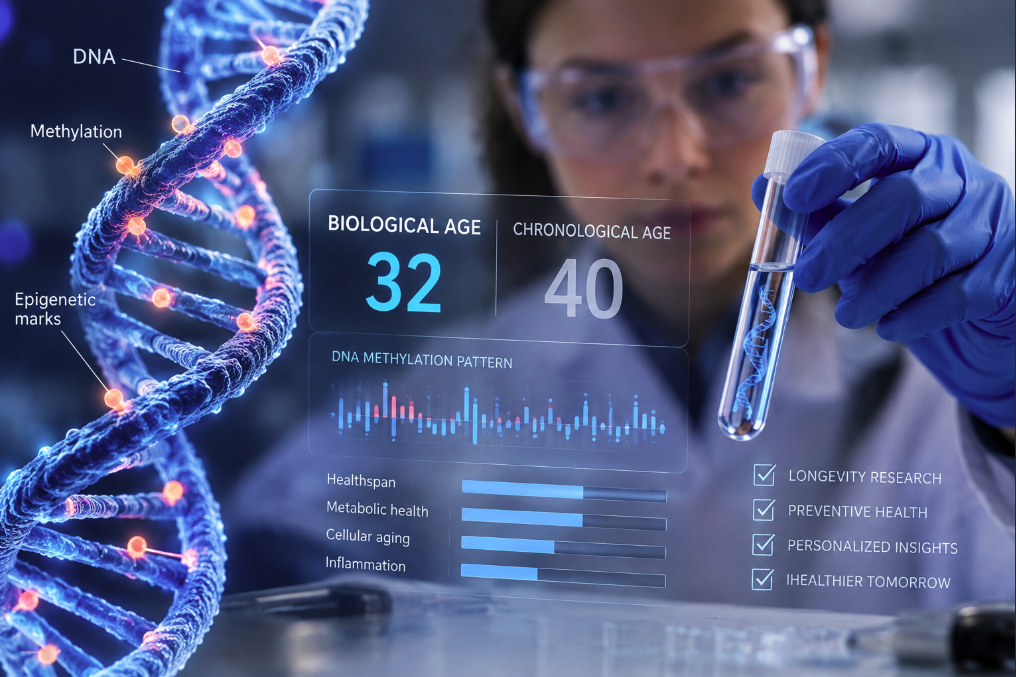
Your passport knows exactly how old you are. Your cells are a more complicated matter. Two people born on the same day can reach middle age with very different cardiovascular health, physical resilience and risks of age-related disease. That gap between years lived and the condition of the body has helped turn “biological age” into one of the most marketable ideas in the American longevity boom.
Among the technologies riding that wave are epigenetic age tests, often sold as DNA tests capable of telling customers whether their bodies are aging faster or slower than the calendar suggests. The science behind them is real and increasingly sophisticated. But the seductive simplicity of a result such as “biological age: 37” can hide an important fact: there is no single meter inside the body counting down your remaining years.
Epigenetic clocks are statistical biomarkers. They detect molecular patterns associated with aging and use algorithms to turn those patterns into an age-related estimate. That makes them valuable research tools and potentially useful health biomarkers, but not crystal balls.
The test does not read mutations — it reads molecular annotations
The word epigenetic is crucial. Most consumer descriptions talk about “testing your DNA,” which can make the process sound like conventional genetic testing for inherited variants. Epigenetic clocks generally examine something different: chemical modifications associated with DNA rather than changes to the underlying sequence of the genetic code.
The best-known signal is DNA methylation. In this process, small chemical groups called methyl groups are attached to DNA, commonly at locations where a cytosine nucleotide is followed by guanine, known as CpG sites. Methylation can influence how genes are regulated, and patterns of methylation change in surprisingly predictable ways as humans age.
Scientists discovered that by measuring selected CpG sites and combining their methylation values mathematically, they could estimate a person's age with remarkable accuracy at the population level. Steve Horvath's influential 2013 “pan-tissue” clock used 353 CpG sites and was designed to work across many human tissues. It became one of the foundations of modern epigenetic-aging research.
A typical test therefore starts with a biological sample, often blood or saliva depending on the product and clock. DNA is extracted, methylation at selected sites is measured, and an algorithm compares the resulting molecular pattern with patterns learned from large datasets. The output may be expressed as an estimated epigenetic age or, in newer approaches, as a measure related to the pace of aging, disease risk or mortality-associated biology.
If a 50-year-old receives an epigenetic-age estimate of 46, the tempting interpretation is that the person's body is literally four years younger. Scientists are more cautious. The result means that the methylation pattern, according to that particular model and sample, resembles the reference pattern represented by a younger age or aging profile. A different clock can produce a different answer because different algorithms were trained to capture different signals.
There is more than one biological clock
Early or “first-generation” epigenetic clocks were optimized largely to predict chronological age. Later clocks were developed with a different goal: capturing biological features associated with health outcomes. Some incorporate methylation signals connected to clinical biomarkers, mortality or other age-related phenotypes. Others, such as pace-of-aging measures, attempt to estimate how rapidly age-related physiological changes are occurring rather than simply assigning an age in years.
This distinction explains an apparent paradox. A clock that predicts your birthday extremely well is not automatically the best clock for answering whether you are healthy for your age. Chronological-age prediction and biological-aging assessment overlap, but they are not identical problems.
Research has found associations between accelerated epigenetic aging and a range of health outcomes. A 2025 review in the Annual Review of Public Health described DNA-methylation biomarkers as promising tools for preventive medicine, chronic-condition research and monitoring interventions, while emphasizing challenges involving sex, ancestry, lifestyle, environmental exposures and validation. The field has consequently moved beyond asking, “Can methylation predict age?” toward the harder question, “What exactly does each clock measure?”
That question remains unresolved. Aging is not a single process. It involves immune changes, metabolism, inflammation, cellular damage, gene regulation, tissue-specific deterioration and many other mechanisms. A 2025 Nature Aging commentary highlighted that epigenetic clocks can capture mixtures of intrinsic, environmental, stochastic and programmed signals. Two clocks can therefore disagree without either necessarily being meaningless.
Can you make your epigenetic age younger?
This is where the longevity industry moves faster than the evidence. Commercial testing creates an irresistible feedback loop: take a test, change your diet or exercise program, use a supplement or treatment, then test again to see whether you have “reversed” aging.
Researchers do use epigenetic biomarkers in intervention studies, but interpreting changes is difficult. A 2026 Nature Medicine analysis highlighted just how fragmented this research remains: studies have used different interventions, populations and combinations of clocks, making direct comparisons difficult. A biomarker may respond to an intervention without proving that the intervention has extended lifespan or prevented disease.
Even apparently obvious lifestyle relationships are more complicated than marketing suggests. A 2026 systematic review and meta-analysis of physical activity and DNA-methylation clocks noted that the relationship between exercise and epigenetically measured biological age remained unclear across the available literature. Exercise has extensive established health benefits; the uncertainty concerns whether a particular methylation clock reliably captures those benefits as a younger numerical age.
Measurement itself can also introduce noise. Sample type matters because blood, saliva and other tissues contain different mixtures of cells. Laboratory methods, methylation platforms and statistical processing can affect estimates. Published reviews have reported that some clocks show imperfect test-retest reliability, meaning repeated measurements can differ more than consumers might expect from a number presented with apparent precision.
For that reason, a change from “42” to “39” should not automatically be interpreted as three years of rejuvenation. It could reflect biology, measurement variation, changes in cell composition, the properties of the algorithm or some combination of these factors.
What a biological-age result can — and cannot — tell you
Epigenetic clocks have become scientifically important because they compress a complicated pattern of molecular information into a measurable biomarker. In large studies, that can help researchers compare populations, investigate environmental exposures, study disease and test hypotheses about aging much faster than waiting decades to see who develops illness or lives longest.
For an individual consumer, however, the meaning is less definitive. An epigenetic-age result is not equivalent to a medical diagnosis, and it does not provide a precise forecast of lifespan. It should not override established measures such as blood pressure, blood lipids, glucose regulation, smoking history, physical fitness or medical evaluation simply because the result sounds more futuristic.
There is also no universally accepted “true biological age” against which every commercial clock can be calibrated. Different models answer somewhat different questions. A company may report a single age, a pace-of-aging score or several organ- or system-related metrics, and those outputs should be understood in the context of the specific method used.
The most interesting thing about epigenetic clocks may therefore be less personal than the consumer trend suggests. They demonstrate that aging leaves measurable molecular traces on our genome without rewriting the DNA sequence itself. The body carries a record of time in chemical patterns layered over its genetic instructions, and machine-learning models can recognize part of that record.
Whether those patterns will eventually become routine clinical tools for choosing treatments or monitoring proven anti-aging interventions is still an open question. For now, epigenetic clocks occupy a fascinating middle ground: far more than a wellness gimmick, but not yet a definitive gauge of how old your body “really” is. The number on the report is an estimate from a model. The biology behind it is where the real story begins.