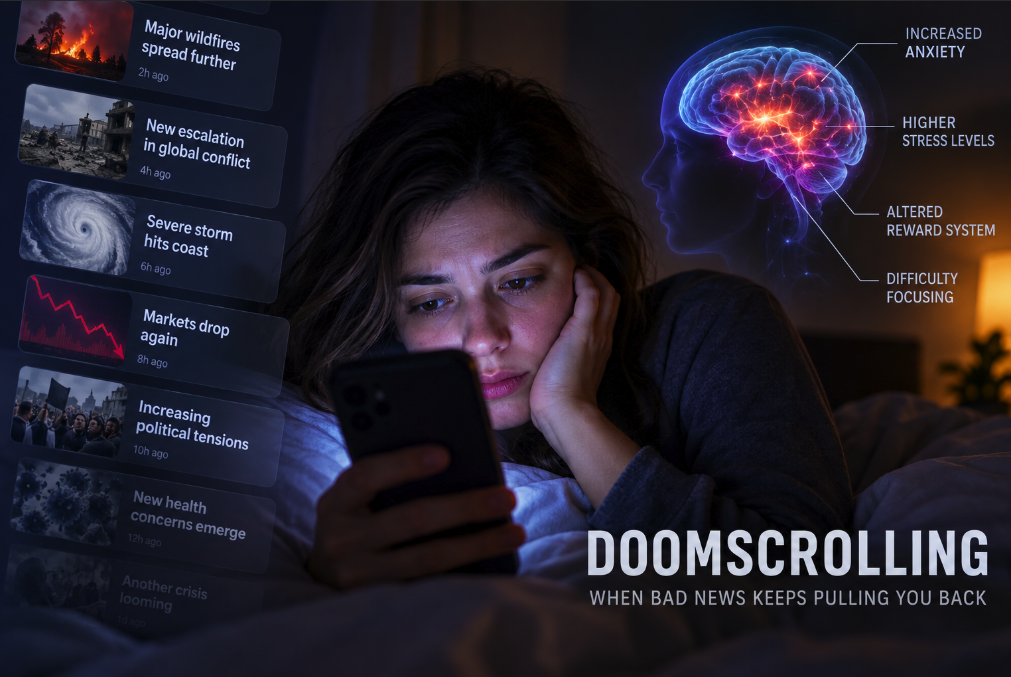
You open a social-media app to check one headline. A war update leads to a natural disaster, which leads to political outrage, an economic warning and a frightening health story. Twenty minutes later, you are still scrolling. You feel worse than when you started, yet stopping feels strangely difficult.
That pattern has acquired a name: doomscrolling. The term became widely familiar during the COVID-19 pandemic, when millions of people repeatedly checked feeds for alarming updates, but the behavior did not disappear when lockdowns ended. Wars, elections, climate disasters, crime, economic uncertainty and health scares now arrive through feeds that never reach a natural endpoint.
Doomscrolling is generally understood as persistent or excessive consumption of negative online news, particularly when a person continues despite feeling distressed. It is not a formal psychiatric diagnosis, and there is no recognized medical disorder called “doomscrolling addiction.” Yet researchers increasingly study it because it sits at the intersection of several well-known psychological forces: threat detection, uncertainty, attention, anxiety and the habit-forming design of digital feeds.
Why bad news is so difficult to ignore
Human attention is not neutral. Potential threats are biologically important, so negative information can capture attention with unusual efficiency. Psychologists often describe a broader “negativity bias”: harmful or threatening events can exert a disproportionate influence on perception, learning and decision-making compared with equally intense positive information.
In ancestral environments, paying close attention to signs of danger could be useful. A rustle in the grass might indicate nothing, but ignoring the one rustle caused by a predator carried a much greater cost. Modern news feeds exploit a nervous system built to notice danger, except the threats now arrive continuously from every part of the planet.
Uncertainty adds another ingredient. During a crisis, checking for information can feel like a sensible attempt to regain control: perhaps the next update will explain what is happening or tell us whether we are safe. Sometimes it does. The problem begins when checking no longer resolves uncertainty and instead supplies another alarming story, prompting another check.
Social platforms remove many of the stopping cues that existed in older media. A newspaper has a final page and a television bulletin ends. An infinite feed can always produce another item. Recommendation systems also learn what holds attention, while notifications and constantly changing content make each refresh potentially different from the last. The result resembles a variable-reward environment: you do not know what the next swipe will reveal, so the next swipe remains tempting.
What happens to the brain?
The most important scientific caveat is that researchers do not yet have a simple brain scan showing a unique “doomscrolling circuit.” Claims that the behavior permanently rewires the brain, destroys dopamine receptors or literally causes brain damage go beyond the evidence. Much of the strongest research measures behavior, mood, cognition and mental-health symptoms rather than directly observing neural changes caused specifically by doomscrolling.
What researchers can say is that repeatedly consuming threatening information engages psychological systems involved in vigilance and emotional arousal. When a headline is interpreted as threatening, the brain and body can mount a stress response. Attention narrows toward danger, physiological arousal may rise and it becomes harder to disengage from information that feels relevant to personal safety.
This helps explain the paradox of doomscrolling: people may seek news because they are anxious, yet the material they find can increase negative emotion, which creates a reason to seek still more information. The loop can become self-reinforcing without requiring a literal chemical addiction.
A study highlighted by the American Psychological Association followed 61 U.S. adults for 30 days during the early COVID-19 pandemic. Greater daily social-media use was associated with more depression and post-traumatic stress symptoms, particularly among participants with a history of childhood maltreatment. The study did not prove that scrolling directly caused those symptoms, but it illustrated how heavy crisis-media exposure and psychological distress can travel together.
Research focused explicitly on doomscrolling has found similar associations. A 2024 study of 400 adults reported that the relationship between doomscrolling and poorer mental well-being was mediated by lower mindfulness and greater secondary traumatic stress — distress that can arise from repeated indirect exposure to other people's suffering. A 2025 longitudinal study of adolescents also found a positive relationship between doomscrolling and social-media addiction over time.
The crucial word is association. An anxious person may doomscroll more; doomscrolling may intensify anxiety; or both processes may reinforce each other. Many studies cannot fully separate these directions of causality.
Attention, reward and the myth of the “dopamine hit”
Online explanations often reduce compulsive scrolling to dopamine, describing every swipe as a tiny chemical reward. Dopamine certainly plays major roles in motivation, learning and reward prediction, but the popular story that social media simply delivers a pleasurable “dopamine hit” is an oversimplification of a much more complicated neural system.
A better way to understand endless scrolling is through learning and attention. The next item is unpredictable. It might be reassuring, shocking, personally relevant or completely trivial. That uncertainty encourages continued checking, especially when the user has learned that important information sometimes appears after one more refresh.
There is also growing evidence that heavy use of rapidly changing feeds correlates with cognitive difficulties. A 2025 systematic review and meta-analysis in Psychological Bulletin, covering 98,299 participants across 71 studies of short-form video use, found that greater use was associated with poorer cognitive outcomes, with particularly notable associations for attention and inhibitory control. This research concerns short-form video broadly rather than doomscrolling specifically, so it should not be treated as proof that reading negative news damages attention. It does, however, reinforce concerns about prolonged exposure to highly stimulating, endlessly refreshed digital environments.
Doomscrolling can become especially disruptive at night. A person who intended to check the news for five minutes may postpone sleep while simultaneously exposing themselves to emotionally arousing content. The resulting sleep loss can itself worsen mood, attention and emotional regulation the next day, potentially making stressful information even harder to manage.
Why knowing more can make you feel less in control
Information usually reduces uncertainty when it answers a finite question. Doomscrolling often does the opposite because many large-scale threats have no immediate resolution. There is always another analysis, eyewitness video, prediction or argument to consume, while the individual reader has limited ability to change the underlying event.
This creates an uncomfortable mismatch between information and agency. The brain receives repeated signals that something important is happening but few opportunities to complete a meaningful action. The person can therefore remain psychologically mobilized while physically sitting in bed with a phone.
The effect is not the same for everyone. Personality, existing anxiety, previous trauma, the type of news being consumed and the reason for using social media all matter. Staying informed is not inherently harmful, and deliberately reading difficult news can be socially and politically valuable. Doomscrolling describes the point at which information seeking becomes repetitive, difficult to stop and emotionally costly.
Breaking the loop without abandoning the news
The solution does not require becoming uninformed. It requires restoring boundaries that infinite feeds deliberately lack. Checking news at planned times rather than continuously creates an artificial endpoint. Going directly to a small number of trusted news sources can reduce the unpredictable mixture of catastrophe, commentary and outrage supplied by algorithmic feeds. Disabling nonessential alerts removes prompts that reopen the cycle throughout the day.
It can also help to notice the question behind the next refresh: “What information am I actually trying to obtain?” If there is no answer — if the goal has shifted from learning something specific to relieving a vague feeling of uncertainty — another twenty headlines may not provide the relief being sought.
Research on broader social-media reduction is still developing. A 2024 systematic review and meta-analysis of digital-detox interventions found a modest improvement in depression but not consistent improvements across every mental-health outcome, underscoring that simply deleting an app is not a universal psychological cure.
Doomscrolling is ultimately compelling because it combines an ancient survival tendency with a very modern machine. Humans are unusually attentive to danger; smartphones can supply signs of danger without limit. The brain is not malfunctioning when a threatening headline captures attention. The problem is that the feed never tells that threat-sensitive brain when it has learned enough — so the user has to create the stopping point instead.