The James Webb Space Telescope is often introduced through spectacular pictures: glowing stellar nurseries, delicate shells of gas, galaxies from the young universe and strange worlds orbiting other stars. But calling Webb simply a very powerful camera misses what makes it extraordinary. Webb is an infrared observatory designed not only to make images, but to separate light into spectra and extract information about temperature, chemistry, motion and distance from objects that may be unimaginably faint.
There is also a useful correction to the idea that Webb produces a new photograph every day. NASA releases Webb material periodically, after observations have been processed and, in many cases, connected to scientific results. As of September 10, 2026, NASA’s Webb image archive does not list a new science photograph released today. Its newest dated image entry is a September 8 artist’s concept of a trans-Neptunian object, while recent genuine Webb imagery includes observations of the Carina Nebula released in August and striking new views of the Lion Nebula, NGC 2392. The distinction matters: a release date is not necessarily the date Webb pointed at the object, and not every picture on a Webb page is an observation made by the telescope.
Why Webb looks at invisible light
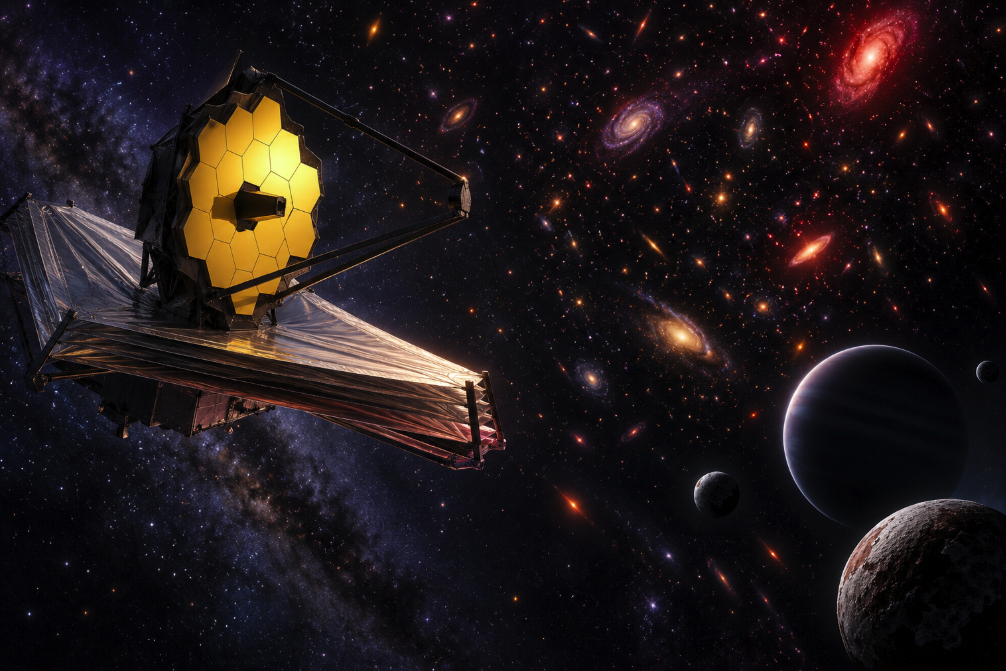
Webb’s primary mirror is 6.6 meters across and consists of 18 hexagonal segments made from beryllium and coated with a very thin layer of gold. The mirror’s job is deceptively simple: collect light already traveling through space and direct it toward a secondary mirror, which sends it into the telescope’s scientific instruments. The gold is not decoration. It is highly effective at reflecting infrared wavelengths, the region of the electromagnetic spectrum in which Webb does much of its work.
Infrared vision gives astronomers several advantages. Dust that blocks visible light can become more transparent at infrared wavelengths, allowing Webb to peer into stellar nurseries where young stars are forming. More dramatically, the expansion of the universe stretches the light from extremely distant galaxies toward longer wavelengths, a phenomenon known as cosmological redshift. Light that began its journey in visible or ultraviolet wavelengths can arrive billions of years later in the infrared. That makes Webb especially well suited to studying very early galaxies.
The observatory detects wavelengths from roughly 0.6 to 28.8 micrometers through four scientific instruments: NIRCam, NIRSpec, MIRI and FGS/NIRISS. Cameras record the brightness of infrared light across many pixels, while spectrographs spread that light into its component wavelengths. Those spectra can reveal chemical signatures that a beautiful image alone cannot show.
This is why Webb can investigate an exoplanet without producing a detailed photograph of continents, oceans or clouds. By measuring changes in starlight as a planet passes in front of or behind its star, astronomers can search for clues about the planet’s atmosphere and temperature. IMOOND’s look at 55 Cancri e and Webb’s observations of its extreme environment is a good example: the scientifically important result comes from infrared measurements and spectroscopy, not from a conventional close-up snapshot of the planet.
Why the telescope has to stay extremely cold
An infrared telescope has an unusual enemy: its own heat. Warm objects emit infrared radiation, so a telescope trying to detect faint cosmic infrared signals can effectively interfere with itself if it becomes too warm. Webb therefore carries a five-layer sunshield roughly the size of a tennis court. It keeps the mirrors and instruments shielded from the intense light and heat of the Sun, Earth and Moon.
Webb operates near the Sun-Earth L2 region about 1.5 million kilometers from Earth, following a large halo orbit rather than sitting motionless at a single point. From there, the Sun, Earth and Moon remain on the same general side of the observatory, allowing the sunshield to protect the cold telescope while its solar-facing side receives power and communicates with Earth.
The result is a machine with two radically different thermal worlds separated by a few thin layers of material: a warm spacecraft side facing the Sun and a cold observing side staring into deep space. That thermal architecture is as essential to Webb as the famous golden mirror.
So what has Webb photographed lately?
NASA’s current Webb galleries are a better answer than any viral post claiming to show “today’s James Webb photo.” The archive is updated as images and science products are released, and the cadence is irregular. On September 10, 2026, the latest listed Webb-related image is a September 8 illustration of a trans-Neptunian object, explicitly identified as an artist’s concept rather than a telescope photograph.
Among the recent actual observations, NASA highlighted an infrared view of part of the Carina Nebula captured by Webb on August 6, 2026 and released later that month. Carina is a vast star-forming complex, and infrared observations can expose young stars and structures hidden or softened by dust at visible wavelengths. It is exactly the kind of target for which Webb’s design pays off: the telescope is not merely making a prettier version of what human eyes would see, but revealing a different physical layer of the region.
Another major August release showed NGC 2392, nicknamed the Lion Nebula, using Webb’s NIRCam and MIRI instruments. Combining near- and mid-infrared observations lets researchers trace different components of the nebula, including stars, gas and dust. The resulting image is visually dramatic, but its colors are a translation of infrared measurements into wavelengths our eyes can perceive. Webb does not literally see the cosmos in the same colors presented on a screen.
That same principle applies when Webb studies chemically rich regions of our own Galaxy. In Sagittarius B2, the Milky Way’s extraordinary molecular cloud, infrared observations help expose stars, warm dust and dense structures in a region famous for complex interstellar chemistry. Some of the most interesting information in astronomy is therefore hidden twice: first from human eyesight because it lies outside visible wavelengths, and then inside the data until astronomers process and interpret it.
Webb’s images can feel immediate, as though humanity has opened a window and looked directly into deep space. In reality, each release is the final stage of a much stranger chain. Ancient photons cross the universe, strike 18 carefully aligned golden mirrors, pass through filters or spectrographs, become electrical signals, travel back to Earth as data and are reconstructed into something scientists can measure and the public can see. The famous pictures are not merely cosmic postcards. They are visual translations of information that human eyes were never built to detect.
That is the deeper reason new Webb releases remain so compelling. Sometimes they reveal a spectacular nebula; sometimes a barely visible galaxy from the early universe; sometimes the atmospheric chemistry of a planet that appears as little more than a point of light. The telescope’s real achievement is not that it takes beautiful photographs. It is that it has taught us how much of the universe was hiding beyond visible light.