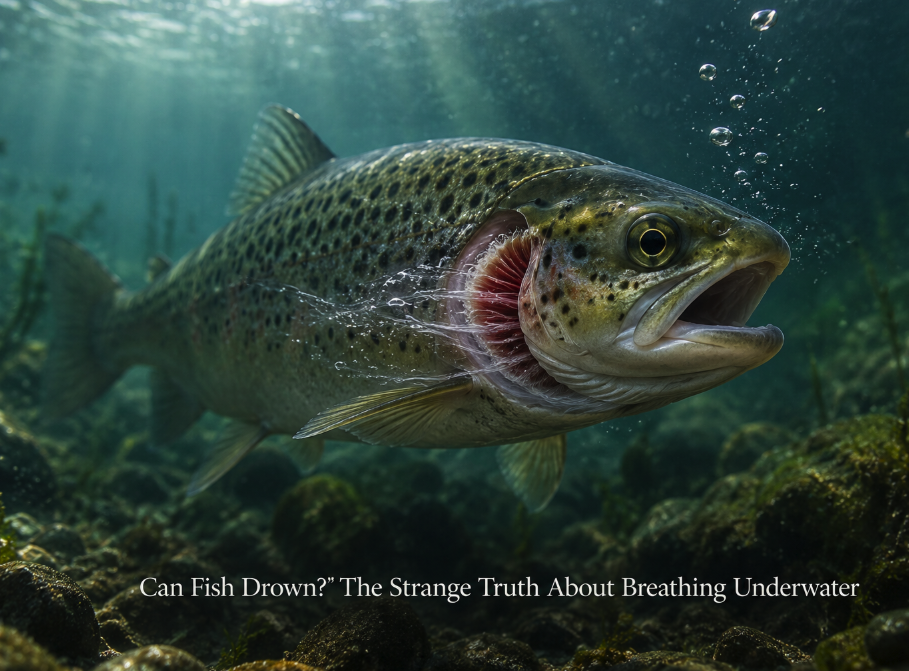
A fish can be surrounded by water and still run out of oxygen. That sounds like a contradiction only because we tend to think of water itself as the thing fish breathe. It is not. Most fish depend on oxygen gas dissolved in water, extracting it through delicate gills. If too little oxygen is available, or if water cannot move properly across those gills, a fish can suffocate underwater.
So can fish drown? In everyday language, yes — although “suffocate” or “asphyxiate” is more biologically precise. Human drowning involves the respiratory system being impaired by submersion in liquid. A fish is already adapted to life in liquid, but its respiratory system can fail for a surprisingly similar ultimate reason: its tissues no longer receive enough oxygen.
Fish do not breathe water — they breathe oxygen in water
Water enters a fish’s mouth and is moved across the gills, where extremely thin respiratory surfaces allow gases to diffuse between water and blood. Oxygen moves into the bloodstream while carbon dioxide moves out. The arrangement is remarkably efficient: in many fish, blood and water move in opposite directions across the gill surfaces, a countercurrent system that helps maintain oxygen transfer along the length of the gill.
This is why a lake, aquarium or stretch of ocean can contain plenty of water yet become dangerous to fish. What matters is the concentration of dissolved oxygen. The U.S. Environmental Protection Agency notes that oxygen requirements vary among species, but declining dissolved oxygen can stress aquatic animals and, at sufficiently low levels, kill them. The agency generally describes concentrations below 1 milligram per liter as hypoxic and usually unable to support much life.
Different fish tolerate oxygen shortage very differently. Trout and salmon, for example, are relatively demanding, while some species adapted to warm or stagnant environments can withstand much poorer conditions. A single oxygen number therefore cannot define danger for every fish, but the principle is universal: gills cannot extract oxygen that is not there.
How water can lose its oxygen
Low-oxygen events happen naturally, but human activity can make them more severe. Warm water holds less dissolved oxygen than cold water. Algae and aquatic plants produce oxygen during photosynthesis, yet they also respire, and bacteria consume oxygen while decomposing dead organic matter. During warm weather, especially after heavy algal growth, oxygen can fall sharply at night or near the bottom of a poorly mixed body of water.
The U.S. Geological Survey identifies low dissolved oxygen as a common cause of summer fish kills. Nutrient pollution can intensify the problem by encouraging algal blooms; when large quantities of algae die and decompose, microbes consume oxygen, sometimes creating hypoxic “dead zones.” Fish capable of swimming away may escape. Those trapped in a pond, enclosed bay, net or poorly aerated aquarium may not.
A fish in oxygen-starved water may become sluggish, alter its swimming behavior or gather near the surface. Some species can gulp air or use specialized respiratory adaptations, but ordinary gill breathing cannot compensate indefinitely for severe oxygen depletion.
Why water flow across the gills matters
Having oxygenated water nearby is only part of the equation. That water also has to reach the respiratory surfaces. Most bony fish actively pump water through the mouth and across the gills using coordinated movements of the mouth and operculum, the protective gill cover. Others can supplement this with “ram ventilation,” using forward swimming to drive water over the gills.
This explains the familiar claim that pulling a fish backward through the water can make it suffocate. There is a real idea behind the claim, but it is often stated too broadly. Fish gill ventilation is normally organized around largely one-way water flow. Forcing water in the reverse direction can interfere with that system and may physically harm delicate gill structures, but the effect varies greatly by species and circumstances. It is not accurate to say that every fish immediately stops breathing whenever it moves backward.
The clearest examples come from animals that depend heavily on forward motion. Some fast-swimming sharks and pelagic bony fish use ram ventilation extensively. According to Hawaiʻi’s Department of Land and Natural Resources, certain sharks must maintain sufficient swimming speed to move water through the mouth and across the gills. Other sharks can actively pump water and can remain stationary while still breathing.
That distinction matters because the popular statement “sharks must keep swimming or they die” is not true for all sharks. Bottom-dwelling species commonly ventilate their gills while resting. Even among species traditionally described as obligate ram ventilators, research continues to reveal behavioral exceptions and complexities. What matters is not movement for its own sake, but whether enough oxygenated water is passing across functioning gills.
Can a fish drown in ordinary, oxygen-rich water?
It can still suffocate if its gills cannot do their job. Gill damage, disease, pollutants, sediment, parasites or material that clogs respiratory surfaces can interfere with gas exchange. The NOAA Fisheries description of fish respiration makes the basic dependency clear: maintaining water passage over the gills is essential for obtaining oxygen.
This also helps explain why taking a fish out of water is so dangerous even though the surrounding air contains far more oxygen than water. Gills are built to function while supported and separated by water. Out of water, their fine structures can collapse and stick together, drastically reducing the surface area available for gas exchange. Unless a species has evolved an additional way to breathe air, abundant atmospheric oxygen does it little good.
Fish therefore face an unusual respiratory paradox. They live immersed in their breathing medium, yet they are never guaranteed access to usable oxygen. A pond can become suffocating without losing a drop of water, and an animal with perfectly healthy gills can die simply because the invisible gas dissolved around it has fallen too low.
Calling that “drowning” is not quite the terminology a physiologist would choose. But the surprising answer to the question is still yes in the everyday sense: fish can die underwater from lack of oxygen. Water keeps them alive only when it carries enough oxygen — and when their remarkable gills can keep that oxygen flowing into the blood.