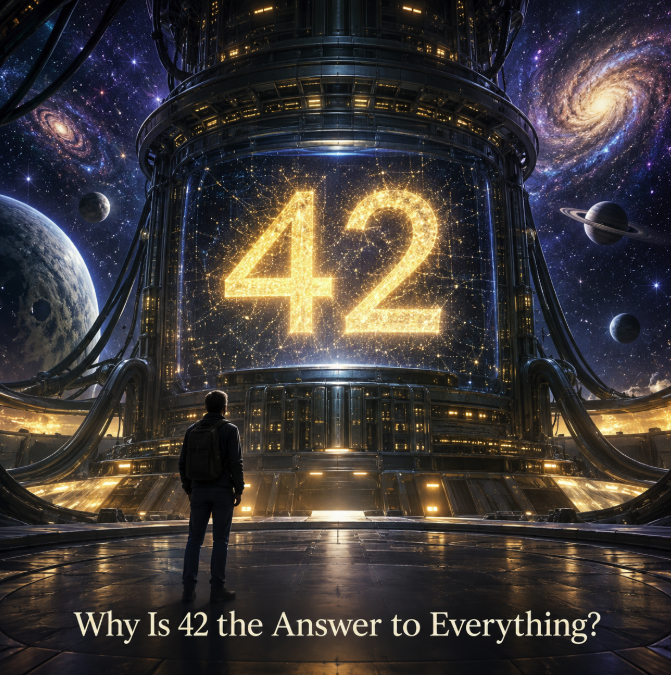
Ask the meaning of life in the right corner of the internet and there is a good chance someone will answer with a number: 42. It has become one of popular culture’s most durable private jokes, recognizable to science-fiction readers, programmers, mathematicians and people who may never have opened the book that made it famous.
The number comes from Douglas Adams’s The Hitchhiker’s Guide to the Galaxy, but the joke is stranger — and better — than simply declaring that the meaning of existence is forty-two. Adams built an elaborate cosmic setup in which an unimaginably powerful computer spends millions of years solving the greatest question imaginable, only to produce an answer that is almost aggressively ordinary. The real problem, it turns out, is that nobody properly understands the question.
Where 42 comes from
In Adams’s story, a supercomputer called Deep Thought is asked to calculate the Answer to the Ultimate Question of Life, the Universe, and Everything. Deep Thought warns that the calculation will take a while. Specifically, it takes seven and a half million years.
When the long-awaited moment finally arrives, the descendants of the people who posed the problem gather to hear the result. Deep Thought announces the answer: 42. The anticlimax is the point. After an absurdly grand intellectual project, the universe appears to have handed everyone a small, meaningless integer.
Deep Thought then explains the deeper problem: knowing an answer is useless if you do not know exactly what question it answers. A far more sophisticated computer is therefore required to determine the Ultimate Question itself. In Adams’s universe, that computer is Earth, built as part of a vast experiment — and, with characteristically cruel comic timing, destroyed before its work can be completed.
The idea first reached audiences through Adams’s BBC radio comedy in 1978 and became internationally famous through the novel The Hitchhiker’s Guide to the Galaxy, published the following year. The joke worked because it treated metaphysics like a badly specified computing problem. Humanity wants a final explanation for existence; Adams gives it an output without usable context.
Did Douglas Adams hide a secret meaning in 42?
Fans have spent decades trying to prove that he did. They have found patterns in mathematics, computer science, number bases, religion and literature. The problem with these theories is that Adams himself gave a remarkably unromantic explanation.
In a 1993 discussion on the Usenet group alt.fan.douglas-adams, Adams said the choice was simply a joke. He needed an ordinary, relatively small number, looked into his garden, decided that 42 would do, and typed it. He explicitly dismissed theories involving binary notation, base 13 and Tibetan monks. The surviving Usenet exchange preserves his explanation.
That matters because 42 has accumulated an impressive mythology. In binary it is written 101010, a pleasing pattern that looks suspiciously deliberate. Another famous theory points to a joke later in the series involving six multiplied by nine. In ordinary base-10 arithmetic, six times nine is 54, not 42. But the decimal value 54 is written as 42 in base 13, leading fans to suspect an elaborate mathematical trick.
Adams rejected that interpretation too. The mathematical coincidence is real; the claim that it explains his original choice is not.
This distinction is part of what makes 42 so entertaining. A random number selected because it sounded funny became so culturally important that generations of readers began searching for reasons it could not possibly have been random. The hunt for hidden meaning accidentally reenacts the central joke of The Hitchhiker’s Guide: intelligent beings desperately trying to force a satisfying cosmic explanation out of an answer they already possess.
Then mathematics made 42 even stranger
Although Adams did not choose 42 because of a secret mathematical property, mathematicians later gave the number an unexpectedly dramatic story of its own.
For decades, researchers studied the “sum of three cubes” problem: for a given integer, can it be expressed as x³ + y³ + z³ using integers? Many values were solved, but 42 became one of the famously stubborn cases. In 2019, mathematicians Andrew Booker of the University of Bristol and Andrew Sutherland of MIT found a solution after an enormous distributed computation.
The result was:
80,435,758,145,817,515³ + 12,602,123,297,335,631³ + (−80,538,738,812,075,974)³ = 42.
MIT described the breakthrough with the inevitable nod to Adams. Reality had supplied a wonderfully appropriate sequel: a number chosen because it was supposed to be mundane ended up requiring enormous computational effort to settle a famous mathematical question.
That does not retroactively give Adams’s 42 a mathematical origin. It simply adds another layer to its cultural life.
Why the joke survived
If Deep Thought had answered “7,391,284,” the scene might still have been funny, but probably less memorable. Forty-two is short, familiar and completely plausible as a number someone might casually say. It is neither symbolically majestic like infinity nor comically obvious like zero. Its ordinariness gives the enormous buildup something perfectly flat to crash into.
The joke also arrived at an ideal moment. The Hitchhiker’s Guide became deeply embedded in computing and geek culture just as personal computers and online communities were expanding. Programmers began using 42 in examples, Easter eggs and references. Search engines and digital assistants later joined the tradition. The number evolved from a literary punchline into a compact signal: if you recognize 42, you are in on the joke.
But its staying power comes from more than fandom. Adams was parodying the human desire for definitive answers. We often imagine that if we could build a sufficiently powerful machine, collect enough data or think for long enough, the universe might eventually yield a neat explanation. Deep Thought does exactly that — and demonstrates that an answer detached from a meaningful question can be worthless.
That is why 42 is “the answer to everything.” Not because Douglas Adams discovered a hidden mathematical key to existence, and not because the number has mystical properties. It is the answer because an absurd fictional computer said so after seven and a half million years of calculation. The fact that people have spent decades trying to discover what 42 really means only makes Adams’s joke more accurate.