A penguin standing on ice looks as though someone designed a bird with a torso, two feet and almost nothing in between. Its legs seem impossibly short, and when it starts walking, the familiar side-to-side waddle only strengthens the illusion that there cannot be much hidden beneath those feathers.
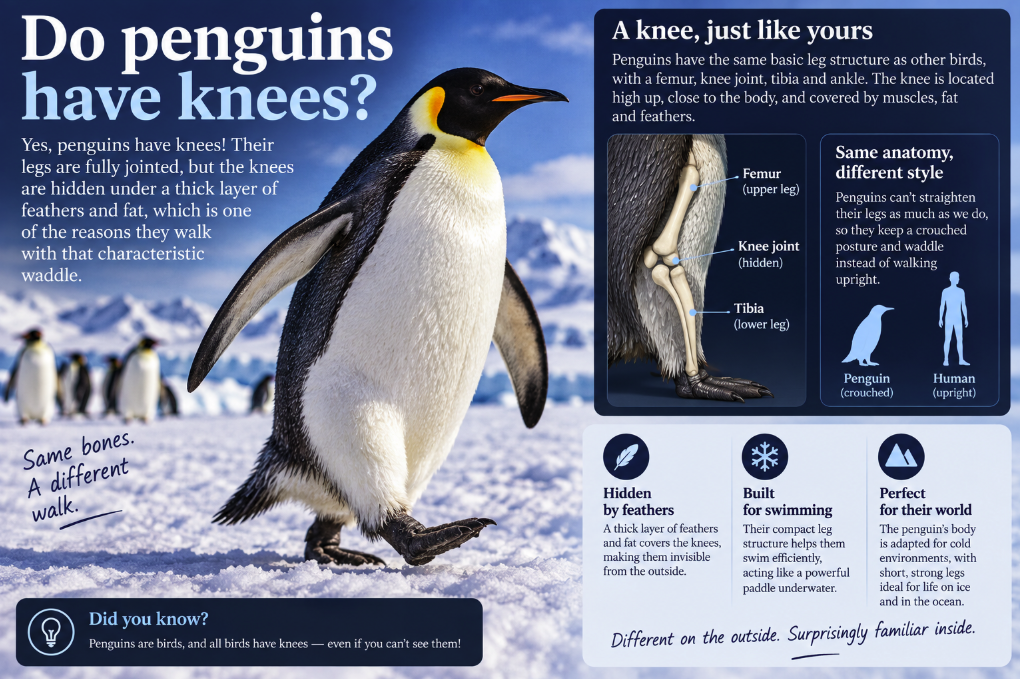
But penguins absolutely have knees. Their skeleton contains the same basic sequence of major hind-limb structures found in other birds, including a femur — the upper leg bone — and a knee joint connecting it to the lower portion of the limb. The surprise is where those bones are located.
A penguin's femur sits high inside the body contour, angled forward from the hip. The knee is therefore much farther up than most people expect and is concealed beneath plumage, muscle and other soft tissues. What looks like the penguin's entire leg from the outside is only the more exposed lower part of a considerably longer anatomical structure.
That hidden anatomy is real. But one popular explanation needs correcting: penguins do not waddle simply because their knees are buried under feathers and fat. Their famous walk is a much more interesting product of evolution, biomechanics and a body built primarily for swimming.
The leg you see is not the whole leg
Penguins are birds, and their hind limbs follow the characteristic avian plan. Starting at the hip is the femur. Below the knee lies the tibiotarsus, a long bone formed during development from structures corresponding to the tibia and parts of the ankle region. Farther down is the tarsometatarsus, another distinctively avian fused bone leading toward the toes.
The terminology sounds unfamiliar because a bird leg is not simply a miniature human leg. Evolution has reorganized and fused several bones, creating a limb optimized for very different forms of locomotion.
Detailed anatomical work published by the Smithsonian Institution has documented the appendicular muscles and bones of penguins across species, while CT material from the University of Texas DigiMorph project makes it possible to view the skeleton of an Adélie penguin inside its body.
The result is instantly clarifying. The femur does not extend visibly downward like a human thigh. It remains tucked close to the torso. The knee lies near the lower edge of the body rather than halfway down the externally visible leg.
That is why illustrations that place a penguin skeleton beside its silhouette can look almost like an X-ray revelation: a substantial portion of the leg has been there all along, hidden inside the bird's streamlined outline.
So why do penguins waddle?
It is tempting to say, “because their knees are hidden.” That explanation is catchy, but it confuses appearance with mechanics.
Penguins are extraordinary swimmers that happen to spend part of their lives walking. Their bodies have been shaped by intense evolutionary pressure for efficient movement through water. Smithsonian Ocean notes that their legs and feet sit far back on the body. On land, that arrangement contributes to their distinctive gait; underwater, the rearward position helps keep the body streamlined, with the feet assisting in steering.
Their functional legs are also short relative to body size. That matters because short legs require rapid force production during walking and reduce the stride length available to the animal.
In 2000, researchers Timothy Griffin and Rodger Kram studied emperor penguins walking across a force platform. Their work produced a wonderfully counterintuitive result. Penguins do use considerably more energy to walk a given distance than similarly sized animals, but the sideways waddle itself is not simply wasted motion.
As UC Berkeley reported from the study, the real energetic disadvantage was the penguins' short legs. Their rocking movement actually helped recover mechanical energy from one step to the next.
The researchers described the motion using an inverted-pendulum model. As a penguin rocks toward one side, some energy of motion becomes gravitational potential energy. As it rocks back through the vertical position, that stored energy is converted back into movement. In some of the birds studied, mechanical-energy recovery reached unusually high levels.
In other words, waddling is not a clumsy mistake evolution forgot to fix. Given a penguin's proportions, it can be part of the solution.
A strange walk can also be a stable walk
Another study, published in the Journal of Theoretical Biology in 2008, examined the variability of penguin steps. Humans normally make continuous side-to-side adjustments to foot placement to remain stable, so researchers wondered whether the exaggerated lateral movement of a penguin represented an unstable gait.
They found something unexpected: penguins showed more consistency in step width than in step length. The authors concluded that the waddling pattern may be an effective strategy for maintaining stability in the side-to-side plane.
This makes sense when the animal is considered as a whole. A penguin has a compact body, short legs, large feet and a center of mass that must be shifted over each supporting foot. Rocking the body from side to side helps move that center of mass while the bird advances.
The gait may look comical to us because human walking is built around long, relatively straight legs and a much narrower lateral sway. Penguins are solving the same basic problem — moving a body over alternating feet — with dramatically different proportions.
Why evolution did not give penguins longer visible legs
Because walking is only one part of being a penguin.
Penguins are among the most radically aquatic birds on Earth. Their wings became stiff flippers, their bodies became streamlined, and their dense bones and powerful swimming musculature help them pursue prey underwater. Some species spend much of their lives at sea.
A long-legged terrestrial design would impose different hydrodynamic costs. Instead, penguins have a compact profile in which much of the upper limb remains close to the body and the feet are positioned toward the rear.
The trade-off becomes obvious when a penguin moves from land into water. The awkward-looking pedestrian suddenly becomes an extraordinarily graceful swimmer. Its flippers generate propulsion while its feet and tail contribute to control, and the torpedo-shaped body slips through the water with far less apparent effort than its walking style suggests.
Calling a penguin badly designed for walking therefore misses the larger evolutionary picture. Natural selection does not optimize an animal for looking elegant to humans on a sidewalk. It favors traits that work across the environments and behaviors that matter to survival and reproduction.
Do penguins bend their knees?
Yes. The knee is a real joint, not a vestigial structure frozen inside the body. Penguins flex and extend their hind limbs as they walk, swim, climb, jump and move between standing and resting postures.
What can confuse observers is that much of this motion happens underneath the visible body outline. Feathers smooth the silhouette and conceal the joints, so the movement does not resemble a human thigh and knee swinging in plain view.
The joint that people sometimes mistake for a backward-facing knee lower on a bird's leg is associated with the ankle region. This is a common source of confusion in bird anatomy generally. Birds often appear to have knees bending the “wrong” way because the conspicuous joint we notice is not actually the knee.
Once the skeleton is understood, the illusion disappears. The real knee bends in the expected direction between the femur and the lower leg; it is simply positioned much higher and better hidden than our human-centered intuition predicts.
So yes, penguins have knees. They also have thighs, ankles and a surprisingly substantial leg skeleton tucked beneath that smooth black-and-white exterior. Their knees are difficult to see because the upper legs lie close to the body and disappear beneath feathers and soft tissue.
And the waddle? That is not evidence that their knees are missing — nor merely the consequence of hidden joints. It is the gait of an animal with short legs, rear-positioned feet and a body whose most spectacular engineering reveals itself not while walking across the ice, but the moment it dives beneath it.