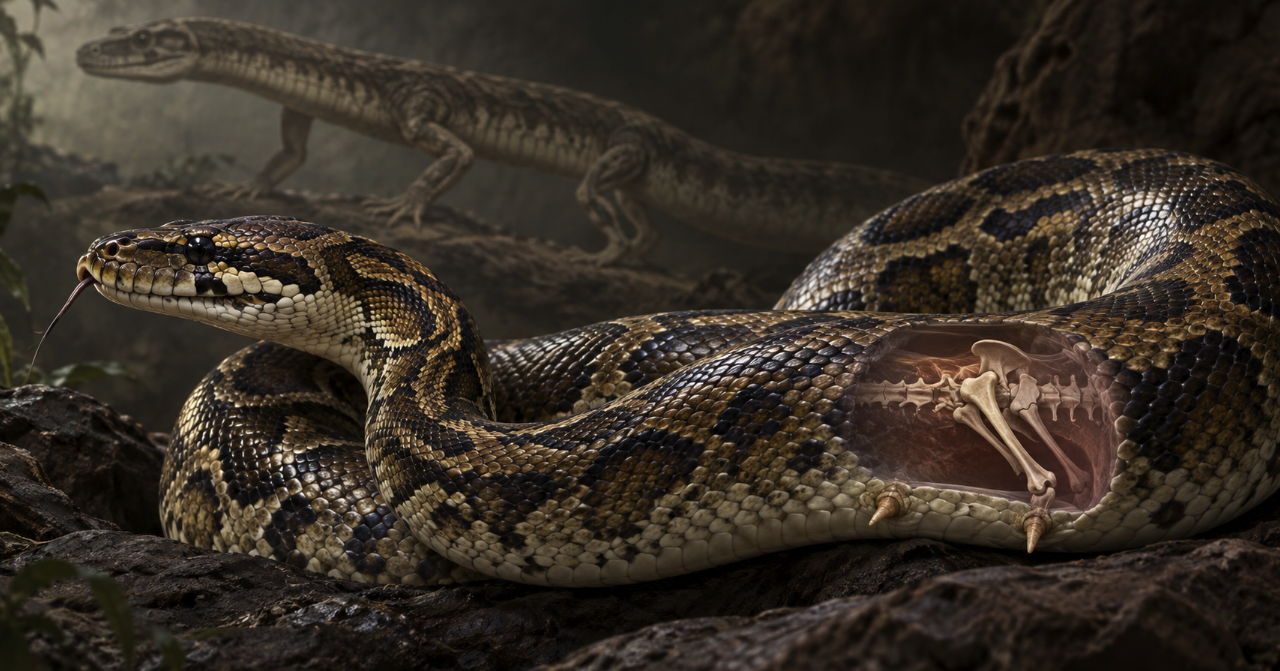
Ask whether snakes have legs and the obvious answer seems to be no. A cobra, viper or grass snake has no arms, no feet and no visible limbs at all. Yet the evolutionary answer is more interesting: snakes descend from four-limbed reptilian ancestors, and some living species still carry anatomical traces of the hind legs their lineage lost millions of years ago.
The clearest examples are pythons and boas. Near the cloaca, many of these snakes have a pair of small claw-like projections known as pelvic spurs. Beneath them lie reduced bones associated with the pelvis and hind limbs. They are not miniature walking legs, and they cannot support the animal during locomotion, but they are remnants of an ancestral body plan that once included functional limbs.
Snakes did not always have a legless body
Snakes are squamate reptiles, the same major reptile group that includes lizards. Their elongated, limbless form evolved from ancestors with limbs, but the transition was not simply a moment when four legs disappeared at once. Fossils indicate a long evolutionary period in which early snakes retained hind limbs after the forelimbs had already vanished.
One of the most revealing fossils is Najash rionegrina, described from Cretaceous rocks in Patagonia. Roughly 95 million years old, Najash was a terrestrial snake with robust hind limbs and a pelvis connected to the vertebral column. Its anatomy provided important evidence that substantial legs persisted in some early snakes and were not limited to marine forms. Later discoveries and CT studies of additional Najash material strengthened the picture of early snakes as a diverse group in which hind limbs remained for a surprisingly long stretch of evolutionary time.
Research published in Nature on the original Najash fossils and later work on newly discovered skeletons suggest that snakes with external hind limbs existed across tens of millions of years. The fossil record remains incomplete, so scientists continue to debate details of where and how the snake body plan originated, but limb reduction itself is supported by fossils, comparative anatomy, developmental biology and genetics.
The tiny 'legs' still found in pythons and boas
Modern pythons and boas preserve some of the most conspicuous traces. Their pelvic spurs appear as small projections on either side of the cloaca and are associated internally with reduced pelvic and hind-limb elements. A scientific review of snake anatomy concluded that the most recent common ancestor of living snakes probably retained pelvic elements and rudimentary hind limbs, followed by repeated reductions and losses in different snake lineages.
Calling these structures vestigial does not mean that they are necessarily useless. In some living snakes, pelvic spurs have a role in courtship and mating. They are evolutionary leftovers in the sense that they derive from ancestral hind limbs, but natural selection can preserve or repurpose remnants after their original function—in this case walking—has disappeared.
There is also an important correction to a common description of snake spurs: they are not simply hidden bones entirely inside the body. Much of the reduced skeletal apparatus is internal, but in pythons and boas the claw-like pelvic spurs themselves can be externally visible beside the cloaca.
Snake embryos reveal another part of the story
The evidence is not confined to fossils and adult anatomy. Developing python embryos briefly begin building structures associated with a hind limb. Research on limb development has shown that python embryos can initiate formation of a temporary distal leg skeleton before development is curtailed. This is a striking example of an old developmental program surviving in modified form long after fully functional legs disappeared.
Genetics helps explain why. A major player in vertebrate limb development is the Sonic hedgehog gene, commonly abbreviated SHH. Its activity in developing limbs is controlled in part by a regulatory DNA sequence called ZRS. Studies comparing snakes with other vertebrates found that this regulatory region accumulated evolutionary changes that interfere with normal limb development. Experiments in mice using snake versions of the regulatory sequence produced severely reduced limbs, offering a molecular glimpse of how changes in gene regulation can transform anatomy over evolutionary time.
This matters because evolution does not always require the disappearance of an entire gene. Altering when and where a gene is switched on can produce profound changes in body structure. The evolution of the snake body is therefore not just a story of bones shrinking away; it is also a story written in the genetic switches controlling embryonic development.
So, do snakes have legs?
No living snake has four functional walking legs, and most modern snakes have no externally visible limb remnants. But some, especially pythons and boas, retain vestiges of the pelvis and hind limbs, including their characteristic pelvic spurs. Fossils show that ancient snakes once possessed much more substantial hind legs, while evolutionary relationships point further back to four-limbed ancestors.
The apparently simple question therefore has a wonderfully complicated answer. A snake sliding across the ground may look like the perfect definition of a legless animal, yet inside some species—and in the DNA and embryos of the lineage—evolution has left traces of a time when the ancestors of snakes had limbs.