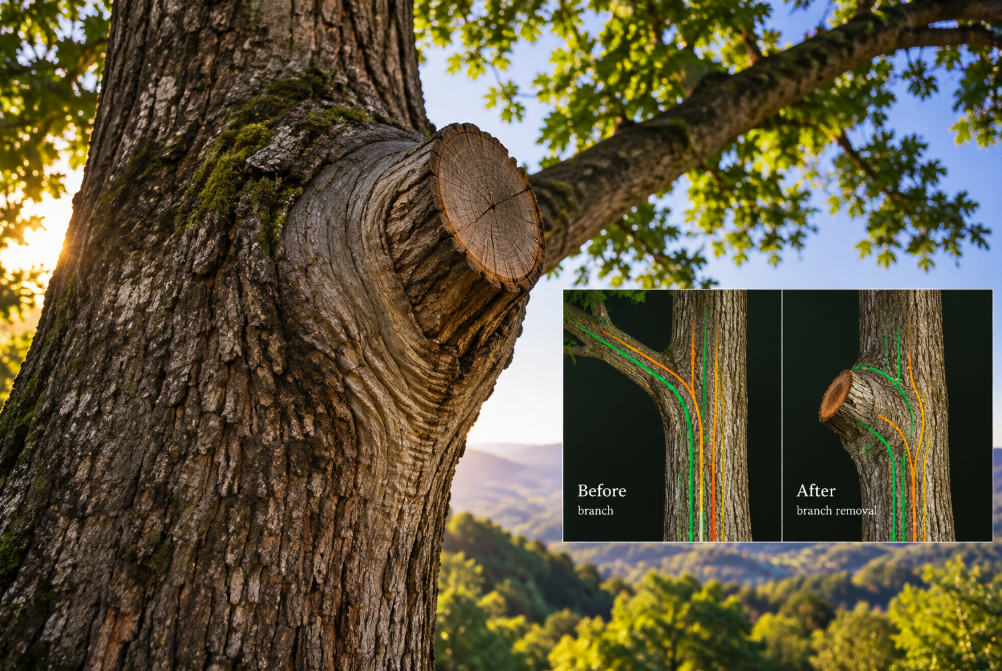
An old tree can carry the shape of an injury long after the branch that caused it has disappeared. A swollen collar may surround the site of a lost limb. Growth rings can bend around the old wound. New wood may accumulate unevenly, and the internal plumbing of the trunk can remain permanently altered. Decades later, a cross-section may still reveal exactly where the damage occurred.
This has inspired an evocative description: the tree has a “phantom limb.” The comparison is memorable, but it needs an important correction. Trees do not have phantom-limb syndrome in the medical sense. They have no brain or nervous system capable of producing the human experience of a missing arm or leg. Nor is “phantom limb” a standard botanical diagnosis.
What trees actually do may be more interesting. Because they cannot repair old wood the way animals repair damaged tissue, they preserve injuries inside themselves and build the rest of their lives around them. In that limited sense, a missing branch can remain written into a tree for decades.
A tree does not heal a wound — it grows past it
When human skin is cut, damaged tissue can be repaired and replaced. A tree works differently. Once wood has been injured, those old cells cannot simply regenerate into pristine wood.
Instead, trees compartmentalize damage. The influential model known as CODIT — Compartmentalization of Decay in Trees — describes how chemical and anatomical boundaries restrict the movement of decay organisms through wounded wood. Research summarized by Penn State Extension explains that trees wall off damaged areas and then produce new tissue around them rather than restoring the original structure. citeturn0search7turn0search2
After a branch breaks or is cut, cambial tissue around the wound produces callus and then organized woundwood. Over time, that new growth can roll inward from the margins and eventually cover the opening. The surface may look healed, but the original injury remains inside.
This distinction explains why a decades-old pruning cut can still be identified in the wood of a mature tree. The tree has not erased the event. It has enclosed it.
The tree's plumbing changes too
A branch is not simply a wooden lever attached to a trunk. It is connected to a vascular network. Water and dissolved minerals move primarily through xylem, while sugars and other compounds are distributed through phloem. The geometry of these tissues develops along with the architecture of the tree.
When a major limb is lost, the associated tissues do not continue functioning exactly as though the branch were still present. At an injury, trees can plug or chemically alter vascular pathways as part of compartmentalization. The University of Florida's explanation of the CODIT model notes that xylem vessels above and below a wound can become plugged, forming one of the boundaries that slows the longitudinal spread of decay. citeturn0search6
New vascular tissue subsequently forms with later growth. The result is not a conscious rerouting decision, but a living transport system whose future anatomy develops around a changed structure.
Calling this a redistribution of “sap” is broadly understandable, but it can be misleading if imagined as a tree deliberately opening and closing pipes to compensate for a missing limb. The real response involves growth, hydraulic function, hormones, wound chemistry and cambial activity interacting over time.
Mechanical stress can change how a tree grows
The most intriguing part of the phantom-limb metaphor comes from biomechanics.
Trees are continually loaded by gravity, their own weight and the wind. A branch becomes heavier as it lengthens. A trunk bends slightly in storms. Snow can load one side of a crown. Plants detect mechanical conditions and alter their development in response.
One family of responses is called thigmomorphogenesis. Experiments have shown that repeated wind or mechanical flexing can reduce elongation and increase radial growth, producing shorter, thicker structures. A classic study of Fraser fir found that mechanically perturbed trees reinforced branch bases and increased radial stem growth in the direction associated with the mechanical treatment. citeturn0search11
At the cellular level, the vascular cambium — the thin layer responsible for producing much of a tree's new wood — can respond to mechanical signals. Research on cambial development describes mechanosensory regulation as an important component of plant growth, while experimental work in poplar has linked mechanical loading and leaning with hormonal signaling and increased cambial cell division. citeturn0search16turn0search0
Remove a substantial branch and the mechanical system changes immediately. Weight distribution changes, wind loading changes and the remaining crown continues growing under a different set of forces.
Reaction wood is a tree's structural engineering
Trees possess an especially striking mechanism for responding to displacement: reaction wood.
When stems or branches need to maintain or alter their position, trees can produce wood with specialized anatomical and mechanical properties. Conifers generally form compression wood, while many flowering trees form tension wood. These tissues generate internal growth stresses that help stabilize or reposition woody organs.
A review in New Phytologist describes reaction wood as important for reinforcing stress points, maintaining branch angles and responding to gravity and mechanical loading. citeturn0search4
There is even experimental evidence tantalizingly close to the popular “phantom branch” idea. Literature on reaction wood reports that when one branch was removed from a whorl of white pine branches, remaining branches formed compression wood on the sides facing away from the newly created gap, contributing to movement that filled some of the vacant space. citeturn0search8
That is not the tree remembering the exact weight of its amputated branch. It is the surviving structure responding to a newly altered environment of gravity, light and mechanical equilibrium.
So does a tree have memory?
The answer depends entirely on what we mean by memory.
If memory means a nervous system storing a representation of a branch that is no longer there, the answer is no. There is no evidence that a tree experiences an absent limb as a human amputee can experience a phantom hand.
If memory means that a past event produces persistent biological changes that influence future behavior, plants can display many forms of such history-dependent response. An old wound remains compartmentalized. The cambium lays down new wood around it. Growth rings preserve changes in development. Architecture formed under years of mechanical stress affects how later loads are distributed.
In this broader sense, the tree's body itself can function as an archive.
A forest scientist can sometimes reconstruct episodes of drought, fire, injury, leaning or abrupt changes in competition from wood anatomy and tree rings. What happened years earlier remains physically embodied in tissues that were produced in response to those conditions.
It is less like a brain remembering an amputation and more like a building whose later renovations still reveal the wall that was once removed.
Why the effects can last for decades
Trees achieve enormous longevity partly because they continually add new structure around old structure. The interior of a trunk can contain wood formed when the tree was young, while a thin region near the outside remains actively involved in producing new secondary growth.
This means an injury can become buried rather than erased. New annual increments accumulate outside it. The wound may close externally, but discolored, compartmentalized or decayed wood can remain within the trunk for the rest of the tree's life.
Colorado State University Extension similarly emphasizes that trees do not replace damaged tissue; they chemically isolate affected regions, leaving the consequences incorporated into later growth. citeturn0search17
Large branch losses can also change crown architecture permanently. Remaining limbs gain space and light. New shoots may develop. Mechanical stresses shift as the crown expands. Years of subsequent growth therefore occur under conditions created by an event that may have lasted only seconds — a storm snapping a limb, for example.
The longer the tree lives, the more layers can accumulate around that moment.
The danger of making trees too human
Plant biology is particularly vulnerable to seductive metaphors. Trees “talk,” “remember,” “feel,” “feed their children” and “heal.” These expressions can make complex science accessible, but they can also quietly replace mechanisms with human intentions.
A tree does not need to calculate that one side has become lighter after losing a branch. Mechanical forces themselves change. Living tissues respond to gravity, strain, hormones, water status and light. The cambium produces wood under those new conditions. The resulting architecture can look remarkably purposeful because natural selection has favored organisms capable of surviving mechanical disruption.
The scientifically interesting story is not diminished when consciousness is removed from it. It becomes more precise.
A tree is a structure that builds itself while standing outdoors for decades or centuries. It must remain upright while continuously changing its own size and mass, enduring wind, losing branches and sometimes growing around major wounds. It cannot walk away from mechanical stress or replace a damaged trunk. Its solution is to alter future growth.
The real “phantom” is written in wood
So the phrase “phantom limb syndrome in trees” is best treated as a poetic analogy, not a biological condition. Trees do not mourn missing branches or preserve a neurological map of them. What they preserve is physical history.
After a limb disappears, vascular pathways can be compartmentalized, woundwood grows around the injury, mechanical loading changes and future wood can develop asymmetrically. Remaining branches may respond to new light and structural conditions. The original wound can persist internally long after bark has hidden it from view.
Years later, the missing branch is absent from the crown but present in the architecture.
That may be the closest botanical equivalent to a phantom limb: not a sensation of something that is gone, but a living organism whose future shape continues to carry evidence that it was once there.