Watch a turkey closely and its stare can seem almost unnervingly steady. Its eyes sit high on the sides of its head, scanning the surroundings while the bird walks, feeds and watches for danger. Around Thanksgiving, that intense gaze has inspired a surprisingly common question: do turkeys actually blink?
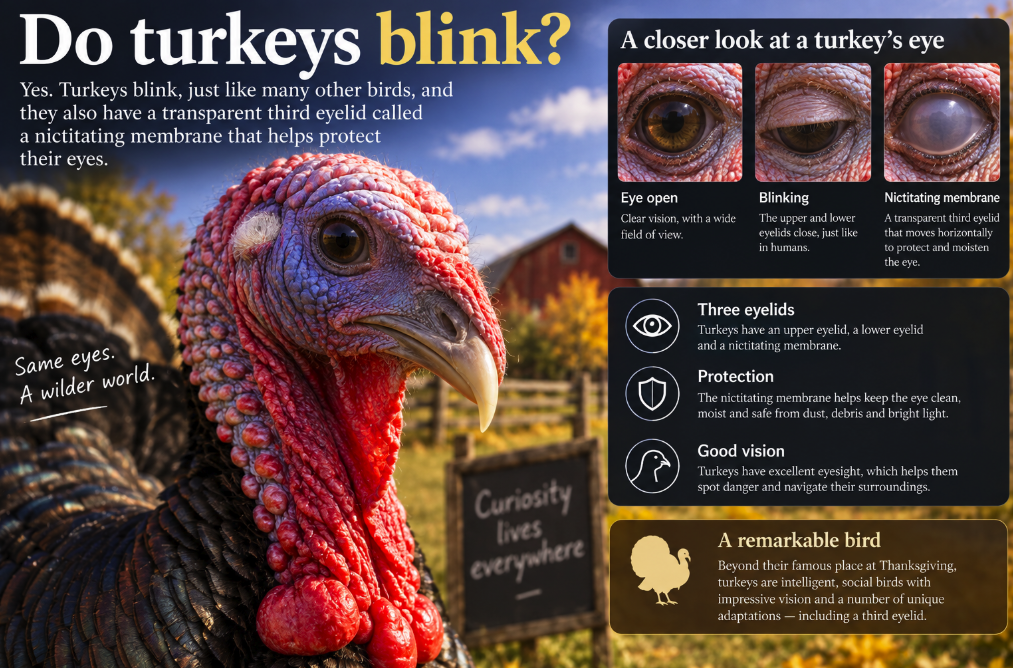
Yes. Turkeys have ordinary eyelids and they blink. But they also possess something humans do not: a functional nictitating membrane, often called a third eyelid. This thin, translucent membrane can sweep across the surface of the eye, helping to keep it moist, clean and protected while still allowing some light through.
The feature is not a turkey oddity. It is part of the basic eye equipment of birds, and versions of it occur in many other vertebrates. Once you know what to look for, a fleeting pale film crossing a bird's eye is not a sign that something has gone wrong. It may simply be the third eyelid doing its job.
A turkey has more than one way to close its eye
Like us, a turkey has external eyelids that can close over the eye. Ordinary blinking helps protect the exposed surface and distribute moisture. Veterinary examinations of poultry even pay attention to whether the eyelids are open normally and whether there is swelling, discharge or unusual closure, because changes around the eye can signal disease.
Behind those familiar lids sits the nictitating membrane. The Cornell Lab of Ornithology's glossary of bird anatomy describes it as a thin, translucent fold that sweeps sideways across the eye. Unlike the vertical movement we associate with a human blink, the membrane travels across the eyeball from the side.
Its functions are wonderfully practical. Cornell notes that it can moisten and clean the eye while protecting its surface. That matters for an animal whose face regularly comes close to soil, vegetation, dust and debris.
The membrane is sometimes easiest to notice in photographs or slow-motion video. For a fraction of a second, the bird's normally dark, glossy eye may appear milky or cloudy as the translucent layer moves across it. Because the movement can be extremely fast, a casual observer may never see it at all.
Why do birds need a third eyelid?
An exposed eye is a biological compromise. The cornea must remain clear so light can enter, but that also leaves delicate tissue facing the outside world. Eyelids, tears and protective reflexes help solve the problem.
Birds face additional challenges because many species move quickly through complicated environments. A hawk may pursue prey through vegetation. A duck can put its head underwater. A terrestrial bird such as a turkey spends much of its day near grasses, branches and ground-level particles.
The nictitating membrane acts something like a built-in protective screen. Cornell's bird-camera specialists have documented the same structure in owls, hawks and other species. In a 2024 observation of a Great Horned Owl, the lab described the membrane as the bird's third eyelid, explaining that all birds have one and that it helps lubricate and protect the eye.
In some birds its role becomes especially obvious. Cornell describes the transparent nictitating membrane of the Hooded Merganser, a diving duck, as functioning almost like a pair of goggles while the bird swims. The precise demands differ between species, but the underlying anatomical solution is shared across birds.
Humans retain only a tiny reminder of this evolutionary feature. The small fold of tissue at the inner corner of our eye is related to structures associated with a nictitating membrane in other vertebrates, but we cannot sweep a transparent third eyelid across the cornea the way a turkey can.
Why a turkey's stare looks so different from ours
The third eyelid is only one reason turkey eyes attract attention. Humans have forward-facing eyes, giving us extensive binocular overlap and strong depth perception directly ahead. Turkeys, like many birds that must remain alert to predators, have eyes positioned much farther toward the sides of the head.
That arrangement allows them to monitor a broad area around themselves without constantly turning the entire body. It also helps explain a behavior anyone who has watched poultry will recognize: birds frequently move and tilt their heads as they inspect something.
Their visual world is not simply a human view stretched wider. Bird eyes and visual systems have evolved under different pressures, and different species specialize in different tasks. Raptors need extraordinary visual performance for hunting; diving birds must cope with air and water; ground-dwelling birds need to forage while remaining alert to danger.
Turkeys belong to that last category. Wild turkeys spend substantial time walking and feeding on the ground, where being able to notice movement around them is valuable. Their alert posture and prominent eyes are part of a sensory system shaped by that lifestyle.
What does it mean if a turkey keeps one eye closed?
A normal blink or quick sweep of the nictitating membrane lasts only briefly. Persistent eye closure is different.
The Merck Veterinary Manual advises that bird owners take symptoms such as swelling, redness, discharge, excessive blinking or prolonged closure of an eye seriously because they can accompany ocular or respiratory disease. Poultry examinations similarly check whether eyes are clear and bright and whether eyelids are free of swelling.
In other words, seeing a turkey blink is normal. Seeing the pale third eyelid flash across the eye can also be normal. A bird continually holding an eye shut, blinking excessively or showing discharge should not simply be dismissed as demonstrating its unusual anatomy.
The distinction is a useful reminder of how easily normal animal features can look strange when we compare them with our own bodies. A translucent sheet suddenly passing over an eyeball sounds almost science-fictional, yet birds have been doing it for millions of years.
So, do turkeys blink? Absolutely. They can close their ordinary eyelids, and they carry an additional piece of eye protection that humans lack: a translucent nictitating membrane capable of sliding across the eye to help clean, moisten and shield it.
The next time a turkey seems to be staring without blinking, look carefully. You may discover that it has been blinking all along — just sometimes with an eyelid so fast and transparent that you barely knew it was there.