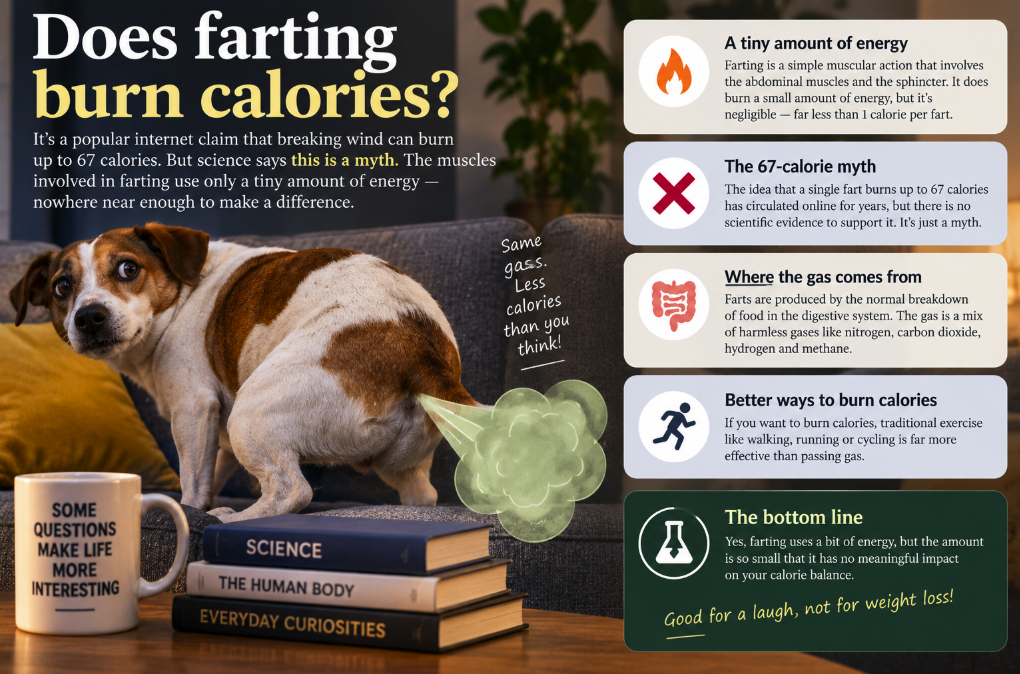
The internet has produced plenty of suspiciously convenient health claims, but few are as appealing as this one: every time you fart, you supposedly burn 67 calories. Repeat the process often enough, the story goes, and your digestive system becomes an accidental workout machine.
Unfortunately, biology is not that generous. There is no scientific evidence that passing gas burns 67 calories, and the energy involved in the act itself is metabolically trivial. Farting is a normal part of digestion, not a meaningful form of exercise.
The myth is still interesting because it mixes a tiny grain of truth with an absurdly large number. Every process in a living body involves energy somewhere, and muscles participate in controlling the passage of gas. But that does not mean every bodily movement burns a measurable number of dietary calories. The leap from “the body uses energy” to “one fart burns 67 calories” is where the internet story falls apart.
Where did the 67-calorie claim come from?
The number has circulated online for years, often presented as though it came from a medical study. Current medically reviewed discussions of the rumor trace versions of it to social-media posts rather than to published metabolic research. One widely shared formulation claimed that a single fart burned 67 calories and that passing gas 52 times could burn roughly a pound of body fat.
The arithmetic itself exposes the problem. If an ordinary bodily function really consumed 67 food calories every time it happened, routine flatulence would represent an enormous component of human energy expenditure.
The U.S. National Institute of Diabetes and Digestive and Kidney Diseases says that studies suggest people pass gas an average of 8 to 14 times per day, while up to 25 times a day can still be considered normal. At 67 calories each, 14 daily farts would supposedly consume 938 calories — comparable to a substantial fraction of many adults' total daily energy needs.
Human metabolism simply does not behave that way. There is no credible physiological mechanism or experimental evidence supporting the number.
What actually happens when you fart?
Flatulence is the release of gas from the digestive tract through the anus. The gas has to come from somewhere, and there are several sources.
Some of it begins as swallowed air. Everyone swallows small amounts while eating and drinking, and behaviors such as eating quickly, chewing gum or drinking carbonated beverages can increase the amount. Air that does not leave through a burp can travel farther through the digestive system.
Another major source is the community of microorganisms living in the large intestine. Human digestive enzymes cannot completely break down every carbohydrate we eat. When some of those carbohydrates reach the colon, bacteria metabolize them and produce gases as by-products.
The Merck Manual's 2026 review of gastrointestinal gas says approximately 75% of flatus is derived from bacterial fermentation in the colon. Common gases include hydrogen, methane and carbon dioxide, while swallowed air and movement of gases between the bloodstream and intestine also contribute.
Eventually, accumulated gas moves through the intestines and reaches the rectum. Muscles involved in continence regulate whether it stays there temporarily or is released. Passing gas is therefore a coordinated physiological event, but it is a very small one in energetic terms.
But don't muscles burn calories?
Yes. Muscle activity requires energy. So do breathing, maintaining body temperature, pumping blood, operating ion channels in cells and keeping the brain functioning. Even while you are lying completely still, your body is continuously using energy.
The important question is not whether any energy is involved. It is whether farting adds enough energy expenditure to matter.
There is no research establishing a meaningful calorie cost for an individual fart, and no evidence for the famous 67-calorie figure. Passing gas is commonly facilitated by relaxation of the muscles controlling the outlet, although abdominal pressure and muscular effort can vary from one episode to another. Deliberately straining would involve some muscular work, but any extra calorie expenditure attributable to that brief effort would be negligible compared with normal daily metabolism or physical activity.
That distinction matters because “calorie” can make tiny physiological processes sound larger than they are. A food Calorie — the unit printed on nutrition labels — is actually a kilocalorie, enough energy to heat one kilogram of water by one degree Celsius. Burning dozens of those units requires vastly more metabolic work than a momentary release of intestinal gas.
Why can farting make you feel lighter?
This may be the part of the myth that makes it intuitively believable. If you are bloated and then pass gas, your abdomen can feel less tight almost immediately. You may genuinely feel lighter, flatter or more comfortable.
But relief from pressure is not the same thing as loss of body fat.
Bloating is the sensation of fullness or swelling in the abdomen. NIDDK notes that gas symptoms commonly include belching, bloating, distention and passing gas. Releasing trapped gas can reduce that uncomfortable sensation without meaningfully changing the body's stored energy.
The same principle explains why short-term changes on a bathroom scale do not necessarily represent fat loss. Body weight can fluctuate because of water, food and waste moving through the digestive system. Losing fat requires a sustained energy imbalance over time, not simply emptying material or gas from the gut.
Why do some foods make you fart more?
Beans have become the comic symbol of flatulence for a reason, but they are far from the only food involved. Gas production depends partly on which carbohydrates escape digestion in the small intestine and reach bacteria in the colon.
NIDDK explains that gut bacteria break down undigested carbohydrates, generating gas in the process. Different people have different microbiomes, digestive abilities and dietary patterns, so the same meal can produce dramatically different symptoms from one person to another.
Fiber-rich foods can increase gas when introduced rapidly, even though dietary fiber is an important part of a healthy diet. Certain sugars and sugar alcohols can also be poorly absorbed. Lactose can cause substantial gas in people with lactose intolerance, while some people are sensitive to groups of fermentable carbohydrates often known as FODMAPs.
The smell is another matter. Most of the gases that make up flatus are odorless. Merck notes that unpleasant odor correlates with sulfur-containing compounds such as hydrogen sulfide, which can be noticeable even at low concentrations.
When is frequent gas worth checking?
Farting itself is normal, and frequency varies considerably. A person who passes gas more often than a friend does not automatically have a digestive disorder.
What matters more is a change from your normal pattern and whether other symptoms appear. NIDDK recommends talking with a doctor when gas symptoms are bothersome, change suddenly, or occur alongside symptoms such as abdominal pain, constipation, diarrhea or weight loss.
Food intolerances, constipation, irritable bowel syndrome and other gastrointestinal conditions can alter gas symptoms. The goal in those situations is to understand why the digestive pattern changed — not to treat flatulence as a calorie-burning opportunity.
So, does farting burn calories? In the broadest biochemical sense, your body is always consuming energy, including while digesting food and controlling muscles. But there is no evidence that releasing a fart burns anything remotely close to 67 calories, and any additional energy expenditure from the act is too small to matter for weight loss.
Passing gas may make you feel less bloated. It may make a room less pleasant. It may even keep an internet myth alive for another decade. What it will not do is replace a workout.