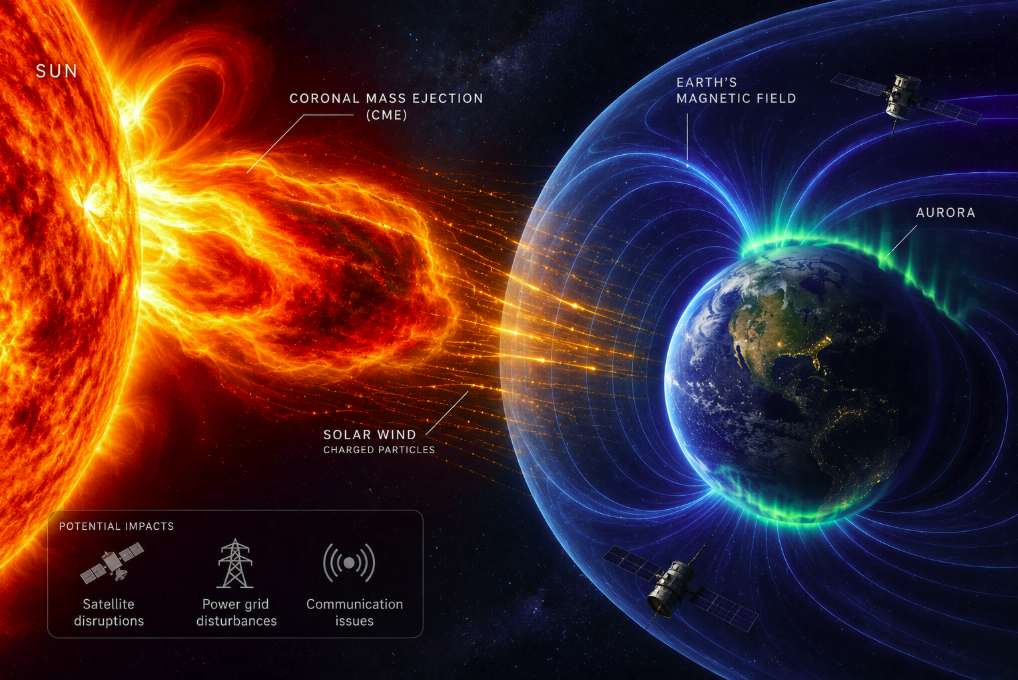
The most spectacular sign of a geomagnetic storm can look almost supernatural. Green curtains ripple across the night sky, red light appears hundreds or even thousands of kilometres farther south than normal, and photographs of auroras flood social media from places where they are rarely seen.
But the light show is only the visible edge of a much larger event.
High above us, Earth’s magnetic environment is being disturbed by energy arriving from the Sun. Satellites can experience increased drag and electrical charging. GPS accuracy can deteriorate. High-frequency radio communications can fade. Electrical currents can appear in long conductors on the ground, including power-transmission networks and pipelines.
This is a geomagnetic storm: not a storm in Earth’s atmosphere, but a temporary disturbance of the enormous magnetic system surrounding our planet.
It begins roughly 150 million kilometres away.
The Sun is constantly blowing toward Earth
The space between the planets is not empty. The Sun continuously releases a stream of electrically charged particles called the solar wind, composed largely of protons and electrons embedded in a magnetic field.
Under ordinary conditions, Earth’s own magnetic field deflects much of this flow. The region dominated by our planet’s magnetic field is called the magnetosphere. It is compressed on the side facing the Sun and stretched into a long tail on the night side.
NASA describes the solar wind as a continuous flow that touches every part of the solar system. Earth’s magnetosphere acts as a protective magnetic bubble, but it is not an impenetrable wall.
The Sun is also variable. Its magnetic field becomes twisted and stressed as solar plasma moves and the star rotates. Magnetic reconnection can suddenly release enormous amounts of stored energy.
One result can be a solar flare: an intense burst of electromagnetic radiation. Another can be a coronal mass ejection, or CME, in which a huge cloud of magnetized plasma erupts outward into space.
These phenomena are related but not identical. A solar flare does not itself have to strike Earth like a physical cloud. Its electromagnetic radiation travels at the speed of light and can affect the ionosphere within minutes. A CME is actual solar material and magnetic field traveling through space, usually taking many hours or days to reach Earth.
When a suitable disturbance reaches our planet, a geomagnetic storm can begin.
Why some solar eruptions hit harder than others
It might seem that the largest and fastest CME should automatically produce the strongest geomagnetic storm. The real physics is more interesting.
The orientation of the magnetic field carried by the incoming solar plasma is crucial. When its magnetic field is oriented favorably for interaction with Earth’s field — particularly when it has a strong southward component opposite to the northward direction of Earth’s dayside field — magnetic reconnection can efficiently transfer energy into the magnetosphere.
In simplified terms, the two magnetic systems connect.
That allows enormous amounts of energy to enter Earth’s magnetic environment. Currents intensify, the magnetosphere changes shape and charged particles are accelerated along magnetic field lines.
This is why forecasting the arrival time of a CME is only part of the space-weather problem. Scientists also want to know the magnetic structure carried inside it.
NASA highlighted this problem after an April 2023 storm became unexpectedly severe. Researchers found that the CME’s orientation relative to Earth contributed to its intensity, demonstrating why a seemingly unexceptional solar eruption can sometimes produce a much stronger response than forecasts initially suggest.
High-speed streams in the ordinary solar wind can also produce geomagnetic storms, particularly when they interact effectively with Earth’s magnetic field. A CME is therefore a major cause, not the only possible cause.
The aurora is a clue that energy has entered the system
The aurora borealis in the north and aurora australis in the south are among the most beautiful consequences of this energy transfer.
During disturbed conditions, charged particles are accelerated through Earth’s magnetic environment and guided toward the upper atmosphere, especially around the polar regions. There they collide with atoms and molecules.
Those collisions excite atmospheric gases. As the atoms and molecules return to lower-energy states, they emit light.
Oxygen is responsible for much of the familiar green aurora and can also produce deep red emissions under appropriate conditions. Nitrogen contributes blue, purple and reddish colors. The exact appearance depends on altitude, atmospheric composition and particle energy.
During a strong geomagnetic storm, the auroral zones expand toward lower latitudes. Places far from the Arctic or Antarctic can suddenly see displays that would normally be confined much closer to the poles.
The extraordinary auroras of May 2024 demonstrated this vividly. A series of Earth-directed CMEs produced the strongest geomagnetic storm in more than two decades, spreading auroras to unusually low latitudes around the world.
What does G1, G3 or G5 actually mean?
The U.S. National Oceanic and Atmospheric Administration’s Space Weather Prediction Center classifies geomagnetic storms on a five-level scale.
G1 is minor. G2 is moderate. G3 is strong. G4 is severe. G5 is extreme.
The categories are associated with the planetary Kp index, a measure of disturbances in Earth’s magnetic field calculated from magnetometer observations. G1 begins at Kp 5, while G5 corresponds to Kp 9.
The scale is designed less as an abstract scientific ranking than as a way to communicate potential consequences. According to NOAA’s Space Weather Scales, minor storms can produce weak fluctuations in power grids and small satellite effects. At higher levels, problems can include increased satellite drag, spacecraft charging, degraded navigation and radio communication, and more significant stresses on electrical infrastructure.
At G5, NOAA warns that some power systems can experience widespread voltage-control and protective-system problems, while satellite navigation and high-frequency radio can suffer substantial disruption.
A G5 designation does not mean those consequences will occur everywhere. Duration, geography, infrastructure, local geology and the precise properties of the storm all influence the actual effects.
How a storm in space can affect electricity on the ground
One of the strangest effects of geomagnetic storms happens without solar particles physically reaching a power station.
Rapid changes in Earth’s magnetic field induce electric fields at the surface. Those fields can drive geomagnetically induced currents through long conductive systems such as high-voltage transmission lines and pipelines.
Power grids are particularly vulnerable because they contain vast networks of conductors and transformers. Under severe conditions, unwanted currents can interfere with voltage regulation, cause protective equipment to operate unexpectedly and heat transformer components.
The danger is strongly dependent on location and geology. Conductivity in the ground influences how electric fields develop, while the design and orientation of a power network affect how currents enter it.
A famous example occurred in March 1989, when a geomagnetic storm contributed to the collapse of the Hydro-Québec power grid in Canada, leaving millions of customers without electricity for hours.
The possibility of larger events is one reason power-grid operators monitor space-weather warnings even when the sky above them appears perfectly clear.
Satellites are much closer to the action
Spacecraft face a different collection of hazards.
A geomagnetic storm deposits energy in Earth’s upper atmosphere, heating it and causing it to expand. The atmosphere remains extremely thin at satellite altitudes, but even a small increase in density can create additional drag on spacecraft in low Earth orbit.
The result is a loss of orbital energy. Satellites can descend faster than predicted, forcing operators to update orbit calculations or perform corrective maneuvers.
Charged particles can also produce electrical charging on spacecraft surfaces and interfere with electronics. Communications between satellites and the ground may become less reliable, and disturbances in the ionosphere can reduce the accuracy of satellite-navigation signals.
These effects matter more than ever because modern civilization has placed thousands of operational spacecraft into orbit. Navigation, communications, weather forecasting, Earth observation, financial timing systems and military operations all depend to varying degrees on space infrastructure.
A geomagnetic storm therefore interacts with a planet that is technologically far more vulnerable than it was a century ago.
Could a geomagnetic storm hurt people?
For people standing on Earth’s surface, even a major geomagnetic storm is generally not a direct radiation emergency.
Our atmosphere and magnetosphere provide powerful protection. NASA notes that solar storms do not directly harm people on the ground because Earth shields us from their worst radiation effects.
The situation is different in space. Astronauts outside much of Earth’s protection can face increased radiation exposure during solar energetic particle events associated with major solar activity. High-altitude aviation, particularly polar routes, can also face communications issues and elevated radiation exposure under certain space-weather conditions.
The everyday risk for most people is therefore indirect: disruption to technology rather than being physically struck by dangerous solar material.
The Carrington Event remains the legendary benchmark
On September 1, 1859, British astronomer Richard Carrington observed an intense brightening on the Sun. Roughly a day later, Earth experienced an extraordinary geomagnetic disturbance.
Auroras appeared at remarkably low latitudes. Telegraph systems — the cutting-edge communications infrastructure of the era — malfunctioned. Operators reported electrical shocks and sparks, and some telegraph circuits reportedly continued functioning temporarily using geomagnetically induced electricity even after their batteries had been disconnected.
The episode became known as the Carrington Event and remains a benchmark for extreme space-weather planning.
It occurred before modern electrical grids, satellites, GPS, undersea data infrastructure and global aviation existed. Scientists therefore study historical evidence and modern storms to understand what a comparable event might mean for today’s interconnected technological systems.
NOAA describes the Carrington Event as substantially stronger than the May 2024 storm in planning comparisons, although reconstructing the exact intensity of a nineteenth-century event inevitably involves uncertainty.
The 2024 Gannon storm gave scientists a modern laboratory
On May 10, 2024, Earth entered a G5 geomagnetic storm, the highest category on NOAA’s scale. It was the first G5 event in more than two decades.
The storm, later named the Gannon storm in memory of space-weather physicist Jennifer Gannon, produced spectacular auroras and measurable technological effects but no global technological catastrophe.
NASA has described it as one of the best-documented major geomagnetic storms ever observed. The enormous quantity of satellite, ground and atmospheric data collected during the event is helping researchers improve models of how the magnetosphere and upper atmosphere respond to extreme solar activity.
Modern forecasting is improving as well. NASA reported in August 2026 that observations from its PUNCH mission had enabled researchers, in an initial proof-of-concept test, to predict the near-Earth arrival of a solar eruption to within about 30 minutes. Better tracking does not eliminate the danger, but more warning time gives satellite operators, power companies and other infrastructure managers additional opportunities to prepare.
Earth lives inside the atmosphere of a star
The phrase “space weather” can sound metaphorical, but it describes a physical environment as real as terrestrial weather. The Sun continuously sends particles and magnetic fields through the solar system, and Earth exists directly inside that flow.
Most of the time, our magnetic field quietly redirects it. Occasionally, the Sun launches a disturbance with the right speed, density and magnetic orientation to shake the entire system.
Then the effects become visible.
Auroras move toward the equator. Satellites feel the upper atmosphere thicken. Navigation signals wobble. Electrical currents appear in infrastructure on the ground. Instruments around the world record the magnetic field changing from minute to minute.
What looks from the ground like colored light dancing peacefully across the sky is actually evidence of a planetary magnetic storm stretching tens of thousands of kilometres into space.
The aurora is beautiful precisely because Earth is being hit — and because our planet’s magnetic shield is responding.