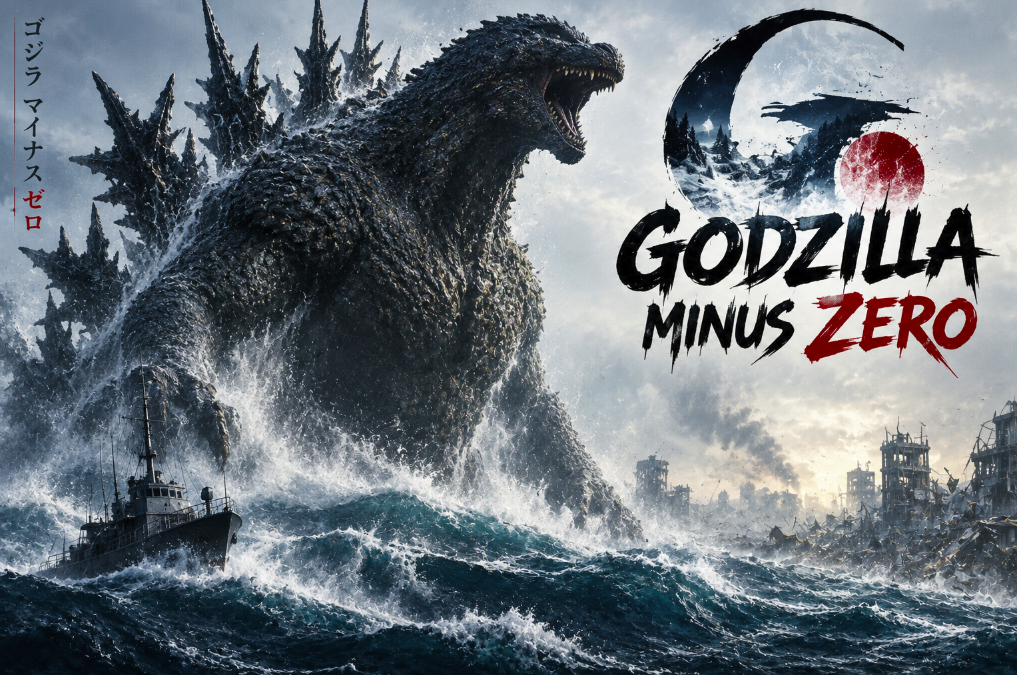
Three years after Godzilla Minus One transformed a relatively modest Japanese monster movie into an international phenomenon and an Academy Award winner, Takashi Yamazaki is returning to the devastated world he created. The sequel now has a title, a setting, a returning cast and a release date: Godzilla Minus Zero.
This is not a reboot, nor another unrelated entry in Toho’s enormous Godzilla chronology. Official material confirms that the film continues the story of Koichi Shikishima and his family in 1949, two years after the events of Minus One. Japan is rebuilding from the Second World War and from Godzilla’s destruction, only for another calamity to threaten the fragile life its survivors have assembled.
The premise gives the title an ominous logic. Minus One imagined a country already reduced to “zero” by war and then pushed below zero by Godzilla. The new film asks what happens after people have painfully begun climbing back.
And this time, Yamazaki appears determined to make Godzilla frightening again rather than merely bigger.
From Minus One to Minus Zero
When Godzilla Minus One opened in Japan in 2023, it arrived as the latest domestic film in a franchise approaching its seventieth anniversary. Its international trajectory quickly became extraordinary.
The movie returned Godzilla to postwar Japan, following former kamikaze pilot Koichi Shikishima, played by Ryunosuke Kamiki, as he struggled with survivor’s guilt and attempted to build a makeshift family with Noriko Oishi, played by Minami Hamabe, and the orphaned Akiko. Godzilla’s arrival turned Shikishima’s personal trauma into a national catastrophe.
The film combined large-scale destruction with an unusually intimate human story. Its visual effects, created with a comparatively small team under Yamazaki’s supervision, ultimately won the Academy Award for Best Visual Effects — the first Godzilla film ever to win an Oscar.
Toho subsequently announced another Godzilla project with Yamazaki returning. The title Godzilla Minus Zero was revealed in November 2025, and official teasers in 2026 finally established that the new movie would directly continue the Shikishima story.
Toho’s official Godzilla site confirms that the sequel takes place in 1949, two years after Minus One.
Japan has begun to recover — and Godzilla returns
The historical setting matters. Japan in 1949 was still under Allied occupation, but the country was changing rapidly. Cities were being reconstructed, industry was recovering and everyday life was beginning to move beyond the immediate devastation of 1945.
That recovery provides the dramatic background for Minus Zero.
Official story material says that Japan has struggled to reclaim ordinary life after war and Godzilla’s previous attack. Just as that hard-won peace begins to feel possible, a new threat arrives.
Toho has deliberately kept major plot details under wraps. The trailers reveal Godzilla’s return and several familiar characters, but many questions remain unanswered. How the creature survived the climax of Minus One, what form the new disaster takes and how directly the sequel will develop the strange final moments involving Noriko have not been fully explained in official material.
That restraint is worth preserving. With a major franchise film still months from release, supposed plot summaries and online “leaks” can easily become repeated as facts even when they originate in speculation.
What is confirmed is that the Shikishima family remains at the centre of the story.
The cast of Minus One returns
Ryunosuke Kamiki reprises his role as Koichi Shikishima. Minami Hamabe returns as Noriko, whose survival after Godzilla’s attack on Ginza provided one of the first film’s most surprising revelations.
They are joined by several other returning actors. Hidetaka Yoshioka is back as Kenji Noda, the former naval weapons engineer who helped devise the civilian plan against Godzilla. In Minus Zero, official character information places Noda as director of the Disaster Response Bureau.
Yuki Yamada returns as Shiro Mizushima, while Kuranosuke Sasaki again plays former naval captain Seiji Akitsu. Sakura Ando reprises her role as Sumiko Ota, Shikishima’s neighbor, now described as running a local orphanage. Miou Tanaka also returns as Tatsuo Hotta, the former captain of the destroyer Yukikaze.
A significant newcomer is Min Tanaka as Kanji Murakami. Toho describes Murakami as a biologist carrying deep psychological scars from the war and says he will be a pivotal character in the new story.
The choice of a biologist is immediately intriguing in a Godzilla film, but Toho has not yet disclosed enough to say precisely how Murakami’s scientific work connects to the monster. Anything more specific remains speculation.
Takashi Yamazaki is again directing the monster himself
Yamazaki returns in the unusually broad combination of director, screenwriter and visual-effects supervisor.
That combination was central to Minus One. Rather than treating visual effects as a separate technical layer added after the dramatic scenes were planned, Yamazaki could shape camera movement, performances, editing and digital imagery around the same vision.
Shirogumi is again handling visual effects, while Toho Studios and ROBOT are involved in production.
Official behind-the-scenes footage released in August also confirmed a major technical milestone: Godzilla Minus Zero is the first Japanese production to carry the “Filmed For IMAX” designation. GKIDS says the production used IMAX-certified high-definition digital cameras and was optimized for the format’s image and sound presentation.
That does not simply mean the film will be shown on IMAX screens. The production itself was designed around the format.
Why make Godzilla terrifying again?
One of the most interesting directions revealed around the sequel is Yamazaki’s emphasis on fear.
The temptation after a successful monster film is obvious: make the sequel larger, louder and more destructive. Godzilla has spent decades fighting other giant creatures and evolving into everything from nuclear nightmare to reluctant defender of Earth.
Minus One instead restored something closer to the terror of the 1954 original. Godzilla was not a superhero. He was an incomprehensible disaster intruding into a society still traumatized by war.
Yamazaki has indicated that the new film continues that approach. Rather than relying only on increasing the creature’s size or powers, the goal is to intensify the dread of confronting something believed to have been defeated.
That idea fits the sequel’s setting particularly well. The first movie was about people who had almost nothing left. Minus Zero begins after they have finally regained something worth losing.
A monster can be frightening because it destroys a city. It can be more frightening when the audience knows exactly who lives inside that city.
The shadow of the original 1954 Godzilla
Setting the film in 1949 also leaves it only five years before the release of Ishiro Honda’s original Godzilla in 1954.
That first film emerged from a specific historical anxiety. Japan had experienced Hiroshima and Nagasaki, while the 1954 Castle Bravo nuclear test in the Pacific contaminated the crew of the Japanese fishing vessel Daigo Fukuryū Maru, or Lucky Dragon No. 5. Godzilla became inseparable from fears surrounding nuclear weapons, radiation and technological destruction.
Yamazaki’s films operate in their own continuity, so viewers should not assume Minus Zero is literally building toward the events of Honda’s 1954 movie. But the chronological proximity gives the new story an unavoidable resonance with the franchise’s origins.
The more Minus Zero treats Godzilla as a manifestation of postwar trauma rather than simply a creature to defeat, the closer it moves to the emotional territory that made the original monster culturally powerful.
When will Godzilla Minus Zero be released?
The film is scheduled to make its world premiere at the 64th New York Film Festival on September 26, 2026, according to GKIDS.
Its commercial rollout begins in Japan on November 3. North American theaters follow on November 6, with GKIDS handling distribution. Toho’s global release schedule lists numerous international dates across November.
For Italian audiences, the official schedule currently lists November 12, 2026.
The near-simultaneous global strategy is itself significant. Japanese Godzilla films historically took time to reach many international markets. The enormous overseas success of Minus One changed the commercial expectations surrounding its successor. Minus Zero is being positioned as a worldwide theatrical event from the beginning.
What does “Minus Zero” actually mean?
Toho has not reduced the title to a single official mathematical explanation, but its relationship to the previous film is clear.
Godzilla Minus One used a numerical metaphor for Japan’s condition. War had brought the country to zero; Godzilla pushed it to minus one.
By 1949, people have begun moving upward again. Homes have been rebuilt. Relationships have survived. Institutions are functioning. The Shikishima family has something resembling a future.
The title Minus Zero sounds deliberately unstable — neither simply zero nor another neat step downward. It suggests a country hovering around recovery while still carrying wounds beneath the surface.
That is also where the sequel has an opportunity to avoid the usual problem of a second monster movie. The most important question is not whether Godzilla can destroy more buildings than last time. We already know he can.
The question is what his return means to people who believed the nightmare was over.
Minus One made Godzilla frightening by reducing the scale of the human story: one traumatized pilot, one improvised family, one neighborhood trying to survive. If Minus Zero preserves that intimacy while expanding the catastrophe, Yamazaki may have found something rarer than a successful sequel formula.
He may have found a way to make an eighty-two-year-old monster feel unpredictable again.