Space is famously cold. The number repeated in textbooks, documentaries and trivia lists is about 2.7 kelvin, or roughly −270.4 °C — less than three degrees above absolute zero.
That number is real and extraordinarily well measured. NASA's Cosmic Background Explorer found that the cosmic microwave background has a near-perfect blackbody spectrum at about 2.725 K. But saying “space is −270 °C” hides a fascinating complication: empty space does not have a temperature in quite the same way that air, water or your body does.
The famous 2.7 K figure is primarily the temperature of a radiation field filling the universe — the faint afterglow of the Big Bang. A spacecraft floating in that universe can be hundreds of degrees warmer depending on where it is, which way it faces and what radiation reaches it.
So how cold is space? The answer depends on what, exactly, we are measuring.
Where the 2.7 K number comes from
About 380,000 years after the Big Bang, the expanding universe had cooled enough for electrons and atomic nuclei to combine into neutral atoms. Light that had previously been repeatedly scattered by free electrons could finally travel freely through space.
That ancient light is still around us. As the universe expanded over billions of years, the wavelengths of those photons stretched dramatically, shifting the radiation into the microwave part of the electromagnetic spectrum.
We now call it the cosmic microwave background, or CMB.
NASA's COBE mission measured its spectrum with remarkable precision and found that it matches a blackbody with a temperature of about 2.725 K, approximately −270.4 °C. A later value compiled by NASA's LAMBDA archive is 2.72548 K, with an uncertainty of only a tiny fraction of a degree.
The European Space Agency's Planck explanation of the CMB describes the same cosmic background as being about 2.7 K today. Its temperature was once thousands of kelvin; cosmic expansion cooled its radiation to microwave wavelengths.
Because this background arrives from essentially every direction, an object placed far from stars and other heat sources is immersed in a faint radiation bath corresponding to roughly that temperature. This is the origin of the familiar claim that deep space is around −270 °C.
But can empty space actually have a temperature?
Temperature usually describes the statistical energy of particles in a physical system. In a gas, for example, it is related to the distribution of molecular motion. Heat can then move through matter by conduction and convection.
A near-perfect vacuum contains extremely little matter. There is no dense collection of air molecules around an astronaut to have an ordinary atmospheric temperature or to carry heat away through convection.
NASA's Cosmicopia discussion of temperature in space makes this distinction: the universe is permeated by the roughly 2.7 K relic radiation, while talking about the “temperature of the void” itself requires care.
In practical astronomy, scientists can meaningfully talk about the temperature of radiation fields and of the sparse gas and plasma found in space. But an ideal vacuum is not simply a freezer filled with invisible −270 °C air.
This matters because a person or spacecraft in space does not instantly become 2.7 K.
Why sunlight can make space dangerously hot
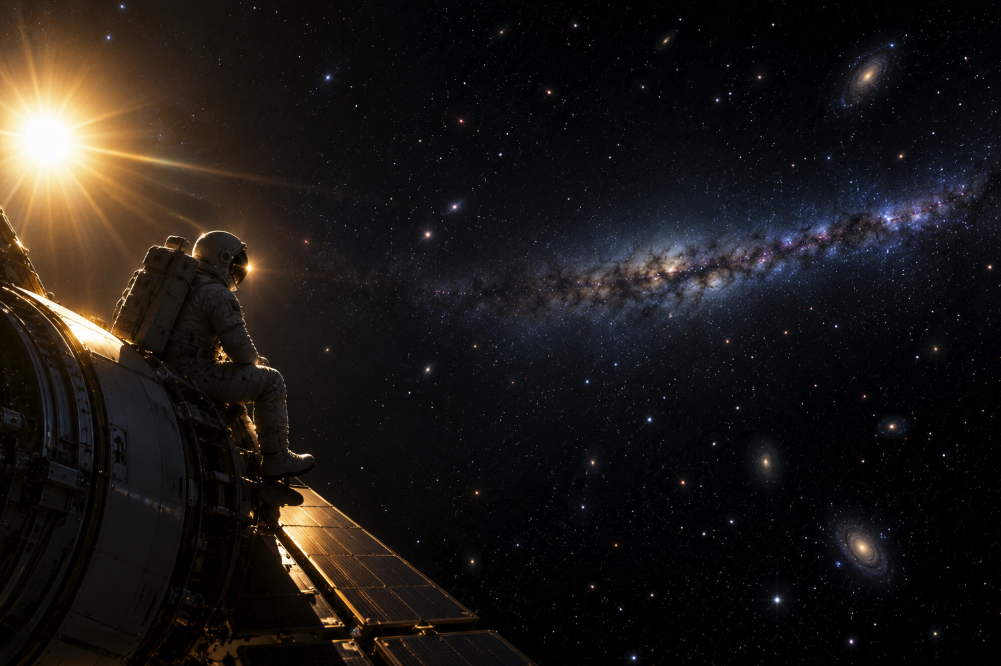
Imagine placing a metal object in sunlight in space. There is almost no surrounding air to warm it, but it absorbs electromagnetic radiation directly from the Sun. At the same time, it loses energy by emitting infrared radiation.
Its temperature settles according to the balance between the energy it absorbs and the energy it radiates away.
That is why spacecraft thermal engineering is so complicated. A sunlit surface can become very hot while a shaded surface on the same vehicle becomes extremely cold. Space itself has not changed temperature between the two sides; their exposure to radiation has.
On Earth, air and contact with surrounding material help redistribute heat through convection and conduction. In vacuum, those mechanisms largely disappear outside the spacecraft. Radiation becomes the dominant way heat crosses empty space.
This is also why the common movie image of a person instantly freezing solid after exposure to vacuum is misleading. Vacuum is not an icy fluid sucking heat out of the body through contact. An unprotected person in space faces rapidly life-threatening problems from lack of oxygen and pressure, but heat loss is governed by radiation and evaporation rather than by being immersed in −270 °C air.
Some parts of space are millions of degrees
There is another apparent contradiction. Astronomers routinely describe gas in space as having temperatures of thousands, millions or even tens of millions of kelvin.
How can space be both 2.7 K and millions of degrees?
The answer is density.
Temperature and total heat content are not the same thing. A very thin plasma can contain particles moving at enormous speeds, corresponding to a very high kinetic temperature, while having so few particles per cubic meter that it transfers relatively little heat to a solid object.
The hot gas in galaxy clusters, stellar coronae and other astrophysical plasmas is a good example. Individual particles may have tremendous kinetic energies, but the gas can be fantastically sparse compared with Earth's atmosphere.
Conversely, the 2.725 K CMB refers to the temperature of a radiation spectrum, not the kinetic temperature of every atom floating between galaxies.
There is therefore no contradiction. Different components of the same region of space can be assigned very different temperatures because scientists are describing different physical populations.
How close is 2.7 K to absolute zero?
Absolute zero is 0 kelvin, equivalent to −273.15 °C. It is the lower limit of the thermodynamic temperature scale.
A CMB temperature of about 2.725 K is therefore only 2.725 degrees above absolute zero. In Celsius terms, that is approximately −270.425 °C. The often quoted −270.45 °C is close enough for casual use, although the exact conversion depends on which measured CMB value is being rounded.
Yet the universe contains places effectively colder than the CMB under special circumstances. Expanding gas can cool below the background radiation temperature, and laboratory experiments on Earth can reach temperatures vastly closer to absolute zero than 2.7 K. The CMB is a cosmic radiation floor in an important sense, not a rule that forbids every physical system from becoming colder.
Would an object eventually reach 2.7 K in deep space?
In an idealized thought experiment, place an object unimaginably far from stars, galaxies and other significant energy sources. Give it no internal heat source. Let it radiate away energy for a very long time while remaining exposed to the CMB.
Its equilibrium temperature would approach the temperature set by the surrounding radiation field.
The real universe is messier. Starlight, infrared emission from dust, cosmic rays, gas, radioactive decay and other energy sources can all matter. Even intergalactic space is not perfectly empty, and a spacecraft contains electronics, batteries and other systems that generate their own heat.
This is why engineers cannot design a telescope by simply assuming “space temperature = 2.7 K.” ESA's Planck spacecraft, built specifically to study the CMB, needed an elaborate cooling system. Some detectors were cooled to around one-tenth of a kelvin — substantially colder than the cosmic background they were observing.
So the classic answer is both correct and incomplete. The universe is filled with relic microwave radiation corresponding to about 2.725 K, or −270.4 °C. That is the number people usually mean when they describe the temperature of deep space.
But space is not a giant refrigerator held uniformly at that temperature. A vacuum has almost no matter to conduct heat, radiation fields have their own temperatures, sparse gases can be extraordinarily hot, and real objects settle at temperatures determined by the energy they absorb and emit.
The coldest-looking emptiness in the universe can therefore sit beside blazing stars, million-degree plasma and sun-heated spacecraft. In space, asking “how cold?” is only the beginning. The next question is: the temperature of what?