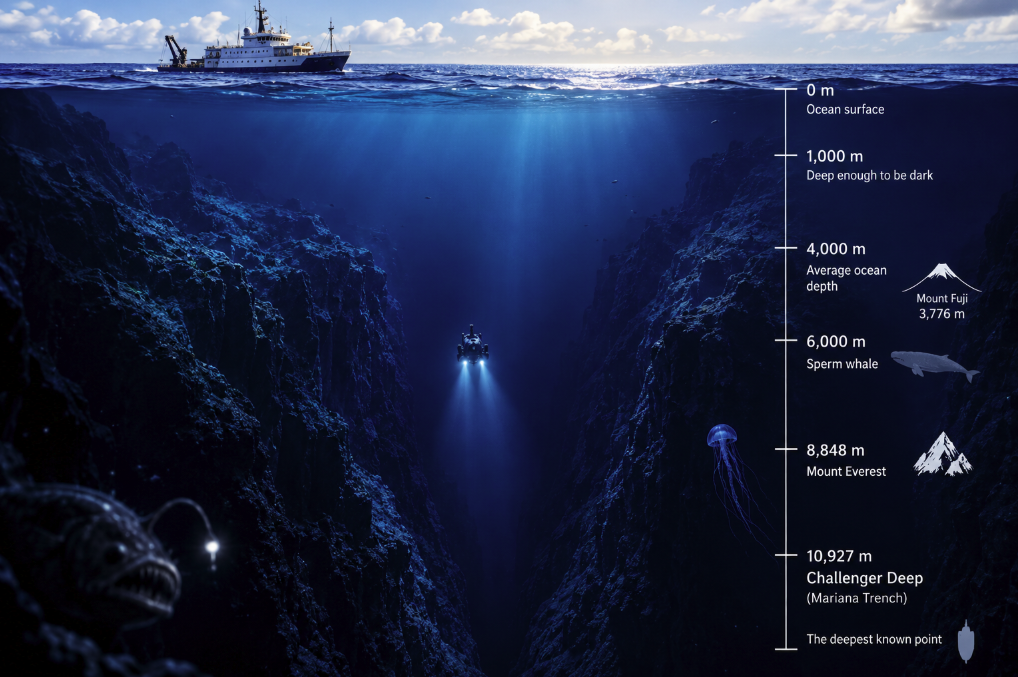
Stand on a beach and the ocean looks almost two-dimensional: a glittering surface stretching to the horizon. The reality underneath is closer to an inverted mountain world. Plains, ridges, volcanoes, canyons and trenches disappear beneath kilometers of water, and the deepest known point lies so far below sea level that Mount Everest could be placed inside it without reaching the surface.
So how deep is the ocean? The simplest answer is that its average depth is about 3,682 meters, or 12,080 feet. But averages conceal the extraordinary topography of the seafloor. In the western Pacific, Challenger Deep in the Mariana Trench descends to approximately 10,935 meters—35,876 feet, or about 6.8 miles—below mean sea level.
That number is difficult to visualize. A passenger jet commonly cruises at roughly the same order of altitude above your head as Challenger Deep lies beneath the waves. If Mount Everest, 8,849 meters high, were somehow lowered into Challenger Deep with its base at the deepest measured seafloor, its summit would still be more than two kilometers underwater.
A descent through an ocean most people never see
The first few meters beneath the surface belong to the familiar ocean of sunlight, reefs and swimmers. Light penetrates the upper water column, allowing photosynthesis and supporting the marine food webs most people picture when they imagine life at sea. But continue downward and the world changes rapidly.
By roughly 200 meters, you are entering what oceanographers commonly call the twilight or mesopelagic zone. Sunlight weakens until it is no longer sufficient for photosynthesis. Many animals here produce their own light through bioluminescence, creating flashes, lures and signals in an environment that human eyes would experience as increasingly dark.
At 1,000 meters, sunlight has effectively disappeared. The water is cold, and pressure has climbed enormously. Pressure in the ocean increases by roughly one atmosphere for every 10 meters of depth, so organisms in the abyss live under forces that would be catastrophic for an unprotected human body.
Continue past 4,000 meters and you reach the abyssal realm, an immense portion of the deep seafloor. The word “abyss” sounds like a bottomless void, but these regions include broad plains as well as mountains and other geological features. Even here, life persists: sea cucumbers, brittle stars, crustaceans, worms and microorganisms exploit food arriving from above or chemical energy associated with the seafloor.
Below about 6,000 meters begins the hadal zone, named after Hades, the underworld of Greek mythology. Hadal environments are concentrated mainly in deep ocean trenches. This is where the descent becomes truly extreme.
The Mariana Trench is not just a single hole
The Mariana Trench is a vast curved depression in the western Pacific near Guam and the Mariana Islands. It formed where one tectonic plate is forced beneath another in a subduction zone. Challenger Deep is the deepest known part of this trench and, according to current measurements, the deepest known seafloor on Earth.
A detailed 2021 study based on crewed submersible transects and pressure measurements reported the deepest observed seafloor at 10,935 meters, with an uncertainty of ±6 meters. NOAA now uses approximately 10,935 meters as its current figure for Challenger Deep. Different sources sometimes quote slightly different depths because measuring a place nearly 11 kilometers underwater is far more complicated than dropping a ruler from a boat.
Water pressure, temperature, salinity, local gravity, tides and the way acoustic signals travel through seawater all affect precision. Even defining depth requires a reference level. Modern expeditions combine multibeam sonar, highly calibrated pressure sensors and other instruments to refine measurements that earlier explorers could only estimate.
The official NOAA Ocean Exploration explanation of ocean depth gives both the 3,682-meter global average and the approximately 10,935-meter Challenger Deep figure.
Humans reached the bottom in 1960
The name Challenger Deep comes from HMS Challenger, the nineteenth-century British research vessel whose expedition helped establish modern oceanography. Its crew sounded the Mariana region in 1875, long before sonar and modern submersibles transformed deep-sea science.
The decisive human descent came on January 23, 1960. Swiss oceanographer Jacques Piccard and U.S. Navy Lieutenant Don Walsh climbed into the bathyscaphe Trieste and descended for hours into the Mariana Trench. They reached the bottom of Challenger Deep inside a pressure-resistant sphere, becoming the first people known to visit the deepest part of the ocean.
More than half a century later, filmmaker and explorer James Cameron made a solo descent in 2012 aboard the Deepsea Challenger. In 2019, explorer Victor Vescovo reached Challenger Deep in the submersible Limiting Factor, part of a new generation of vehicles capable of repeated dives to full ocean depth. Subsequent dives and surveys have helped scientists improve measurements of the trench.
The engineering challenge is immense. At Challenger Deep, pressure exceeds a thousand times normal atmospheric pressure at sea level. Every viewport, cable penetration, battery housing and structural component must tolerate conditions that relentlessly exploit weaknesses.
There is life almost all the way down
The deep ocean once seemed so hostile that scientists debated how much life could exist at great depth. Exploration has repeatedly overturned assumptions. Animals and microorganisms inhabit abyssal and hadal environments despite darkness, cold, scarce food and enormous pressure.
Fish, however, appear to encounter a physiological limit before the very bottom. NOAA notes that research suggests a boundary around 8,200 to 8,400 meters below which fish may be unable to survive because of the biochemical effects of pressure. The deepest confirmed living fish observations involve snailfish at depths above that boundary. Deeper still, invertebrates such as sea cucumbers and amphipod-like crustaceans can persist where no known fish does.
Life at these depths has adaptations that seem alien only because surface conditions are normal to us. Deep-sea organisms have cell membranes and proteins suited to pressure, slow metabolisms adapted to limited energy and sensory systems designed for darkness. Some depend ultimately on organic material sinking from the productive surface ocean; elsewhere, communities around hydrothermal vents use chemical energy rather than sunlight as the foundation of their food webs.
We still do not have a perfect map of the bottom
One of the strangest facts about ocean depth is that the planet's largest physical landscape remains incompletely mapped at high resolution. Satellites can infer broad seafloor features because underwater mountains and trenches subtly affect Earth's gravity and therefore the height of the sea surface above them. But satellite-derived maps cannot reveal the bottom with the detail produced by ships using multibeam sonar.
NOAA reported that only about 26 percent of Earth's seafloor had been mapped at high resolution as of June 2024. International projects are steadily increasing that coverage, but surveying hundreds of millions of square kilometers from ships takes time. NOAA estimates that a single vessel working alone would require on the order of a millennium to map the entire ocean at all depths.
This does not mean scientists have no idea what most of the seafloor looks like. Global satellite-based maps provide a broad picture. The missing ingredient is detailed, direct mapping comparable to replacing a blurry planetary sketch with high-resolution topography.
Could there be somewhere deeper than Challenger Deep?
In principle, improved mapping could reveal an overlooked depression. Science rarely declares that future measurements are impossible. In practice, however, the major trenches are known, and Challenger Deep has been repeatedly surveyed with modern instruments. It remains the deepest known point in the world ocean.
The more likely changes are refinements of meters rather than discoveries of an entirely unknown trench several kilometers deeper. This is why responsible sources give approximate depths and uncertainties rather than pretending that a moving ocean, irregular seabed and complex measurement process can be reduced to one eternally exact number.
That uncertainty makes the ocean more interesting, not less. We know enough to say that its average depth is about 3.7 kilometers and that its deepest known floor lies nearly 11 kilometers down. Yet between those numbers is the largest habitat on Earth, much of it never seen directly by human eyes.
The surface is the part of the ocean that happens to touch our world. Beneath it is another geography entirely—one whose deepest valleys are taller in vertical scale than Earth's greatest mountains and whose exploration is still, in a very literal sense, only scratching the bottom.