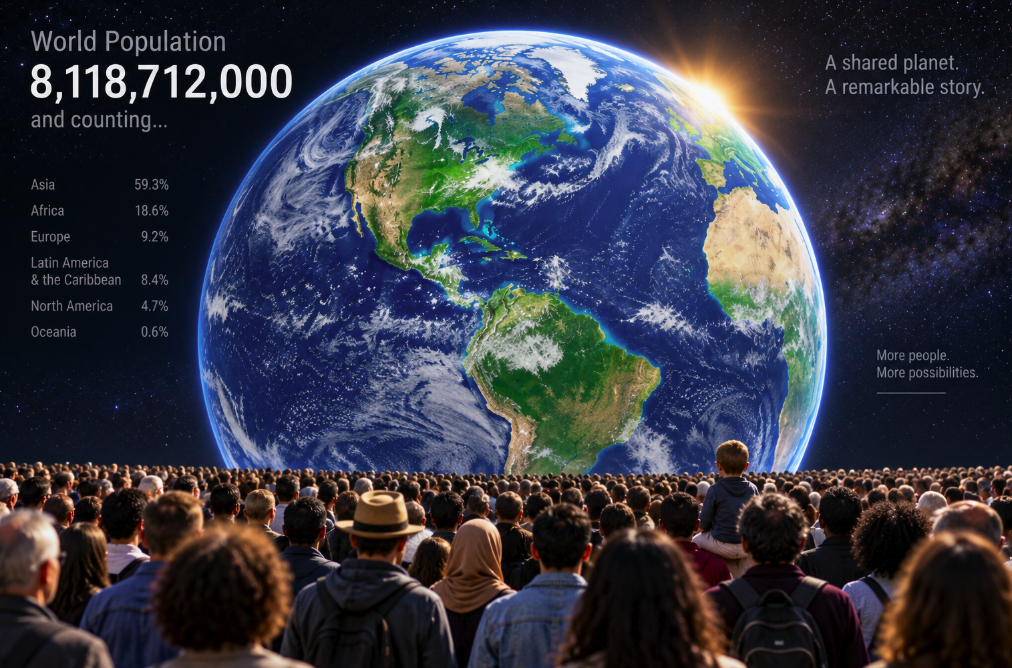
Somewhere on Earth, while you read this sentence, babies are being born and people are dying. Others are crossing national borders, changing the population of one country without changing the population of the planet at all. It makes the world's population seem like something that ought to exist as a gigantic live counter: one number, ticking upward every second.
But there is a surprising problem with the question “How many people are on Earth right now?” Nobody knows the exact answer.
What demographers can provide is an extremely sophisticated estimate. The United Nations estimated the world population at about 8.2 billion in 2024 and projects it to reach roughly 8.5 billion in 2030. That places humanity comfortably above 8.2 billion in 2026, but any number displayed down to the last individual is not a literal head count. It is a mathematical model.
There is no live census of humanity
Population websites often display counters changing every fraction of a second. The effect is compelling: 8,xxx,xxx,xxx people, then one more, then another. It looks as if a global computer has been notified of every birth and death.
Nothing like that exists.
Even wealthy countries with sophisticated civil-registration systems do not instantly feed every birth and death into a single worldwide database. In many parts of the world, registration is delayed or incomplete. National censuses are generally conducted only periodically, and their results require months or years of processing. Migration is particularly difficult to measure because people can move temporarily, cross borders repeatedly or live somewhere without immediately appearing in administrative statistics.
The United Nations Population Division therefore builds estimates from censuses, birth and death registration, surveys and other demographic evidence. Its World Population Prospects 2024 is the twenty-eighth edition of this global demographic project and covers 237 countries or areas. The underlying assessment draws on thousands of censuses and nationally representative surveys.
A “live” population clock takes estimates like these and interpolates between them using assumptions about births and deaths. The digits after the first few significant figures create an impression of extraordinary precision, but they should be understood as a visualization of demographic change rather than the exact number of living humans at that instant.
Eight billion arrived only recently
For most of human history, the idea of billions of people sharing the planet would have been unimaginable. Population growth was constrained by high infant mortality, infectious disease, famine and comparatively short life expectancy. Growth accelerated dramatically after improvements in agriculture, sanitation, medicine and public health reduced death rates in many societies.
The United Nations designated 15 November 2022 as the day humanity reached 8 billion. That date was itself a demographic milestone based on estimates, not the moment an official counter registered person number 8,000,000,000.
The speed of growth is now slowing. According to the UN, humanity took about 12 years to grow from 7 billion to 8 billion, but reaching 9 billion is expected to take roughly 15 years, until around 2037. The reason is one of the most important demographic changes of the modern era: people are having fewer children on average.
The UN reports a global fertility rate of roughly 2.25 births per woman in 2024, about one child fewer than a generation earlier. In many countries fertility is already below the level needed to maintain population size in the long term without migration.
The world is growing, but not everywhere
A single global number hides enormous regional differences. Some countries still have young populations and relatively high fertility, producing rapid natural increase. Others are aging and already shrinking.
The UN's World Population Prospects 2024 groups countries according to when their populations are expected to peak. One in four people already lives in a country whose population has passed its maximum size. In another group of countries, population is expected to peak between 2025 and 2054. Elsewhere — particularly in parts of sub-Saharan Africa — substantial growth is expected to continue for decades.
This redistribution matters as much as the global total. A world of 9 billion people will not simply be today's population with another billion people distributed evenly across the map. The geographic center of population growth is shifting, age structures are changing, and some societies will be dealing with rapid expansion while others confront workforce decline and unprecedented numbers of older people.
India has already surpassed China as the world's most populous country according to UN estimates. China, meanwhile, belongs to the group of countries whose populations have already peaked. Nigeria is projected to continue growing strongly. These contrasting trajectories illustrate why “world population growth” is not one universal experience.
Will humanity keep growing forever?
Older projections often encouraged the idea of a population curve climbing indefinitely. The latest UN assessment tells a different story.
In its 2024 revision, the United Nations projects that the world population will continue increasing for another five or six decades, reaching approximately 10.3 billion in the mid-2080s. It is then expected to decline slightly, to around 10.2 billion by 2100. The UN estimates an 80% probability that global population will peak during this century.
That forecast is not destiny. Population projections depend on future fertility, mortality and migration, all of which can change. Small differences in average family size, compounded over decades and billions of people, can produce large differences in the eventual total. Long-range demographic projections therefore come with uncertainty ranges rather than a single guaranteed future.
The shift is nevertheless striking. Only a decade ago, the UN assessed the probability of world population growth ending during the twenty-first century at around 30%. Faster-than-expected fertility declines in some populous countries have substantially changed the outlook.
The most interesting number may not be the total
Knowing whether there are 8.2, 8.3 or eventually 9 billion people is useful, but population size alone says surprisingly little about how humanity lives. Two populations of identical size can have radically different effects on resources, cities and the environment depending on age, income, technology, consumption and geographic distribution.
Age structure is becoming especially important. The UN expects people aged 65 and older eventually to outnumber children under 18 worldwide, while the number of people aged 80 and above is projected to exceed the number of infants by the mid-2030s. Humanity is not merely becoming more numerous; it is becoming older.
That changes questions about schools, housing, pensions, health care, labor markets and migration. In rapidly growing countries, governments may need to create enormous numbers of jobs and expand education and infrastructure. In shrinking countries, the challenge can be supporting an older population with a smaller working-age generation.
So how many people are on Earth right now? More than 8.2 billion, according to the demographic trajectory established by the latest United Nations estimates, with the total still rising toward 8.5 billion around 2030. But the last digit on any live counter is an illusion of precision.
There is no turnstile at the entrance to humanity. The world's population is reconstructed from billions of lives through censuses, registrations, surveys and statistical models. The number is constantly changing — and our best answer is always an estimate of a planet that refuses to stand still long enough to be counted.