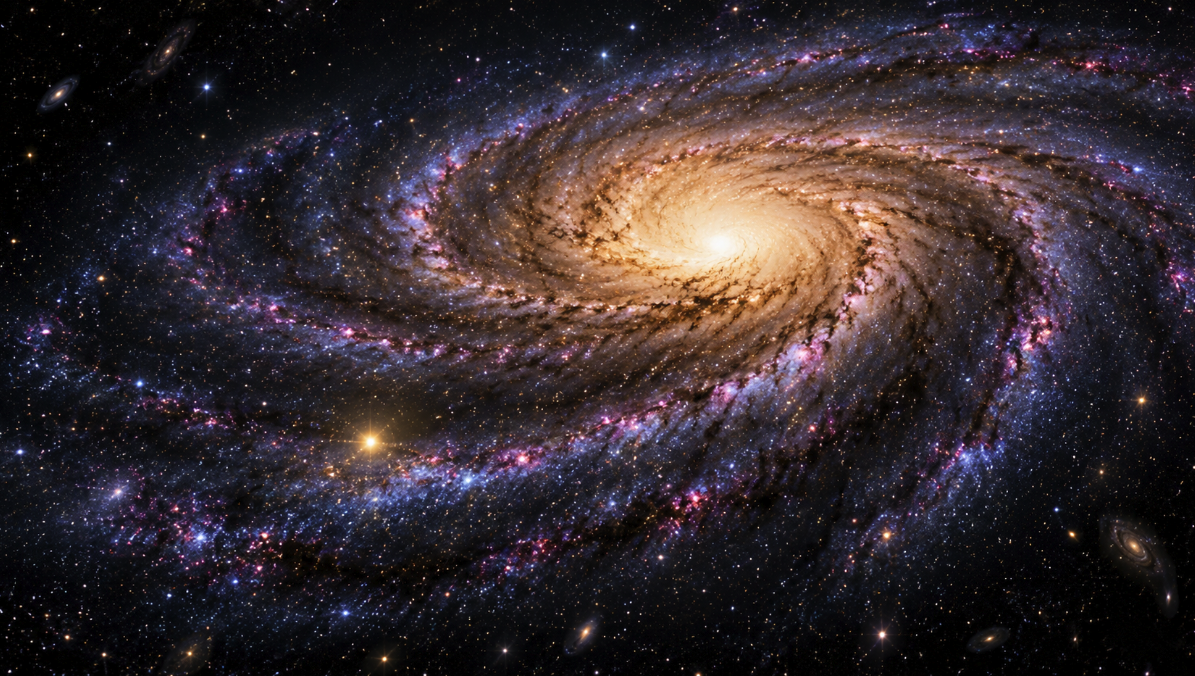
Look up from a truly dark place and the Milky Way appears as a pale river of light crossing the sky. That glow is produced by stars so numerous and distant that most cannot be distinguished individually with the naked eye. It raises one of astronomy's simplest-sounding questions: how many stars are actually in our galaxy?
The answer is surprisingly imprecise. NASA gives a widely cited estimate of roughly 100 billion to 400 billion stars in the Milky Way. Other scientific and educational sources often use figures around 100 billion or 200 billion. That enormous range is not because astronomers have neglected to count. It reflects a basic difficulty: we are trying to inventory a vast, dusty galaxy while living inside it.
There is no viewpoint from which we can photograph the entire Milky Way and count every point of light. Instead, astronomers estimate the stellar population using measurements of mass, brightness, stellar distributions and surveys of representative regions.
Why can’t we simply count the stars?
If Earth were floating far above the Milky Way, counting would still be difficult, but at least we could see the galaxy as a whole. Our actual location is embedded within its disk, roughly tens of thousands of light-years from the center. We look through the Galaxy rather than down upon it.
That creates several problems at once. Stars overlap along our line of sight. Dense regions near the galactic center become extraordinarily crowded. Huge clouds of interstellar dust absorb visible light and hide stars behind them. And the faintest stars are extremely difficult to detect across large distances.
NASA's overview of the Milky Way gives the broad 100–400 billion estimate and places the Galaxy at about 100,000 light-years across. NASA Goddard's more detailed discussion of why the star count is uncertain explains that there simply is no firm, direct census of every star.
Instead, astronomers can estimate how much stellar mass the Milky Way contains and then ask how many stars would be needed to produce that mass. The difficulty moves to another question: what should count as the mass of an “average” star?
The Sun is not a typical star
Using the Sun as the average would seem reasonable. After all, it is the star we know best. But the Milky Way contains huge numbers of stars much less massive than the Sun.
Red dwarfs are small, cool and faint, and they are believed to be the most common class of star in the Galaxy. Because each one contributes relatively little mass and light, a population containing many red dwarfs can hide an enormous number of stars inside a modest total stellar mass.
This is why changing assumptions about the stellar population can shift the final estimate by tens or hundreds of billions. NASA Goddard compares the problem to estimating the number of coins in a mixed bag from its total weight. If the bag mostly contains heavy quarters, there will be fewer coins. If it contains many light pennies, there will be far more — even if the bag weighs exactly the same.
A galaxy is vastly more complicated than a bag of coins. Stars range from objects near the minimum mass required for sustained hydrogen fusion to rare giants dozens of times the Sun's mass. Some are solitary; many live in binary or multiple-star systems. Stellar populations also differ between the disk, central bulge and halo.
Gaia has mapped billions — but not hundreds of billions
The most ambitious stellar census ever attempted has come from the European Space Agency's Gaia mission. Gaia repeatedly measured the positions, motions, brightness and other properties of an extraordinary sample of Milky Way stars.
ESA says Gaia observed about two billion stars. That number is difficult to comprehend on its own, yet it is still only a small fraction of the estimated galactic population.
Gaia's importance lies not in counting every star but in measuring a huge, well-characterized sample with exceptional precision. Those data allow astronomers to reconstruct the structure and history of the Milky Way, study how stars move through it and improve models of the Galaxy's stellar populations.
The challenge becomes especially vivid near the galactic center. In June 2026, ESA's Euclid mission released a visible-light image of the Milky Way's crowded central region containing more than 60 million stars in a single enormous view. Even that spectacular image covers only part of one region of our galaxy.
Dust hides a large part of the Galaxy
The dark streaks visible across photographs of the Milky Way are not empty holes. They are clouds of dust and gas that block visible light from stars behind them.
This is one reason astronomers observe the Galaxy at many wavelengths. Infrared light can penetrate dust more effectively than visible light, revealing stars that optical surveys struggle to see. Radio observations map gas and trace galactic structure through another window entirely. X-ray and gamma-ray observatories reveal energetic objects invisible to ordinary telescopes.
Combining these views produces a much richer map, but it still does not turn the Milky Way into a simple catalog in which every star receives one tick mark.
Some stars are simply too faint. Others are hidden in dense regions. Very close pairs may initially appear as one source. The Galaxy also evolves: stars are being born while others die, so the population is not literally frozen at one permanent number.
Why dark matter does not count as hidden stars
A separate complication is the Milky Way's total mass. Astronomers know from the motions of stars, star clusters and other tracers that the Galaxy contains far more gravitational mass than can be explained by visible stars and gas alone.
Much of that mass is attributed to dark matter. NASA's Hubble material, for example, discusses estimates placing the Milky Way's total mass around a trillion or more solar masses, while noting that ordinary stars represent only a fraction of the total.
That means astronomers cannot simply measure the Galaxy's gravitational mass and divide it by the mass of an average star. They first need models separating the contribution of stars, gas, the central black hole and the much larger dark-matter halo.
The “number of stars” question is therefore entangled with some of the biggest problems in galactic astronomy: how matter is distributed, how stars formed over billions of years and how much unseen material surrounds the luminous disk.
How few of those stars can we actually see?
The contrast with the night sky is astonishing. Under excellent dark conditions, a human observer can see only a few thousand stars at one time with the unaided eye. Over the entire celestial sphere, the number bright enough to be visible to human vision is still only a tiny fraction of the Galaxy's stellar population.
Every individual star visible in the ordinary night sky belongs to the Milky Way. The hazy band behind them is the combined light of countless more distant stars packed along the plane of the galactic disk.
If the Milky Way contains 100 billion stars, then the naked-eye sky reveals far less than one millionth of one percent of them individually. If the true total lies closer to 400 billion, the fraction is smaller still.
And our Sun is just one member of that population — neither at the center nor at the edge, but orbiting within the Galaxy's disk.
So is it 100 billion or 400 billion?
For a general answer, 100–400 billion remains a useful way to express the uncertainty. It should not be read as though astronomers counted 100 billion stars and then misplaced another 300 billion. It is the output of different models and assumptions applied to a galaxy that is exceptionally difficult to survey completely from the inside.
Some NASA resources use “at least 100 billion,” while others cite approximately 200 billion or the broader 100–400 billion range. These figures are best understood as estimates at different levels of simplification, not competing exact measurements.
Future surveys will improve the census. Better infrared observations can see through dust, deeper surveys can find fainter stars, and Gaia's measurements allow increasingly sophisticated models of the Milky Way's structure. The range may narrow as astronomers understand the Galaxy's low-mass stellar population more precisely.
But the uncertainty is part of what makes the question interesting. Humanity has mapped billions of stars and can measure the motions of objects thousands of light-years away, yet we still cannot say exactly how many suns share our own galaxy.
Somewhere between roughly 100 billion and 400 billion is the current answer — and one of them is the star lighting the page in front of you.