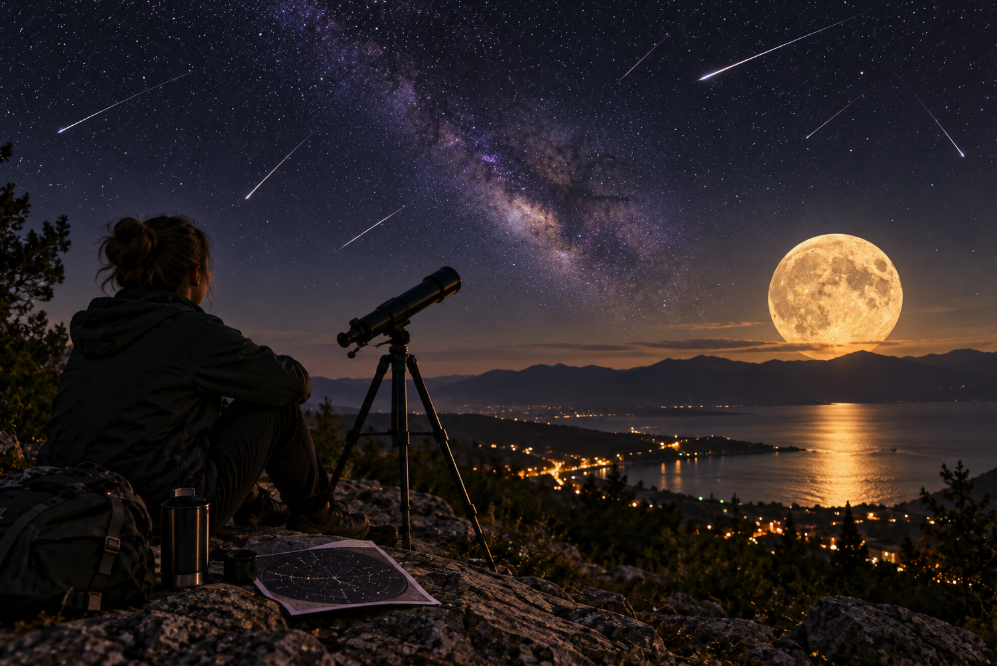
Astronomy has a reputation for expensive telescopes, complicated star charts and distant objects visible only through professional instruments. Yet some of the sky's most memorable events require nothing more sophisticated than a pair of eyes, enough darkness and the patience to look up.
A meteor can cross the sky in less time than it takes to point at it. The Moon can appear enormous as it rises behind a distant building. A familiar constellation can disappear almost completely under urban light and then reappear in astonishing detail after a short drive into the countryside. Much of naked-eye astronomy is therefore not about magnification. It is about understanding what you are seeing — and arranging the conditions so that the sky has a chance to reveal it.
A supermoon is real, but the name is not very scientific
The Moon does not travel around Earth in a perfect circle. Its orbit is elliptical, so its distance changes continuously. NASA gives an average distance of roughly 363,300 kilometres at perigee, the closer part of the orbit, and about 405,500 kilometres at apogee, the farther part. When a full Moon occurs near perigee, it is popularly called a supermoon.
The term sounds more precise than it is. NASA notes that “supermoon” is not an official astronomical term; it is generally used for a full Moon occurring within roughly the closest 10 percent of its orbit to Earth. Astronomers can describe the geometry more precisely, but “supermoon” has proved much better at surviving in headlines.
The effect is measurable. At the closest extreme, NASA says a full Moon can appear up to about 14 percent larger in diameter and 30 percent brighter than the faintest full Moon occurring near apogee. Those figures sound dramatic, but the visual experience is subtler. Without two photographs side by side, most observers will struggle to recognize a modest change in the Moon's apparent diameter from memory.
There is another reason photographs of giant moons can be deceptive. A telephoto lens can frame the Moon behind a distant landmark, making it appear enormous relative to a building, mountain or person. The famous “Moon illusion” also makes a Moon near the horizon seem larger to human perception even though its angular size has not suddenly expanded because it is close to the landscape.
A supermoon is therefore not a Moon that balloons in size for one night. It is a normal consequence of orbital geometry, amplified by perspective, photography and our own perception.
Why meteor showers arrive on schedule
Meteor showers seem chaotic because individual streaks appear without warning. On a larger scale, however, many showers are remarkably predictable.
Comets shed dust and small particles as they travel through the Solar System. When Earth's orbit carries our planet through one of these debris streams, particles enter the atmosphere at enormous speed. They heat the surrounding air and produce the brief luminous trails we call meteors. The object does not have to be large: tiny particles can create surprisingly conspicuous flashes.
Because Earth returns to roughly the same region of its orbit each year, major showers recur seasonally. The Perseids arrive in August as Earth encounters debris associated with comet 109P/Swift-Tuttle. The Eta Aquariids and Orionids are both connected with Halley's Comet. The Geminids are unusual because their parent body is the asteroid-like object 3200 Phaethon rather than a conventional active comet.
The names describe perspective rather than origin. Trace the paths of Perseid meteors backward and they appear to radiate from the constellation Perseus. That point is called the radiant. The particles are not actually being fired out of the constellation; it is a perspective effect, rather like parallel railway tracks appearing to converge in the distance.
This also explains why staring directly at the radiant is not necessary. NASA's 2026 Perseid guidance reminded observers that meteors can flash across any part of the sky. A broad, unobstructed view is often more valuable than precisely locating one constellation.
The number “meteors per hour” is not a promise
Announcements of a meteor shower often come with impressive hourly rates. The Geminids, for example, can produce very high rates under ideal circumstances. But the quoted number should not be read as a guarantee that one person standing in a city park will count exactly that many.
Meteor rates depend on dark skies, the altitude of the radiant, weather, the phase and position of the Moon, the observer's latitude and local obstructions. Light pollution can erase the faint meteors that make up much of a shower's activity. Bright moonlight can do the same thing.
This is why a theoretically strong shower can feel disappointing from a brightly illuminated city and spectacular from a rural location on the same night. The astronomical event has not changed; the observer's threshold for seeing it has.
Your eyes need time to become astronomical instruments
Human night vision is surprisingly capable, but it does not switch on instantly. NASA's meteor-watching advice repeatedly recommends spending roughly 20 to 30 minutes in darkness so the eyes can adapt. Looking at a bright phone screen during that period works against the process.
The best equipment for many meteor showers is consequently a reclining chair, warm clothing and patience. Find a safe location far from streetlights, give yourself a wide view of the sky and avoid staring at one tiny patch. Meteors are fleeting; covering more sky increases the chance of catching one.
A telescope can actually make meteor watching worse. Its narrow field of view is excellent for examining the Moon or a planet but poorly suited to unpredictable streaks that can appear almost anywhere overhead. For a meteor shower, unaided eyes are often the superior instrument.
The Moon creates the opposite situation. It is bright, large and full of visible structure. Binoculars can reveal craters and dramatic terrain, especially when the Moon is not full. Near the boundary between lunar day and night — the terminator — low-angle sunlight casts shadows that make surface relief easier to perceive.
Darkness matters more than most beginners expect
The single biggest improvement in casual stargazing may be geographical rather than technological: move away from artificial light. A modest pair of binoculars under a genuinely dark sky can reveal more wonder than a much more expensive instrument surrounded by glare.
Artificial skyglow scatters through the atmosphere and raises the brightness of the background sky. Faint stars lose contrast. The Milky Way, obvious under dark conditions, can become invisible. Meteors disappear unless they are unusually bright.
Weather forecasts alone are not enough when planning an observing night. Cloud cover matters, but so do atmospheric transparency, haze and the Moon. A nearly full Moon can function like a natural floodlight. For faint targets and meteor showers, checking the lunar phase and the time of moonrise or moonset can be almost as important as checking for clouds.
Photographing a meteor is an exercise in probability
Astrophotography changes the rules because a camera can collect light over time. For meteors, however, it cannot know where the next streak will appear. The solution is to maximize the amount of sky being recorded and keep taking exposures.
NASA's meteor photography guide recommends a tripod, a wide-angle lens, manual focus and a shutter release or timer to avoid camera shake. A wide lens is particularly useful because it covers more sky, increasing the probability that a meteor crosses the frame.
Focusing at night deserves special attention. Autofocus can struggle when presented with little more than tiny points of light. A practical approach is to use manual focus, magnify a bright star in live view and make small adjustments until the star is as sharp as possible. Test photographs are more reliable than simply turning the focus ring to the infinity symbol and assuming it is correct.
Exposure settings depend on the camera, lens, sky brightness and desired result, so there is no universal combination. Long exposures collect more light but also allow Earth's rotation to stretch stars into trails. Higher ISO can reveal fainter details but increases noise. Fast lenses gather more light. The useful skill is not memorizing one magic setting but learning to balance these variables for a particular sky.
Moon photography is almost the reverse. A full Moon is illuminated by direct sunlight and is much brighter than the surrounding night. Exposures suitable for stars will usually turn it into a featureless white disc. Photographing lunar surface detail therefore calls for much shorter exposures than photographing the Milky Way or meteors.
The sky rewards preparation, not expensive gear
The most useful observing routine is simple: know what event is happening, check when it is visible from your location, inspect the weather and lunar conditions, find a safe dark place and arrive early enough for your eyes to adapt. For photography, add a stable tripod, spare battery power and enough time to experiment.
It also helps to recalibrate expectations. A supermoon will not fill half the sky. A meteor shower does not resemble science-fiction rain. The Milky Way will not look to the naked eye exactly like a heavily processed long-exposure photograph. The real phenomena are often subtler than the images that advertise them.
That subtlety is part of their appeal. The streak from a grain of cometary debris may last a second, yet the particle may have been travelling through the Solar System for generations before Earth intercepted it. The slightly oversized full Moon is a visible clue to the geometry of an orbit hundreds of thousands of kilometres across. Even the gradual appearance of faint stars after twenty minutes in darkness is a small demonstration of human physiology.
Good stargazing begins when the sky stops being scenery and becomes evidence. Once you know what to look for, a clear night can reveal orbital mechanics, comet debris, atmospheric physics and the motion of Earth without a laboratory — and often without a telescope.