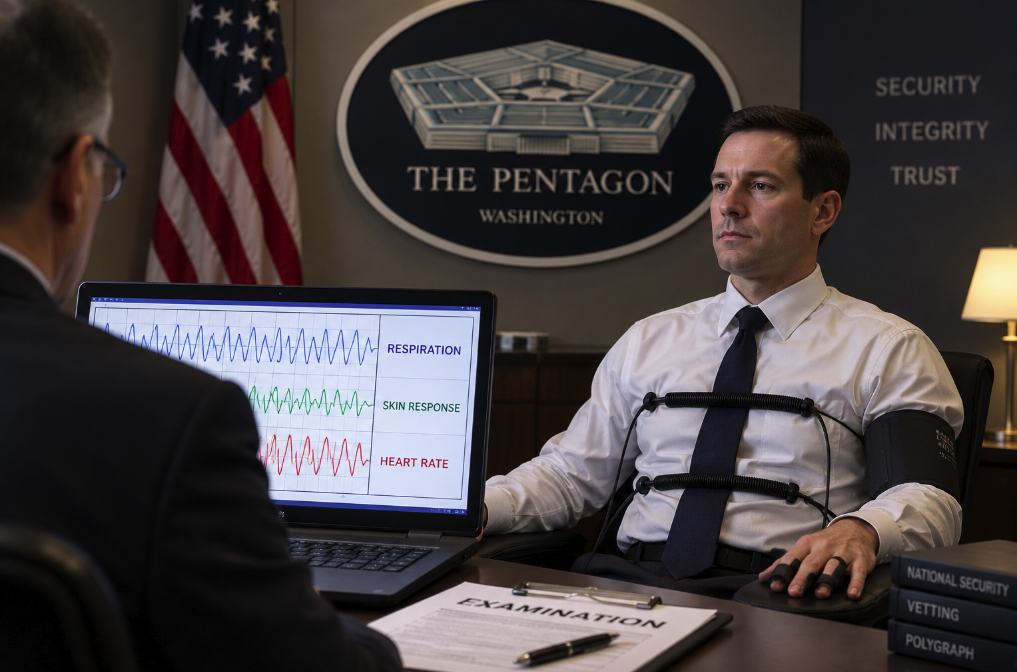
Some of the most senior people inside the U.S. military recently found themselves in an unusual position: sitting in a room, connected to physiological sensors, answering questions while investigators searched for the source of leaks from the Pentagon.
According to reporting by The New York Times and CBS News, roughly 50 military and civilian members of the Joint Staff underwent polygraph examinations in August 2026 as part of a sweeping investigation into unauthorized disclosures to journalists. The reported inquiry followed news stories containing sensitive information, including details about U.S. weapons stockpiles during the war with Iran.
The scale attracted immediate attention. Polygraphs have long existed inside the American national-security system, particularly in intelligence, counterintelligence and highly sensitive access programs. What made this episode remarkable was the reported concentration of examinations among personnel working at exceptionally senior levels of the Pentagon.
It also revived an old question that follows the polygraph wherever it goes: what does a “lie detector” actually detect?
The answer is less straightforward than the machine’s nickname suggests.
The leak hunt inside the Joint Staff
The Joint Staff supports the Joint Chiefs of Staff, the senior uniformed military leadership that advises the president, secretary of defense and National Security Council. Its personnel routinely work with highly sensitive operational information.
The 2026 polygraph effort was reported as part of a broader attempt to identify unauthorized disclosures from inside the Defense Department. CBS News reported that some high-ranking military officials were examined after classified details concerning sophisticated U.S. weapons inventories appeared in the press.
The New York Times described approximately 50 members of the Joint Staff as having been subjected to polygraph testing, an unusually broad inquiry at that level of military leadership.
The examinations took place against a larger backdrop of Pentagon concern over leaks. In 2025, The Washington Post had reported on plans for broader use of nondisclosure agreements and random polygraph examinations among thousands of military, civilian and contractor personnel working in the Office of the Secretary of Defense and Joint Staff.
Those developments should not be conflated automatically. A proposal for random screening across a workforce and a targeted investigation into specific unauthorized disclosures are different uses of polygraph examinations. But together they show how prominently the technology has re-entered debates over information security inside the Pentagon.
A polygraph does not directly detect a lie
The popular term “lie detector” creates a misleading mental picture. A polygraph cannot look inside a person’s mind and identify whether a statement is true or false.
Instead, the instrument records physiological activity while an examiner asks a structured series of questions. Depending on the equipment and examination technique, measurements commonly include respiration, cardiovascular activity and changes in the electrical properties of the skin associated with sweating.
The theory is that psychologically significant questions can produce measurable physiological responses. An examiner compares patterns across different types of questions and applies a standardized scoring method.
But the machine measures the body’s reactions, not deception itself.
Anxiety, fear, attention, surprise and other psychological processes can also influence physiology. That distinction is one reason polygraph validity has been debated for decades and why results are treated differently across legal, scientific and national-security contexts.
Inside a security investigation, however, the examination can serve purposes beyond producing a simple pass-or-fail score. The pre-test interview, the questions themselves and follow-up discussion can elicit admissions, clarify inconsistencies or generate information investigators can check independently.
In that sense, a polygraph examination is both an instrument-based procedure and an investigative interview.
The Pentagon has used polygraphs for decades
The 2026 Joint Staff investigation did not suddenly create Pentagon authority to use polygraphs.
Congress established a statutory framework for a Department of Defense counterintelligence polygraph program decades ago. Current 10 U.S.C. §1564a authorizes the secretary of defense to administer counterintelligence polygraph examinations to specified categories of people whose duties involve particularly sensitive information or activities. Covered categories can include military and civilian Defense Department personnel, defense-contractor personnel, people assigned to the department and applicants for certain positions.
Department policy is further defined by DoD Instruction 5210.91, which governs polygraph and other credibility-assessment procedures.
The instruction provides for several contexts in which examinations may be used, including personnel security screening and specific investigations. It requires approved components operating personnel security screening programs to establish written procedures governing which positions can be subject to initial, periodic or randomly selected examinations.
It also requires quality-control review, rules for handling admissions and unresolved examinations, provisions for postponing testing when a person is medically, psychologically or emotionally unfit, and audio or video recording of personnel security screening examinations.
Those details matter because the cinematic image of a detective improvising questions while watching a needle jump bears little resemblance to the regulated federal process.
What are Pentagon examiners actually asking about?
The scope depends on why the examination is being conducted.
A counterintelligence-scope polygraph generally focuses on national-security threats rather than every aspect of a person’s private life. DoD instructions identify relevant areas such as involvement with foreign intelligence services or espionage, sabotage, terrorism, unauthorized handling or disclosure of classified information and certain undisclosed foreign contacts.
A specific-issue examination can be narrower. If investigators are trying to determine who disclosed a particular classified document or sensitive operational fact, questions can be structured around the incident under investigation.
That is conceptually different from routine screening associated with access to highly sensitive programs. Screening asks whether a person presents specified security concerns. A leak investigation starts with an event that has already happened and attempts to identify responsibility or obtain information about it.
Public reporting on the 2026 Joint Staff inquiry has not provided a complete transcript of the questions asked, nor has the Pentagon publicly released individual examination results in the material reviewed for this article. Claims about exactly who “passed,” “failed” or confessed should therefore be treated cautiously unless supported by official records or reliable reporting.
Who trains federal polygraph examiners?
The federal government maintains a specialized institution for this work: the National Center for Credibility Assessment, or NCCA.
Part of the Defense Counterintelligence and Security Agency, the NCCA provides polygraph and credibility-assessment education, technical support, research and quality oversight. It trains federal examiners, conducts audits of polygraph programs and advises Defense and intelligence officials on technical standards.
The institution traces its origins to the U.S. Army Polygraph School established in 1951. It later became the Department of Defense Polygraph Institute before evolving into the modern NCCA.
Its existence illustrates how deeply institutionalized polygraph use is in parts of the American security apparatus. This is not a technology pulled from a police drama when a leak occurs; the federal government maintains an entire training, standards and oversight system around it.
Can someone lose a clearance because of a polygraph?
A polygraph examination can have serious professional consequences, but the process is more complicated than a machine flashing “DECEPTION” and immediately revoking someone’s clearance.
DoD policy requires procedures for adjudicating refusals, terminated examinations and unresolved results. Information admitted during an examination can also generate investigative or security referrals.
For personnel whose access to certain information is conditioned on completing authorized screening, refusing an examination can affect eligibility for that access or assignment. The precise consequence depends on the person’s position, the legal authority involved and the circumstances of the examination.
Crucially, a physiological response by itself is not the same thing as independently proven misconduct. Investigators can use admissions and leads from an examination to seek documentary, electronic or testimonial evidence.
This is particularly important in a leak investigation. Modern classified-information inquiries can involve access logs, email records, messaging systems, document histories, printer records and other digital evidence. A polygraph may become one component of a much larger investigative picture.
Why polygraphs remain controversial
Polygraphs occupy an unusual position in American institutions. They are restricted or excluded in many contexts, yet they remain established tools in national-security vetting and investigations.
The Employee Polygraph Protection Act generally prevents most private employers from using lie-detector tests, while providing exemptions for government and certain security-related situations. Courts have also often been skeptical about admitting polygraph evidence because of disputes over reliability and the risk that juries might give a scientific-looking result more weight than it deserves.
National-security agencies operate under a different logic. Their task is not always to prove a crime beyond a reasonable doubt. They may instead be deciding whether a person should retain access to extraordinarily sensitive information, whether a security concern requires investigation or whether an unexplained inconsistency can be resolved.
Supporters of polygraph programs therefore often emphasize their value as part of a broader screening and interviewing process rather than claiming that the instrument is infallible.
Critics respond that false positives can place innocent people under suspicion, that physiological reactions are not uniquely linked to lying and that large-scale testing can create fear without reliably identifying a culprit.
Those concerns become especially consequential when polygraphs move from specialized intelligence programs into a highly visible hunt for leaks among senior military personnel.
Why the 2026 screenings matter
The Pentagon has always had a difficult relationship with secrecy. Military operations require genuine protection of information: premature disclosure can reveal capabilities, intelligence methods, vulnerabilities or operational plans and can put lives at risk.
At the same time, the Pentagon operates inside a democracy where journalists report on military decisions, congressional oversight depends on access to information and public debate often relies on officials willing to describe what is happening inside government.
Unauthorized disclosure of classified information can be a serious security violation. But not every piece of nonpublic information is classified, and disputes over leaks can become entangled with political efforts to control embarrassing reporting. That is why the scope, legal basis and proportionality of leak investigations matter.
The reported decision to polygraph roughly 50 members of the Joint Staff is significant precisely because these are not ordinary workplace interviews. The Joint Staff sits near the center of U.S. military planning, and subjecting a large group of its personnel to credibility examinations signals the seriousness — and breadth — of the government’s search for a source.
It also demonstrates something paradoxical about the polygraph itself.
The technology is more than a century old. Its fundamental measurements are familiar: breathing, cardiovascular activity, skin conductance. Its scientific limitations have been debated for generations. Yet in an era of encrypted communications, digital forensics, artificial intelligence and vast electronic surveillance capabilities, the U.S. national-security establishment still sometimes returns to a remarkably human method of investigation.
Put a person in a quiet room. Ask a question. Measure what the body does next.
The machine cannot read a mind. What investigators believe they can learn from the conversation surrounding it remains powerful enough that, in 2026, even some of the people working near the highest levels of the Pentagon were reportedly asked to take the test.