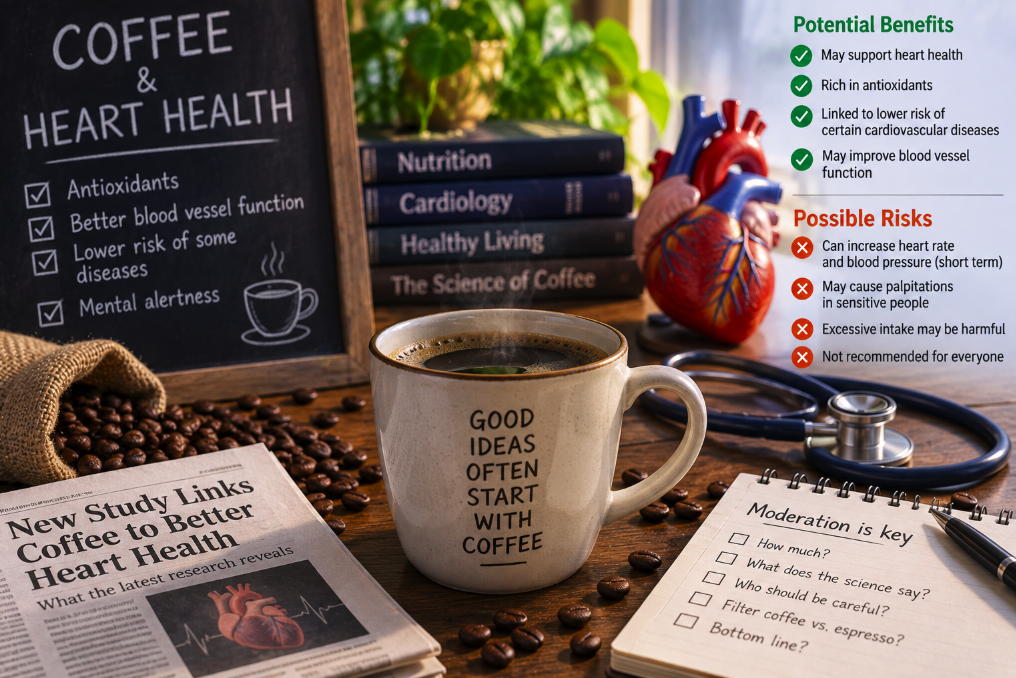
For decades, coffee has occupied an awkward place in conversations about heart health. It contains caffeine, a stimulant that can temporarily raise blood pressure and make some people feel their heart beating faster. Yet large population studies repeatedly find that habitual coffee drinkers are not experiencing the cardiovascular disaster that an older view of caffeine might have predicted. Some studies even associate moderate coffee drinking with lower rates of heart disease, stroke and heart failure.
In 2026, the American Heart Association tried to make sense of that apparent contradiction. Its new scientific statement, published in Circulation, reviewed the evidence on caffeine and cardiovascular disease and reached a reassuring—but carefully qualified—conclusion: for most adults, consuming up to about 400 milligrams of caffeine per day is generally considered safe from a cardiovascular perspective.
That is roughly equivalent to three to five 8-ounce cups of ordinary caffeinated coffee, depending on how strongly the coffee is brewed. It does not mean five giant coffee-shop drinks loaded with espresso shots, syrup and sugar are a prescription for a healthy heart. The details matter.
Coffee and caffeine are not the same thing
The first reason this subject becomes confusing is that researchers often study coffee while headlines talk about caffeine. Coffee contains caffeine, but it also contains hundreds of other compounds, including polyphenols and other bioactive substances with antioxidant and anti-inflammatory properties.
That makes it difficult to attribute every observed effect to caffeine itself. The American Heart Association's 2026 scientific-statement summary explicitly notes this problem: much of the research involves naturally caffeinated coffee, so scientists cannot always separate the effects of caffeine from the effects of other components in the drink.
The distinction becomes especially important when comparing coffee with energy drinks. A cup of coffee and a highly caffeinated energy shot may contain the same stimulant, but they are not biologically or behaviorally identical products. The dose can differ dramatically, and energy drinks may contain additional stimulants or other ingredients.
The AHA cautions that evidence involving normal amounts of coffee should not simply be extrapolated to high-dose energy drinks, which have been associated with increased blood pressure and abnormal heart rhythms.
Why might moderate coffee look good for the heart?
Much of the encouraging evidence is observational. Researchers follow large groups of people, record how much coffee they report drinking and compare later health outcomes. Across many such studies, moderate habitual coffee consumption has been associated with lower risks of several conditions, including coronary disease, heart failure and stroke.
The 2026 AHA statement reports that consuming roughly two to four cups of caffeinated coffee a day has been associated with lower risks of heart disease, heart failure and stroke. Habitual coffee consumption has also been linked with a lower risk of developing type 2 diabetes, an important cardiovascular risk factor.
A separate 2026 prospective cohort study published in Nutrition, Metabolism and Cardiovascular Diseases found a U-shaped relationship for unsweetened coffee, with the lowest observed cardiovascular risk around two to three cups per day. Interestingly, the same clear association was not seen for sugar-sweetened or artificially sweetened coffee.
But “associated with” is doing important work in those sentences. People who drink moderate amounts of coffee can differ from non-drinkers in diet, work habits, income, exercise, smoking, sleep and many other ways. Researchers adjust statistically for known differences, but observational studies cannot eliminate every possible confounding factor.
They therefore cannot prove that drinking coffee itself prevents a heart attack. The AHA says more randomized controlled trials are needed to understand cause and effect.
What caffeine does immediately can differ from what studies see over years
Caffeine blocks adenosine receptors in the nervous system, which helps explain why coffee makes people feel more alert. It can also have short-term cardiovascular effects, including changes in blood pressure and heart rate.
Someone who rarely consumes caffeine may notice those effects more strongly than a habitual coffee drinker who has developed some tolerance. Genetics also influence how quickly people metabolize caffeine, which is one reason the same espresso can make one person feel pleasantly awake and another feel shaky and uncomfortable.
This creates an important distinction between acute effects and long-term cardiovascular outcomes. A temporary increase in blood pressure after a cup of coffee does not automatically mean that habitual moderate coffee consumption causes chronic hypertension or cardiovascular disease. Conversely, favorable associations in long-term studies do not mean every individual can consume caffeine without symptoms.
Does coffee cause irregular heartbeats?
Palpitations are one of the most common reasons people become suspicious of caffeine. A strong coffee can make a heartbeat feel more noticeable, particularly in someone who is sensitive to stimulants.
Yet the relationship between coffee and clinically important arrhythmias is more complicated than the sensation of a racing heart suggests. The AHA review found that one to three cups of caffeinated coffee per day was not associated with an increased risk of atrial fibrillation in observational analyses.
Randomized trial evidence reviewed by the AHA adds an intriguing wrinkle: caffeinated coffee was associated with fewer episodes of atrial fibrillation but more premature ventricular contractions, or PVCs—extra beats originating in the lower chambers of the heart.
That is a good example of why “coffee is good for arrhythmias” or “coffee is bad for arrhythmias” is too crude. Different rhythm disturbances are biologically different, and individual responses vary. Someone whose clinician has advised limiting caffeine because of a specific rhythm problem should not replace that individualized advice with a population-level headline.
The cholesterol issue is about how coffee is brewed
One of the most practical findings has surprisingly little to do with caffeine. Coffee contains compounds called diterpenes, including cafestol, that can raise LDL cholesterol.
The amount reaching the cup depends heavily on brewing method. Paper filters trap much of these oily compounds. Unfiltered methods—such as boiled coffee, French press and Turkish-style coffee—allow more of them into the drink. Espresso also contains diterpenes, although serving sizes are usually much smaller.
The AHA statement notes that randomized clinical trials associate cafestol with higher LDL cholesterol. For someone already managing elevated LDL, switching from frequently consumed unfiltered coffee to paper-filtered coffee can therefore be a more relevant consideration than simply arguing about caffeine.
Sugar can change the equation
A cup of black coffee contains very few calories. A large flavored coffee drink can be closer to a dessert, containing substantial added sugar, cream or saturated fat.
That difference makes “coffee consumption” a surprisingly slippery research category. If coffee's polyphenols or other components provide cardiovascular benefits, repeatedly adding large quantities of sugar does not erase the independent health effects of that sugar.
The AHA review says more research is needed on additives, but the broader dietary principle is straightforward: the health profile of plain coffee cannot automatically be assigned to every beverage with the word coffee on the menu.
Can you drink too much?
Yes. The AHA's roughly 400-milligram figure is a general ceiling for most adults, not a target everyone should try to reach. Caffeine content varies enormously between beans, brewing methods and serving sizes, so counting “cups” can be misleading. A standard research cup is often 8 ounces; many commercial drinks are much larger.
Too much caffeine can cause insomnia, anxiety, tremor, gastrointestinal discomfort, palpitations and increases in blood pressure. Sleep deserves particular attention because using coffee to compensate for chronic sleep deprivation can create a cycle in which caffeine taken late in the day makes the next night's sleep worse.
Certain people also need different limits. Pregnancy, particular medications, anxiety disorders, uncontrolled blood pressure, heart-rhythm conditions and individual caffeine sensitivity can change what is appropriate. Medical guidance should be individualized in those situations.
What about the studies that find harm?
The scientific literature is not perfectly uniform. A 2026 systematic review and meta-analysis covering 38 studies and more than 2.8 million participants found mixed cardiovascular results: higher coffee consumption was associated with lower risks of stroke and cardiac arrhythmias in its pooled analysis but with a higher risk of myocardial infarction. It found no significant overall association for coronary heart disease or heart failure when comparing the highest and lowest consumption categories.
Those apparently contradictory findings are precisely why major scientific statements evaluate the full body of evidence rather than relying on a single study. Coffee research varies in how intake is measured, what populations are studied, which brewing methods are common and whether caffeinated and decaffeinated coffee are separated.
The AHA's conclusion is therefore not that coffee has been proved to prevent cardiovascular disease. It is that normal, moderate caffeinated coffee consumption appears safe for most adults and that the accumulated evidence includes potentially favorable cardiovascular associations.
So is coffee good or bad for your heart?
For most healthy adults who already enjoy coffee, the current evidence does not provide a cardiovascular reason to abandon a moderate habit. Plain or minimally sweetened coffee, particularly when paper-filtered, fits comfortably within the evidence reviewed by the American Heart Association when total caffeine remains within an appropriate range.
That does not mean a non-coffee drinker should begin drinking it as medicine. Exercise, not smoking, adequate sleep, blood-pressure control, cholesterol management and a nutritious overall diet have far stronger roles in established cardiovascular prevention.
Coffee is more interesting scientifically because it refuses to fit the simple story that “stimulant equals bad for the heart.” Its immediate effects can be noticeable while its long-term associations are often neutral or favorable. Brewing method matters. Dose matters. Additives matter. The person drinking it matters.
The latest research has not turned coffee into a heart drug or a health villain. It has produced a more useful conclusion: for most adults, a few ordinary cups can be part of a heart-conscious life—and the science is much richer than the caffeine buzz.