Every few years, a headline or social-media post seems to announce the same piece of cosmic good news: Pluto is a planet again. For anyone who learned the old nine-planet Solar System in school, the idea has obvious emotional appeal. Unfortunately for Pluto's supporters, it is not true.
As of 2026, the International Astronomical Union still officially classifies Pluto as a dwarf planet. The organization has not reversed the definition adopted in Prague in August 2006, and its current FAQ answers the question directly: Pluto has not been restored to full planetary status.
The reason is usually summarized by saying that Pluto has not “cleared its orbit.” That phrase is accurate but easy to misunderstand. It does not mean that a real planet must vacuum every asteroid and grain of dust from its path. Earth certainly has not done that. The criterion is about gravitational dominance: a planet must be massive enough to dominate the population of bodies sharing its orbital region.
The three rules that cost Pluto its title
In 2006, discoveries in the outer Solar System forced astronomers to confront a problem that had been growing for years. Pluto, discovered by Clyde Tombaugh in 1930, was no longer obviously unique. Astronomers were finding other large icy bodies beyond Neptune, including Eris, whose discovery intensified the argument over what should count as a planet.
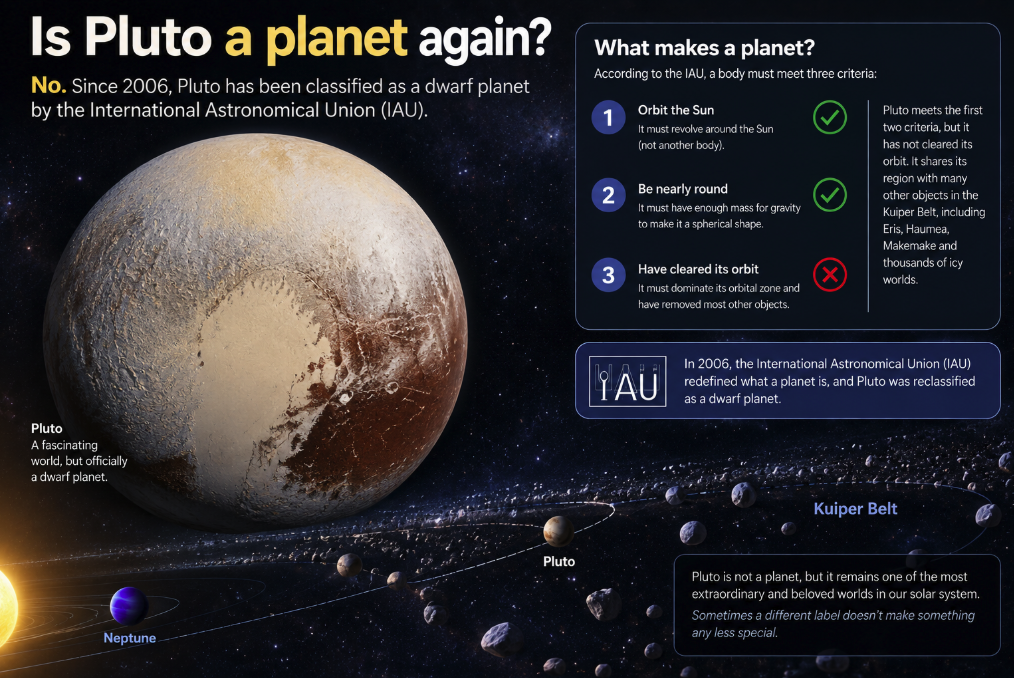
The International Astronomical Union eventually adopted Resolution B5, defining a Solar System planet using three criteria. The body must orbit the Sun, be massive enough for its own gravity to make it nearly round, and have cleared the neighborhood around its orbit.
Pluto passes the first test without difficulty: it orbits the Sun, completing one revolution in about 248 Earth years. It also passes the second. Its gravity has pulled it into a nearly spherical shape.
The third test is where Pluto loses full planetary status.
Pluto lives in the Kuiper Belt, a vast region beyond Neptune populated by icy bodies left over from the Solar System's formation. It is not overwhelmingly gravitationally dominant there. In the language of the IAU definition, it has not cleared its orbital neighborhood. The same 2006 resolution therefore placed Pluto in the newly formalized category of dwarf planets.
The IAU's Resolution B6 went further, explicitly stating that Pluto is a dwarf planet and recognizing it as the prototype of a category of trans-Neptunian objects. NASA continues to use that classification today. Its current Pluto facts page describes Pluto as a complex dwarf planet in the distant Kuiper Belt.
“Clearing the orbit” does not mean an empty orbit
The wording has caused confusion ever since 2006. Jupiter has Trojan asteroids sharing its orbit. Earth encounters near-Earth asteroids. Neptune's gravitational relationship with Pluto itself is evidence that planets do not inhabit perfectly empty lanes around the Sun.
What matters is dynamical dominance. A major planet contains vastly more mass than the other small bodies in its orbital zone and strongly controls their long-term motion through gravity. NASA's Jet Propulsion Laboratory describes the requirement as being massive enough to gravitationally dominate its region of the Solar System.
Pluto is different. It belongs to a broad population of trans-Neptunian bodies rather than overwhelmingly dominating that population. In fact, the discovery of Pluto-like worlds was precisely what made the old nine-planet arrangement difficult to defend consistently. If Pluto remained a planet simply because history had called it one, astronomers faced the question of whether Eris and potentially many other round outer-Solar-System objects should become planets too.
The 2006 vote produced a Solar System with eight official planets: Mercury, Venus, Earth, Mars, Jupiter, Saturn, Uranus and Neptune. Pluto joined Ceres and Eris in the dwarf-planet category; Haumea and Makemake are also now recognized by the IAU as dwarf planets.
Why people keep hearing that Pluto became a planet again
The classification has never enjoyed universal support among planetary scientists. Some researchers object to the IAU definition itself, particularly its emphasis on orbital dynamics. They prefer geophysical definitions based on an object's intrinsic characteristics — for example, whether it is massive enough to become round and has complex planetary geology.
Under some proposed geophysical definitions, Pluto would indeed qualify as a planet. So would numerous moons and other round worlds that the IAU system does not call planets. That disagreement is scientifically legitimate, but it is not the same thing as an official reclassification.
The IAU's current FAQ specifically addresses recurring reports that Pluto has regained planetary status: the organization says it has not changed its definition since 2006. The debate continues; the official classification has not.
Part of the confusion also comes from the extraordinary success of NASA's New Horizons mission. When the spacecraft flew past Pluto on July 14, 2015, it revealed a world far more geologically diverse than the blurry dot astronomers had known before. New Horizons photographed enormous mountains of water ice, nitrogen-ice plains, layered hazes and the famous heart-shaped region dominated by Sputnik Planitia.
Those discoveries made the word “dwarf” feel almost insulting. Pluto was clearly not a boring frozen rock. It was an active, complicated world with five known moons and a surprisingly dynamic surface.
But scientific classification is not a ranking of importance. Calling Pluto a dwarf planet does not mean it is less interesting than Mercury or Mars. It describes how the object fits within one particular astronomical definition.
Could Pluto become a planet again someday?
Definitions in science can change. The word “planet” itself has changed meaning repeatedly over thousands of years, from the wandering lights known to ancient observers to the physical worlds revealed by modern astronomy. The IAU could theoretically revise its 2006 definition in the future if its members adopted a new resolution.
There is no current official change that has done so. Under the rules in force today, Pluto remains a dwarf planet because it meets the first two planetary criteria but not the requirement of gravitationally clearing — or dominating — its orbital neighborhood.
Perhaps the more interesting lesson is that Pluto did not physically change on August 24, 2006. Its mountains, atmosphere, moons and 248-year orbit were exactly where they had been the day before. Humans changed a category because new discoveries had made an old category difficult to use consistently.
So, is Pluto a planet again? Officially, no. It remains the Solar System's most famous dwarf planet. Whether astronomers should redefine the word “planet” so that Pluto gets its old title back is a different question — and nearly twenty years after the Prague vote, that argument is still very much alive.