On November 20, 1969, Apollo 12 astronauts Pete Conrad and Alan Bean left the lunar surface and rejoined Richard Gordon in orbit. Their lunar module's ascent stage was no longer useful, so mission controllers deliberately sent it crashing back into the Moon.
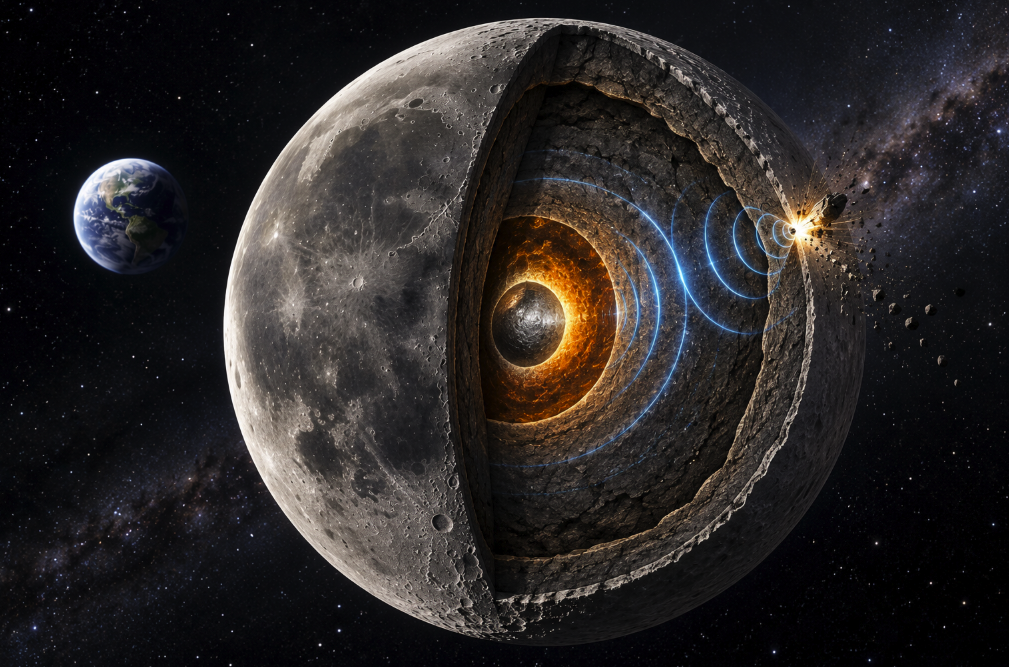
About 76 kilometers from the landing site, the discarded spacecraft hit the surface. A seismometer the astronauts had installed nearby recorded what happened next.
The vibrations went on for more than 55 minutes.
Scientists reached for a memorable analogy: the Moon had “rung like a bell.” Decades later, that phrase would become one of the favorite pieces of supposed evidence for an extraordinary claim — that the Moon is hollow, perhaps even artificial.
There is only one problem. The seismic experiment showed nothing of the sort.
The Moon really did reverberate for an unusually long time after the Apollo impact. But lunar seismology explains why, and the same family of experiments that produced the famous ringing has helped reveal a differentiated world with a crust, mantle and small metallic core.
What Apollo 12 actually measured
Apollo 12 deployed a Passive Seismic Experiment on November 19, 1969. Its purpose was to record vibrations from moonquakes, meteorite strikes and deliberately created impacts so scientists could investigate the Moon's interior.
The following day, the lunar module ascent stage hit the Moon after carrying Conrad and Bean back into orbit. According to NASA's historical account of the Apollo Lunar Surface Experiments Package, the resulting seismic vibrations persisted for more than 55 minutes.
The original Apollo 12 Preliminary Science Report described the signal as exceptionally prolonged, with a gradual buildup and decline unlike typical terrestrial earthquake records. Scientists immediately recognized that something unusual was happening in the way seismic energy traveled through lunar material.
But “rang like a bell” did not mean astronauts had discovered an enormous empty shell.
A seismometer does not listen for audible sound in an atmosphere. It measures motion of the ground. The phrase described how long the seismic vibrations persisted, much as vibrations in a bell continue after it has been struck.
Earth rings after earthquakes too. NASA has pointed out that planetary bodies can support long-lived seismic oscillations. The unusual feature of the Moon is how weakly some of its rocks damp those vibrations.
Why the Moon reverberates for so long
Earth's crust contains abundant water, fluids and geologically active structures that help absorb and dissipate seismic energy. The lunar environment is radically different. Its near-surface rocks are extremely dry, heavily fractured by billions of years of impacts and capable of scattering seismic waves repeatedly.
NASA lunar scientist Walter Kiefer has explained that the Moon is colder and seismic waves do not attenuate as efficiently there as they do on Earth. Instead of quickly dying away, energy can continue reverberating through lunar rock.
Early analysis of deliberately created impacts found exceptionally low absorption compared with typical terrestrial crust. A NASA technical report on seismic data from human-made lunar impacts concluded that a combination of wave dispersion and scattering could explain the prolonged reverberations observed by Apollo 12.
That distinction is crucial. A hollow metal bell rings because of the elastic vibrations of its shell. A rocky planetary body can also sustain long-lived seismic vibrations without being hollow. Similar language does not imply identical internal structure.
In fact, the Apollo scientists were deliberately creating impacts precisely because seismic waves passing through a solid body reveal information about what is inside it.
Apollo kept crashing hardware into the Moon on purpose
The Apollo 12 ascent stage was only the beginning. NASA realized that discarded spacecraft hardware offered an unusually useful scientific tool: an impact with a known time, location and approximate energy.
Starting with Apollo 13, Saturn rocket stages were deliberately directed into the lunar surface. Later lunar module ascent stages were also crashed after crews had safely returned to orbit. Seismometers deployed by Apollo 12, 14, 15 and 16 eventually formed a small lunar seismic network that transmitted data until 1977.
These controlled impacts worked a little like medical imaging on a planetary scale. Scientists knew where the seismic energy began, then measured how waves arrived at different instruments. Their travel times, speeds, reflections and attenuation provided clues to the layers they had crossed.
Natural moonquakes and meteorite impacts added many more seismic sources. NASA reports that the Apollo network detected thousands of seismic events, including deep moonquakes linked to tidal stresses from Earth's gravitational pull.
If the Moon had been an enormous empty shell, this accumulating seismic evidence would have been extraordinarily difficult to reconcile with it. Instead, the data revealed a rocky body with internal layering.
What is actually inside the Moon?
The Moon has a crust, a rocky mantle and a comparatively small core.
Apollo seismic measurements provided the first detailed look at lunar internal structure. Early analyses identified a crust tens of kilometers thick overlying a mantle and found evidence that conditions changed deeper inside. The limited geography of the Apollo stations — all on the Moon's near side — meant that the deepest interior was initially difficult to resolve precisely.
Later scientists returned to the old recordings with modern seismic techniques and combined them with other measurements, including lunar laser ranging, gravity observations and electromagnetic constraints.
NASA's Walter Kiefer summarizes current reanalysis as indicating a solid inner core with a fluid outer core above it. He gives the overall lunar core a radius of roughly 350 to 400 kilometers, about one-fifth of the Moon's radius, although exact dimensions depend on the model and remain an active subject of research.
A NASA technical summary of lunar seismic structure similarly describes the commonly accepted deep-interior model as including a solid inner core, fluid outer core and an overlying partially molten boundary region.
The Moon is therefore not a solid uniform rock all the way through, but neither is it hollow. Like Earth, it differentiated early in its history as materials of different densities separated, although its metallic core is proportionally much smaller than Earth's.
How a scientific phrase became a conspiracy theory
The hollow-Moon story thrives because “rang like a bell” sounds far more mysterious when detached from its scientific context.
If you hear only that NASA crashed a spacecraft into the Moon and it rang for an hour, a hollow object may seem like an intuitive explanation. Add the fact that scientists themselves were surprised by the seismic response, and the story becomes almost irresistible.
But surprise is not evidence of a cover-up. The Apollo 12 researchers published what they observed and openly discussed competing explanations for the unusual signal. The mission's preliminary science report notes possibilities involving both the impact source and the propagation properties of lunar material, emphasizing that more analysis and a wider seismic network were needed.
That is exactly what happened. More instruments, more controlled impacts, natural moonquakes and decades of reanalysis progressively improved the model of the lunar interior.
The irony is that the experiment often cited as evidence for a hollow Moon belongs to the scientific program that helped demonstrate its layered internal structure.
The Moon is strange enough without being hollow
The real lunar interior is arguably more interesting than the conspiracy theory.
The Moon is seismically quieter than Earth but experiences several distinct kinds of moonquakes. Some deep events recur with tidal cycles. Its dry, fractured crust allows seismic energy to reverberate for remarkably long periods. Its metallic core is tiny compared with Earth's, and portions of the deep interior may be molten or partially molten.
NASA's Apollo seismic network stopped transmitting in 1977, leaving enormous regions — particularly the far side — comparatively poorly sampled. Future lunar seismometers could answer questions Apollo could not, including finer details of the core and mantle and the distribution of seismic activity across the entire Moon.
So, is the Moon hollow? No. The famous Apollo 12 “ringing” was real, but the interpretation attached to it by hollow-Moon stories is not. The long vibration tells us about the Moon's unusually dry, fractured and weakly attenuating rocks, not a giant cavity beneath the surface.
For more than half a century, the Moon has been telling scientists what lies inside it through seismic waves. Far from revealing an empty shell, those vibrations have mapped a world of rock, mantle and metal hidden beneath the familiar gray surface.