Modern elections are designed to look ordinary. Voters enter a booth, mark a choice, deposit a ballot and wait for arithmetic to produce a winner. In medieval and early modern Europe, choosing a pope, doge, emperor or magistrate could instead involve locked doors, oaths, supermajorities, drawing lots, repeated reductions of an electorate and elaborate rituals intended to prevent bribery, factional capture or outside pressure.
These procedures can look eccentric from a distance. In reality, many were sophisticated responses to a problem that has never disappeared: how do you persuade rival factions to accept the result of an election when enormous power is at stake?
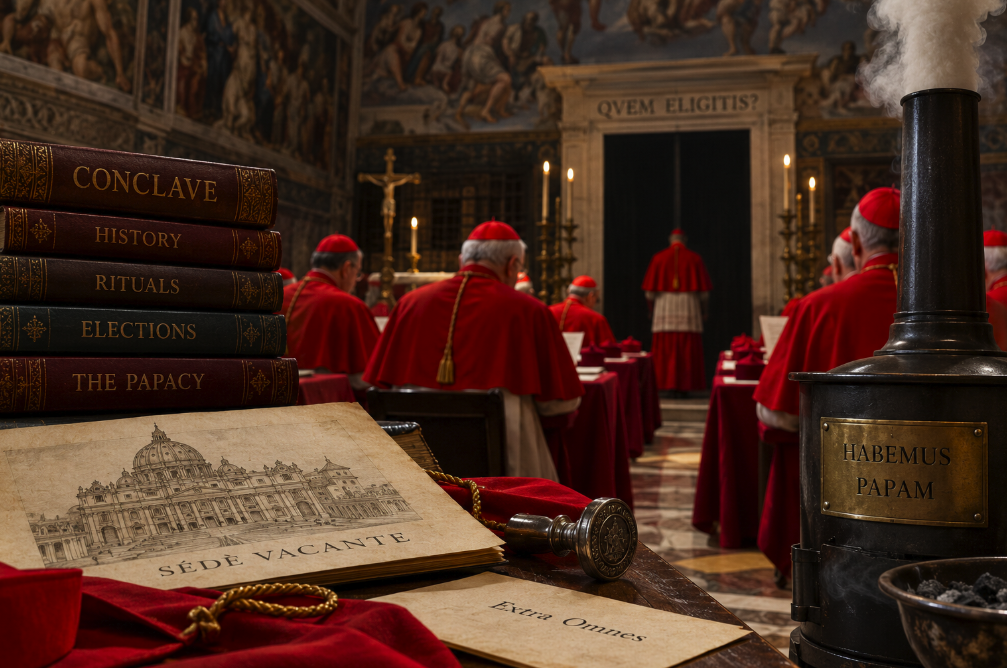
The papal conclave is the most famous surviving example. Its secrecy, ballots and smoke signals seem almost timeless, but they are the product of centuries of institutional experimentation. The conclave did not descend fully formed from antiquity. It evolved because papal elections repeatedly became political crises.
Before the conclave, electing a pope could become chaos
The method of choosing the bishop of Rome changed considerably across the centuries. Clergy, Roman elites, emperors and powerful families all exerted influence at different periods. By the eleventh century, reformers sought to reduce secular interference, and the College of Cardinals became increasingly central to papal elections.
A crucial step came in 1179, when the Third Lateran Council established a two-thirds majority requirement for papal election. The rule was designed partly to prevent competing factions from producing rival claimants. It solved one problem but could create another: a supermajority is excellent at demanding consensus and equally excellent at producing deadlock.
The most notorious deadlock began after the death of Clement IV in 1268. Cardinals gathered at Viterbo, north of Rome, but factional divisions prevented them from agreeing on a successor. The vacancy dragged on for nearly three years.
Local authorities and residents eventually tried to force the issue. The cardinals were subjected to increasingly severe restrictions, traditionally associated with confinement and reduced provisions. Accounts of exactly which measures were taken and when vary, but the political lesson was unmistakable: an election of indefinite duration could destabilize both Church and city.
In September 1271 the electors finally chose Teobaldo Visconti, who became Gregory X. The experience helped inspire formal rules for future elections. Gregory's constitution Ubi periculum, issued at the Second Council of Lyon in 1274, imposed enclosure and progressively restricted food if the cardinals failed to reach a decision.
The word conclave comes from the Latin cum clave, “with a key.” What began as a practical effort to isolate electors became one of the world's most recognizable political rituals.
How the modern conclave actually works
The contemporary procedure is far less physically punitive than its medieval ancestors, but isolation remains central. The governing framework is the apostolic constitution Universi Dominici Gregis, promulgated by John Paul II in 1996 and subsequently amended, notably by Benedict XVI.
Cardinals who have not reached the age limit established by the rules are the electors. The election itself takes place in the Sistine Chapel, while electors reside within Vatican City during the conclave and are protected from unauthorized outside communication. The secrecy is not merely theatrical: the rules prohibit recording and transmitting devices in the areas used for the election and impose strict obligations concerning what happens inside.
The ballot is secret. Under the current rules, election requires at least two thirds of the votes of the electors present and voting. Benedict XVI's 2013 amendments reaffirmed the two-thirds requirement and adjusted several procedural details.
The mechanics are remarkably meticulous. Officials are selected by lot for roles including scrutineers, revisers and those charged with collecting votes from electors who are ill. Ballots are counted and checked. The rules even prescribe that, during the count, ballots be pierced at the word Eligo and threaded together for secure preservation before they are eventually burned.
If no candidate reaches the required threshold, another ballot follows. After the first day, there can ordinarily be two ballots in the morning and two in the afternoon. The familiar smoke communicates the result to the world outside: dark smoke indicates that no pope has been elected; white smoke announces a successful election.
Behind the spectacle is an institutional design with a clear purpose. Secrecy limits direct outside pressure. Repeated ballots allow preferences to evolve. The two-thirds threshold discourages a narrow faction from imposing its candidate. Isolation forces the electorate to continue confronting the same problem until a sufficiently broad coalition emerges.
The conclave once allowed stranger ways of choosing
Secret scrutiny was not always the only recognized route to a pope. Earlier rules contemplated election by acclamation — sometimes described as election by inspiration — in which the electors converged spontaneously on one candidate. Another method, per compromissum, allowed the larger body to delegate the decision to a smaller group.
John Paul II abolished both alternatives in the 1996 constitution, leaving secret scrutiny as the sole form. He argued that acclamation was no longer appropriate for a large and internationally diverse electoral college, while delegation risked reducing the personal responsibility of individual electors.
This is a revealing example of institutional evolution. Ancient procedures often survive because they carry legitimacy, but they can also disappear when the body using them changes. A method that seems plausible among a small group of clerics becomes far harder to defend in a global electorate of cardinals.
Venice turned elections into an obstacle course
If the conclave seems elaborate, the Republic of Venice developed a system for electing its doge that makes many modern electoral procedures look minimalist.
Venetian politics was dominated by aristocratic families, and the republic faced a recurring danger: if one faction controlled the selection process, it might convert an elective office into something resembling hereditary rule. Venice's answer was to combine election with chance.
By the late thirteenth century, the doge was selected through a celebrated sequence of ballots and lotteries. The Great Council first chose a group by lot; that group elected a smaller group; another lottery reduced it again; those survivors elected another group. The process continued through multiple stages until a final body of forty-one electors was produced, which then chose the doge with a qualified majority.
The exact choreography is famously labyrinthine: groups were repeatedly expanded by election and reduced by lot. That complexity was the point. Lotteries made it harder for a faction to know in advance who would control the next stage. Elections ensured that pure chance did not determine the final ruler. The system alternated randomness and deliberate choice to frustrate coordinated capture.
To modern eyes, drawing balls from containers may look less rational than straightforward voting. For Venetian patricians, randomness could serve as an anti-corruption technology.
Why lotteries belonged to politics
The idea was older than Venice. Sortition — choosing officeholders by lot — had deep roots in the ancient world and continued to appear in European civic institutions. Florence famously used elaborate systems involving nominations, scrutiny and the drawing of names from bags for public offices.
Random selection had a political logic. Elections reward organization, popularity, money, alliances and reputation. A lottery can disrupt those advantages. In a restricted political class, it can distribute offices among eligible citizens while making the outcome harder to purchase beforehand.
Of course, historical lotteries were not automatically democratic. Eligibility was often restricted by sex, status, wealth, guild membership or family. The ingenious procedure could operate inside a society that excluded most inhabitants from political power. Institutional sophistication and broad political equality are different things.
Europe experimented because legitimacy was fragile
Unusual voting systems were rarely invented merely because rulers enjoyed ceremony. They arose from structural problems. A simple majority can allow a cohesive faction to dominate. A supermajority can create paralysis. Open voting invites pressure. Secret voting can encourage independence but makes certain forms of accountability harder. Delegation speeds decisions but concentrates power. Random selection limits organized capture but reduces voter control.
Historical institutions mixed these tools in different proportions. The conclave emphasized secrecy, isolation and supermajority consensus. Venice inserted chance into a multistage election. Other European bodies used public declarations, ranked preferences, estates voting as blocs or electoral colleges representing territories rather than individual citizens.
Even the Holy Roman Empire's imperial election developed around a restricted group of prince-electors rather than a popular electorate. The Golden Bull of 1356 formalized major parts of that system, including the privileged role of seven electors. The aim was not democracy in the modern sense; it was an orderly method of producing a ruler in a fragmented political world where dynasties, princes and ecclesiastical territories all possessed competing claims.
The strangest rules often reveal the clearest fears
Election procedures are historical documents. A rule requiring two thirds tells us that division was feared. A locked room tells us that external interference was feared. A lottery tells us that factional planning was feared. A secret ballot tells us that pressure on individual electors was feared.
This is why the rituals surrounding old institutions should not be dismissed as decorative eccentricity. They encode centuries of political memory. The conclave's isolation recalls elections that became international crises. Venice's electoral maze reflects a republic obsessed with preventing any single aristocratic clan from monopolizing power.
Modern democracies have different goals and much broader electorates, but the underlying engineering problem remains recognizable. Every voting system must decide who participates, how preferences are expressed, what threshold produces victory and how to convince the losers that the procedure was legitimate.
Seen that way, a cardinal placing a handwritten ballot into a chalice and a Venetian patrician drawing a ball from an urn are not relics of irrational politics. They are predecessors in a long European experiment: designing rules strong enough to make power change hands without making the political order collapse with it.