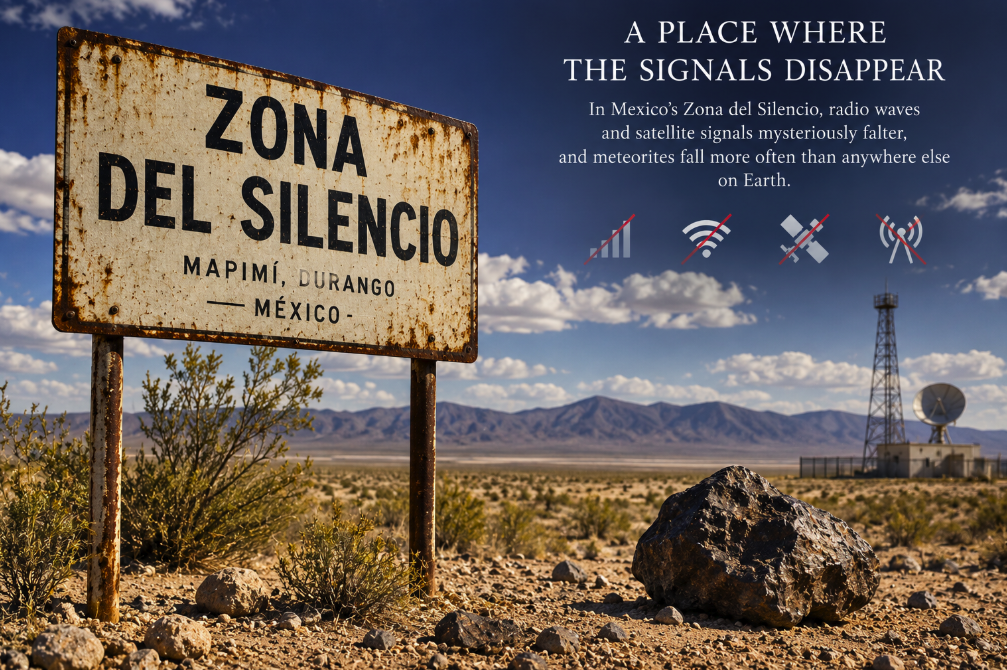
In the Chihuahuan Desert of northern Mexico, where Durango, Chihuahua and Coahuila approach one another across an immense dry basin, a patch of landscape has acquired one of the strangest reputations in North America.
It is called La Zona del Silencio — the Zone of Silence.
According to the legend, radio transmissions mysteriously fail there. Satellite signals disappear. Compasses behave strangely. Meteorites strike the desert with unusual frequency. Stories add mutated plants, unexplained lights and extraterrestrial visitors. The place is sometimes promoted as Mexico's answer to the Bermuda Triangle.
There is just one problem: the extraordinary electromagnetic phenomenon at the center of the legend has never been convincingly demonstrated.
The real Mapimí desert is scientifically fascinating. A U.S. test rocket really did crash there in 1970 after going badly off course. Meteorites really have fallen in northern Mexico. The region contains unusual geology, fossils and one of the continent's important desert ecosystems.
But the famous claim that a mysterious force continuously blocks radio and satellite communication belongs much more securely to folklore than to geophysics.
A “zone” without clear boundaries
The Zone of Silence is generally placed within or near the Bolsón de Mapimí, a large internally drained desert basin in northern Mexico. Part of the area overlaps the Mapimí Biosphere Reserve, a protected landscape established to conserve the ecology of the Chihuahuan Desert.
The first clue that the mystery is difficult to test is geographical: there is no universally defined scientific boundary around the supposed anomaly.
A study examining tourism and local communities in the Mapimí Biosphere Reserve described the Zone of Silence as perhaps the region's most famous attraction, while noting that the alleged difficulty in transmitting radio waves is associated with an area that is not even clearly delimited. The same study reports that local residents themselves reject many of the myths that outsiders attach to the landscape.
This matters. If an electromagnetic anomaly is claimed to exist, researchers need to know where it begins, where it ends, which frequencies are affected, under what atmospheric conditions and by how much. A phenomenon that changes location whenever instruments work normally becomes impossible to falsify.
The Zone of Silence has never acquired the kind of reproducible measurement record that would establish it as a genuine radio-physics anomaly.
The rocket that transformed the desert into a legend
The event that gave the story international momentum was very real.
In July 1970, the United States launched an Athena test rocket from the Green River Launch Complex in Utah. Its intended destination was the White Sands Missile Range in New Mexico.
Instead, the vehicle went off course and crashed hundreds of kilometers to the south in Mexico's Mapimí desert region.
The accident was embarrassing and technically unusual enough to attract attention on its own. The rocket also carried small quantities of radioactive cobalt-57 associated with its payload, making recovery important.
U.S. personnel entered the region with Mexican authorization, located the wreckage and removed the vehicle along with contaminated material from the impact area. A road was reportedly constructed to facilitate the operation.
Later retellings transformed the accident into something more mysterious. Why, people asked, had an American rocket aimed at New Mexico ended up in this particular Mexican desert? Had some unknown magnetic force pulled it off course?
There is no evidence that the Mapimí landscape magnetically attracted the Athena rocket. Guidance failures and trajectory errors do not require paranormal geography. But the coincidence was narratively irresistible.
Once the rocket crash became attached to existing stories about communication problems, the Zone of Silence had its founding myth.
Do radios really stop working?
Remote deserts are excellent places for communication problems.
That is not mysterious.
Radio reception depends on frequency, transmitter power, antenna design, distance, terrain and atmospheric conditions. Mobile phones require access to terrestrial base stations. Satellite systems require appropriate equipment and sufficient visibility of satellites. A sparsely populated desert with little communications infrastructure will naturally contain areas where ordinary consumer devices perform poorly.
None of this demonstrates a local force that absorbs electromagnetic radiation.
If the Mapimí desert genuinely prevented radio waves from propagating through a large region, the effect would be straightforward to investigate. Researchers could transmit controlled signals at multiple frequencies across the alleged boundary, measure attenuation and compare the results with ordinary propagation models.
Decades of publicity have not produced compelling evidence of such a reproducible blackout.
The stronger versions of the legend — that radio, television, GPS and satellite communications simply cease functioning inside the Zone — are particularly implausible because these technologies operate at very different frequencies and use different propagation paths. A physical mechanism capable of suppressing all of them across a large outdoor area would be an extraordinary geophysical phenomenon and readily measurable.
No such mechanism has been established.
What about magnetism?
Another common explanation points to iron-rich minerals in the desert.
Magnetic minerals can certainly affect local magnetic measurements. Geological formations containing magnetite, for example, can produce anomalies detectable with sensitive instruments. This is routine geophysics rather than evidence of a mysterious “vortex.”
But the presence of iron-bearing rocks does not automatically create a radio blackout.
The Mapimí region also contains abundant dark mineral nodules. The biosphere-reserve tourism study notes that hematite nodules formed in the local limestone are sometimes interpreted by visitors as meteorites.
This illustrates how easily real geology can feed a legend. A dark, heavy rock found in a desert famous for meteorites looks exactly like the sort of evidence the story encourages people to expect.
Identification requires mineralogical analysis, not atmosphere.
Does the Zone really attract more meteorites?
Meteorites are another central part of the myth.
Northern Mexico has produced important meteorite finds, and the broader region is associated in popular accounts with several falls. The famous Allende meteorite, for example, fell in Chihuahua in February 1969 and became one of the most scientifically important carbonaceous chondrites ever studied.
But Allende did not establish a mysterious meteorite target centered on the Zone of Silence.
To claim that meteorites fall there at a statistically greater rate than elsewhere on Earth would require a defined geographical area, a reliable catalog of observed falls, an equivalent comparison region and correction for detection bias.
Deserts are exceptionally good places to find meteorites. Dark stones stand out against pale ground, vegetation is sparse, weathering can be slow and rocks remain exposed rather than being buried rapidly in soil or hidden by forests.
A high number of meteorite discoveries therefore does not necessarily mean a high number of meteorite impacts.
More importantly, there is no known physical reason for a small patch of Mexican desert to gravitationally attract meteoroids from space at a substantially greater rate than neighboring terrain. On the scale of incoming extraterrestrial objects, the gravitational differences across such a region are negligible.
The claim of an exceptional meteorite concentration remains part of the legend rather than an established statistical result.
The desert itself is stranger than the paranormal story
The obsession with radio blackouts can obscure what is genuinely remarkable about Mapimí.
The Bolsón de Mapimí is part of the Chihuahuan Desert, one of North America's great desert ecosystems. Its isolation, climate and soils support highly specialized plants and animals. The Mapimí Biosphere Reserve became an important site for ecological research and conservation, including work involving the Bolson tortoise, Gopherus flavomarginatus.
The landscape also records a much older history. Sedimentary rocks and marine fossils reveal environments that existed long before today's desert. Mineral deposits reflect geological processes operating over immense spans of time.
In other words, the region contains authentic mysteries in the scientific sense: questions about ecology, adaptation, geology and environmental change that can be investigated with evidence.
Those subjects are less sensational than extraterrestrial interference, but they are real.
Why the legend became so powerful
The Zone of Silence combines nearly perfect ingredients for modern folklore.
First comes remoteness. A vast desert already feels outside the normal technological world. Mobile reception can genuinely be poor, roads are sparse and the horizon creates a sense of isolation.
Then comes a documented anomaly: a U.S. military rocket unexpectedly crashes there.
Add meteorites, dark mineral rocks and Cold War secrecy. Mix in reports of radio failures that are difficult to reproduce. Finally, introduce UFO culture and tourism.
Each element reinforces the others.
A visitor whose phone loses service has an experience consistent with the legend, even if the nearest cellular tower is simply too far away. A strange rock becomes a meteorite. A light in the sky becomes a UFO. A compass reading that seems unexpected becomes evidence of a magnetic anomaly.
This is a classic feedback loop in folklore: once a place acquires a reputation, ordinary events are interpreted through that reputation and then retold as further proof.
When tourism starts changing the place it celebrates
The legend has consequences beyond entertainment.
Researchers studying tourism around the biosphere reserve have reported tensions between sensational stories promoted to visitors and the interests of residents and conservationists. Some local people have tried to shift attention away from UFOs and electromagnetic myths toward the desert's actual attractions: its night sky, wildlife, geology, thermal springs and archaeological heritage.
This distinction matters because protected desert environments can be fragile. Off-road traffic, collecting rocks or plants and uncontrolled visitation can damage ecosystems that recover slowly.
A fictional mystery can therefore have a measurable ecological footprint.
The silence is real — just not in the way the legend says
There is a reason the name “Zone of Silence” works so well.
Mapimí really is quiet.
Far from major cities, highways and dense communications infrastructure, the desert can produce a form of silence increasingly unfamiliar to urban life. The horizon is enormous. At night, artificial light recedes and the sky becomes dominant. Human signals — visual, acoustic and electronic — become less obvious.
That experience does not require electromagnetic forces.
The documented story is already unusual enough: a remote Mexican desert, a Cold War test rocket that missed its target by hundreds of kilometers, a recovery operation involving radioactive material, a landscape rich in fossils and mineral formations, and decades of stories that transformed it into a paranormal destination.
Science has not confirmed a permanent radio dead zone. It has not demonstrated that satellite signals mysteriously vanish there. It has not shown that meteorites preferentially target this patch of Earth.
What the Zone of Silence reveals instead is how myths form around real events.
A rocket fell from the sky. Radios sometimes failed in a remote desert. Meteorites existed nearby. Those facts were connected until the landscape itself seemed to acquire supernatural properties.
The strange force operating in Mapimí may therefore be something more familiar than magnetism: the human tendency to turn coincidence into pattern, and pattern into legend.