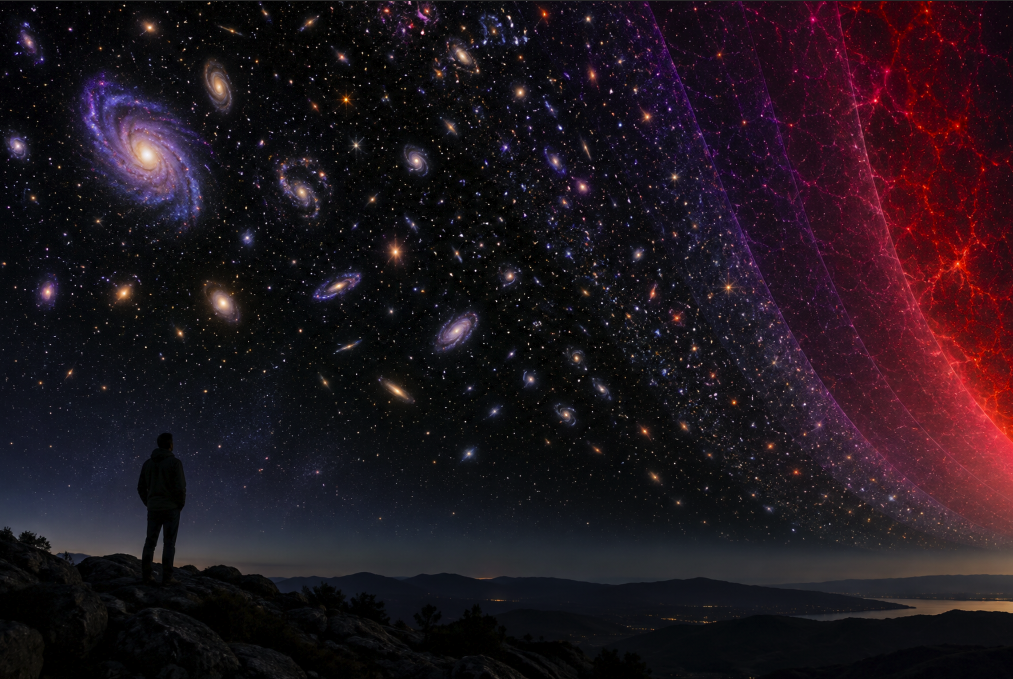
Look up on a clear night and the most obvious feature of the universe is not the stars. It is the darkness between them. That darkness seems perfectly ordinary, yet for centuries it posed a surprisingly deep problem. If space contains an enormous number of stars — and especially if we imagine an infinite, eternal universe populated more or less uniformly with them — why is every part of the sky not shining?
This puzzle is known as Olbers’ paradox, after the German physician and astronomer Heinrich Wilhelm Olbers, who discussed it in the early nineteenth century. The underlying question, however, is older than Olbers. Johannes Kepler had already recognized a version of the problem in the seventeenth century. What eventually made the paradox so important was that its solution turned out to depend not on some obscure property of stars, but on the history of the universe itself.
The strange arithmetic of an infinite sky
At first, distance seems to provide an easy answer. A star twice as far away looks four times fainter, because its light is spread over four times the area. Surely sufficiently distant stars simply become irrelevant.
But there is a catch. Imagine space divided into a series of enormous spherical shells centered on Earth. As the radius of a shell doubles, an individual star in it becomes four times fainter. Yet the shell also has roughly four times as much surface area, so — assuming stars are distributed uniformly — it can contain roughly four times as many stars. The loss in brightness is compensated by the increase in their number.
Extend that reasoning through an infinite number of shells in an eternal, static universe and something remarkable happens: every line of sight should eventually terminate on the surface of a star. The effect is often compared to standing inside a sufficiently dense forest. Nearby tree trunks leave gaps, but look far enough through those gaps and more trunks appear behind them. In the idealized Olbers universe, the celestial sphere should therefore resemble a continuous stellar surface rather than a black background dotted with points of light. NASA describes the classic paradox in essentially these terms in its cosmology educational material.
Interstellar dust was once suggested as an escape route: perhaps something simply blocks most of the distant light. But that does not solve the problem in an eternal universe. Material that continually absorbs radiation would heat up and eventually radiate energy itself. Darkness cannot be maintained indefinitely merely by hiding the stars behind absorbers.
The universe has not had forever
The crucial flaw lies in the assumptions. The observable universe is not infinitely old. Modern cosmology places its age at about 13.8 billion years. Because light travels at a finite speed, we can receive information only from regions whose light has had enough time to reach us. There may be vastly more universe beyond our cosmic horizon — the universe as a whole could even be spatially infinite — but that does not mean its light is visible to us now.
This distinction matters. Olbers’ paradox does not require us to prove that space itself has an edge. A spatially infinite universe can still produce a dark optical sky if it has a finite age and has not been filled with shining stars for eternity. NASA likewise notes that the universe may extend beyond what we can observe while remaining causally inaccessible to us because its light has not had sufficient time to arrive.
Stars also did not switch on at the beginning of cosmic history. The early universe passed through radically different stages before the first generations of stars formed. There has therefore been only a finite amount of time for stellar populations to produce the accumulated light that reaches Earth.
Expansion changes the light itself
Finite age is central to the answer, but cosmic expansion adds another important effect. Space has been expanding throughout cosmic history. Light traveling across that expanding space is stretched to longer wavelengths, a phenomenon known as cosmological redshift. Radiation emitted as visible or ultraviolet light by a sufficiently distant source can arrive at Earth shifted into the infrared or even longer wavelengths, outside the range of human vision.
Expansion also reduces the energy carried by the radiation we receive. So the distant universe does not pile visible light onto our retinas in the way an eternal, static model predicts. This is one reason instruments designed to study the earliest galaxies often observe in infrared wavelengths rather than relying on visible light. A NASA discussion of the dark night sky emphasizes precisely this effect: as the universe expands, radiation from very distant objects is shifted progressively toward longer wavelengths.
There is an especially beautiful twist. The sky is not truly empty of ancient light. In every direction lies the cosmic microwave background, relic radiation released when the universe became transparent roughly 380,000 years after the Big Bang. Expansion has stretched that radiation enormously since then, cooling its spectrum into the microwave range. Human eyes cannot see it, but microwave instruments can. In that sense, the darkness visible to us conceals a sky filled with radiation from the young universe.
The same principle applies more broadly. Astronomers measure diffuse backgrounds across several parts of the electromagnetic spectrum, including the accumulated glow associated with generations of stars and galaxies. The optical night is dark, but the universe is not devoid of photons.
A darkness that tells us something
Olbers’ paradox is powerful because it begins with an observation anyone can make without a telescope. The blackness between the stars is evidence against a simple universe that is static, eternal and uniformly populated by everlasting light sources. Its explanation requires a cosmos with a history.
The paradox also carries a useful warning about the word “infinite.” Even if the universe is spatially infinite — a possibility not ruled out merely by the existence of an observable horizon — it does not follow that we can see infinitely far or receive an infinite amount of starlight. What matters is the combination of cosmic age, the finite speed of light, the history of star formation and the expansion of space.
So the night sky is dark not because the universe is empty, but almost for the opposite reason: it is a record of a universe that evolves. Some light has not had time to reach us. Some was never produced because stars have not existed forever. And some has traveled so long through expanding space that it reaches us at wavelengths our eyes cannot detect.
Every dark patch between the stars therefore contains a quiet piece of cosmological evidence. The absence of visible light is not merely nothingness. It is one of the clues that revealed that the universe has an age, a horizon and a changing history.