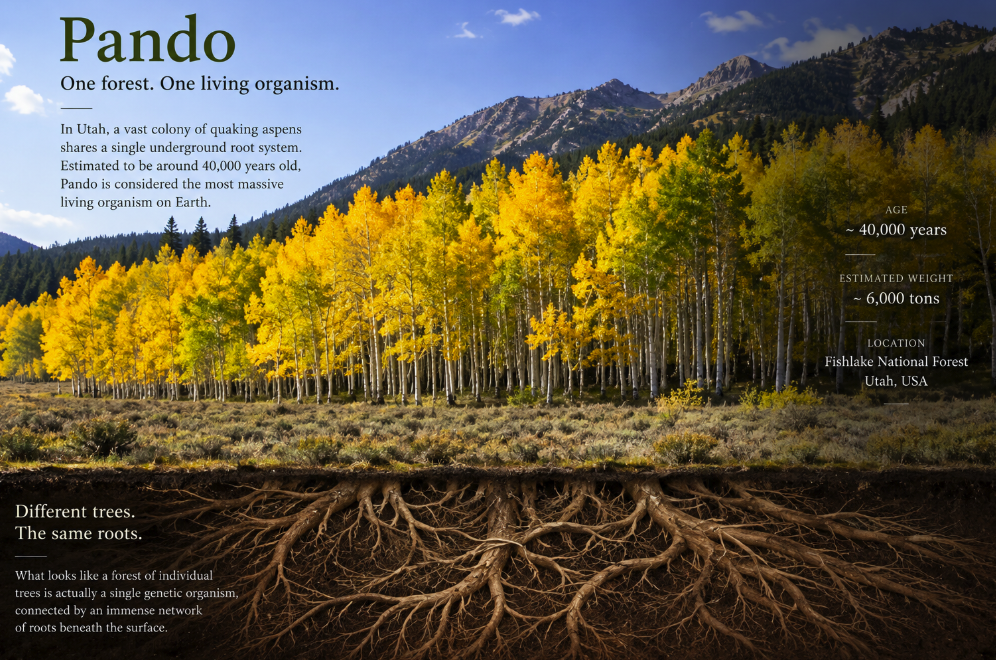
From the road near Fish Lake in central Utah, Pando looks like an ordinary mountain forest. Thousands of pale trunks rise from the ground. Their leaves tremble in the slightest breeze, turning the hillside green in summer and brilliant yellow in autumn.
Walk among them and nothing obvious announces that the landscape is biologically unusual.
Yet genetic testing has shown that a huge portion of this aspen grove is not simply a collection of neighboring trees. The stems belong to the same genetic individual. Beneath the surface, quaking aspen can reproduce by sending up new shoots from a spreading root system, allowing one original plant to occupy an enormous area through repeated vegetative growth.
This particular clone has a name: Pando, Latin for “I spread.”
It covers roughly 43 hectares — about 106 acres — and has been estimated to contain around 47,000 above-ground stems. Its total mass is often placed near 6,000 metric tonnes, making it famous as a candidate for the world's most massive living organism.
Its age is even more extraordinary, but also more uncertain than popular accounts suggest. Pando is frequently said to be 40,000, 80,000 or even older. Recent genomic work is finally beginning to replace those guesses with quantitative estimates.
The result is a strange biological paradox: the “trees” you see may live for little more than a century, while the organism producing them may have persisted for many thousands of years.
One tree, tens of thousands of trunks
Quaking aspen, Populus tremuloides, has two ways to reproduce.
It can reproduce sexually through seeds, creating a genetically new individual. But it can also reproduce vegetatively. Buds form on lateral roots beneath the soil and develop into shoots called suckers. Those shoots become trunks that look and function like separate trees.
Botanists call each above-ground unit a ramet. The complete genetic individual from which the ramets arise is the genet.
This distinction changes the meaning of “tree.”
A person walking through Pando sees thousands of trunks. Biologically, those trunks are comparable to repeated modules produced by one clonal lineage. They share essentially the same founding genotype and originate through vegetative propagation.
The U.S. Forest Service's description of quaking aspen biology explains that new suckers arise from meristems on shallow lateral roots. Disturbance can stimulate these dormant structures to develop into new shoots. Fire or the death of older stems can therefore trigger a burst of regeneration from living roots.
A clone can survive even while its visible trunks continuously die and are replaced.
Scientists had to prove Pando was really one clone
For years, Pando's enormous size was inferred partly from its appearance. Aspen clones can often be distinguished by characteristics such as leaf shape, bark, branching pattern and the timing of autumn color. A large patch behaving uniformly suggested a shared genetic identity.
But appearances alone could not prove that tens of thousands of stems belonged to one organism.
In 2008, researchers Jennifer DeWoody, Carol Rowe, Valerie Hipkins and Karen Mock published a molecular study designed to test the claim directly. They sampled 209 stems across the suspected clone and analyzed genetic markers.
Their conclusion was clear: the enormous patch corresponding to Pando was a single genetic entity.
The molecular study estimated its area at about 43.6 hectares. Interestingly, researchers also found dozens of other genotypes nearby, showing that the surrounding aspen landscape was more genetically diverse than the spectacular uniformity of Pando itself might imply.
The Forest Service separately describes a Utah clone covering about 43 hectares and containing an estimated 47,000 ramets — the figures that have become inseparable from Pando's public identity.
Does Pando really have one enormous root system?
The phrase is broadly useful, but it can create the wrong picture.
Pando is often illustrated as though 47,000 trunks were attached to one permanent, perfectly continuous underground super-root resembling the nervous system of a gigantic animal. Real plant architecture is more dynamic.
Aspen roots grow, branch, die and regenerate. Connections among individual stems can change through time. Some ramets may eventually become physiologically independent even though they arose clonally from the same genet.
What makes Pando one organism is therefore not simply that every visible trunk must remain physically connected to every other trunk at every moment. The deeper biological identity comes from clonal descent from the same original genetic individual.
That is why DNA evidence was so important. Pando's unity is a genetic and developmental history written across the landscape.
How can anyone know the age of a clone?
This is the hardest part of Pando's story.
You cannot simply cut down one trunk and count rings. Individual aspen stems are much younger than the clone that produces them. Western stems may survive for more than a century, but when one dies, the root system can generate another.
The oldest part of the original plant may also be long gone. Clonal organisms replace themselves gradually, creating a version of the philosophical “Ship of Theseus” problem in biology: if roots and trunks are continuously replaced but the lineage remains continuous, how old is the organism?
For decades, estimates of Pando's age were therefore speculative. Numbers ranging from several thousand to tens of thousands of years circulated widely, sometimes presented with more confidence than the evidence justified.
Recent genomic research has introduced a new clock.
As a clone grows, its cells accumulate somatic mutations — genetic changes acquired during the organism's lifetime rather than inherited from its founding seed. By sampling leaves, roots and bark across Pando and studying how these mutations are distributed, researchers can reconstruct aspects of the clone's evolutionary history.
A large sequencing project collected more than 500 samples from Pando and neighboring clones. The latest analysis, currently available as a research preprint, estimates Pando to be roughly 12,000 to 37,000 years old, depending on assumptions about mutation detection and accumulation.
The genomic study of Pando's somatic mutations describes this as the first quantitative age estimate based directly on its genetic history. Nearby lake-sediment pollen records also show a long presence of aspen in the region, providing independent ecological context.
The work has undergone revisions and remains subject to the normal scrutiny applied to preprints, so the range should not be treated as a final birthday. But it is more informative than simply repeating the familiar claim that Pando is exactly 40,000 years old.
Could Pando have survived the last Ice Age?
The upper end of old age estimates raises a fascinating geological problem.
Central Utah was much colder during the last glacial period. If glaciers covered the site where Pando now grows, the clone could not simply have remained there unchanged for 80,000 years.
The recent genomic study explicitly discusses this constraint. Evidence from the Fish Lake Plateau suggests local glacial conditions around the Last Glacial Maximum, roughly 21,000 years ago. That history complicates the largest proposed ages.
At the same time, the researchers caution that their mutation-based calculations have uncertainties and may underestimate age under some assumptions.
So Pando's precise origin remains unresolved. It may have begun when the pyramids were already ancient — or it may predate agriculture itself by many millennia.
Either possibility is extraordinary.
Does it really weigh 6,000 tonnes?
No one has placed Pando on a scale.
The widely repeated mass estimate is derived from estimates of the number and average mass of its stems and associated biomass. Figures around 6,000 metric tonnes have helped earn Pando descriptions such as the “heaviest living organism on Earth.”
That title should be understood as a claim based on definitions and estimates, not an uncontested championship.
Clonal fungi create a particularly interesting comparison. A famous Armillaria fungal individual in Oregon occupies a vastly larger area than Pando, although estimating the total mass of a mostly underground fungal network is extremely difficult. Different definitions of organism, connectedness and biomass can therefore change which biological giant receives which record.
Scientific sources themselves often use careful language. A Forest Service paper describes Pando as the largest living organism “documented to date,” while other research calls it the largest known quaking-aspen clone or says it has been “purported” to be the most massive organism.
The record is less important than the scale. A single clonal lineage occupying more than 40 hectares and producing tens of thousands of trunks is already unlike almost anything humans intuitively imagine when they hear the word individual.
A forest that needs young trees to stay alive
Extreme age does not make Pando immortal.
A healthy aspen clone continually replaces older stems with young suckers. Researchers monitoring Pando have become concerned that in parts of the clone, new shoots are not surviving in sufficient numbers.
Browsing by mule deer and other herbivores can remove young shoots before they grow above feeding height. Changes in fire regimes, human activity and ecological conditions can also affect regeneration.
This creates a demographic problem. Imagine a city containing tens of thousands of residents but almost no children. The population may look large today, yet its future becomes increasingly precarious as older individuals disappear.
The same principle applies to Pando's ramets.
Management efforts have included fencing some areas to reduce browsing and encourage young suckers. The results also demonstrate something important about the organism's biology: protecting the old trunks alone is not enough. Pando survives through regeneration.
The organism is older than its parts
Pando forces us to confront a limitation in everyday ideas about individuality.
A human body has a relatively clear boundary. One person ends where another begins. A tree trunk appears similarly self-contained, which is why a grove naturally looks like a population of trees.
Clonal plants make those boundaries ambiguous.
One genetic individual can spread through soil, repeatedly produce new stems and survive the death of structures that appear to us to be complete organisms. Its visible forest is temporary; its lineage is persistent.
That is the real wonder of Pando.
The individual trunks shaking in the Utah wind are not 20,000 years old. Most are comparatively young. The roots beneath any particular spot need not be as ancient as the clone either. Pando's age belongs to the continuity of the living lineage — a biological identity that has repeatedly rebuilt itself while spreading across a mountainside.
Seen that way, Pando is not simply a very old tree and not quite a forest in the ordinary sense. It is a living process occupying a landscape.
Thousands of trunks appear, grow and die. Autumn after autumn, their leaves turn gold. Beneath them, the clone continues.