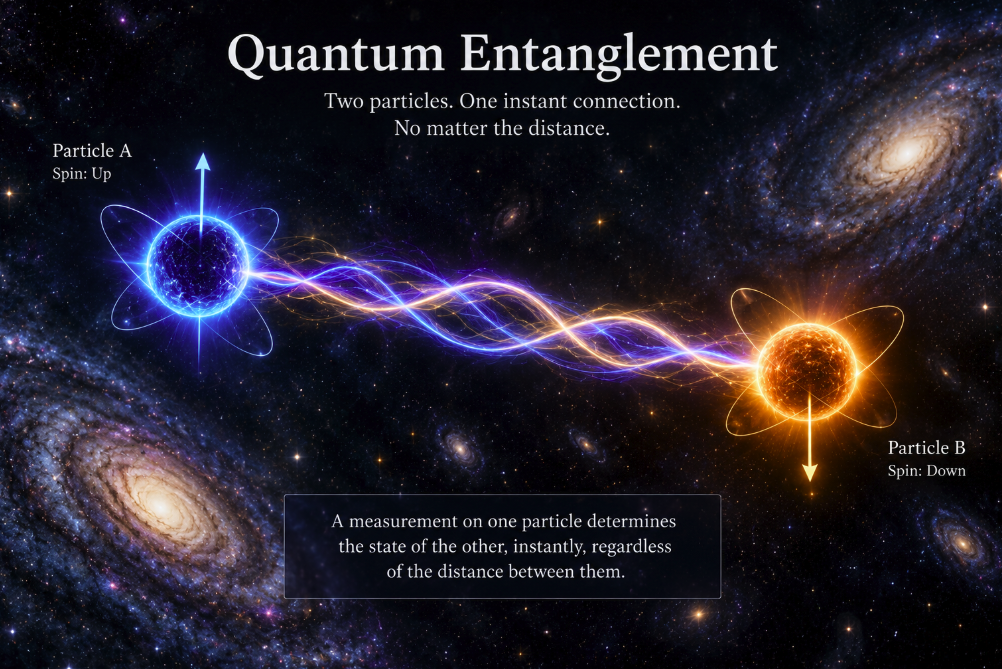
Quantum entanglement is often introduced with a sentence that sounds like science fiction: two particles can be linked so deeply that changing one instantly changes the other, even if they are on opposite sides of the universe.
That description captures the shock of the phenomenon, but it also creates the wrong mental picture.
Entangled particles do not behave like two telephones exchanging a faster-than-light message. One particle does not receive an instruction from the other and obediently change its state. Instead, quantum mechanics describes the pair as a single shared quantum system whose measurement outcomes display correlations that cannot be reproduced by ordinary local classical explanations.
The distinction is subtle, but it is the heart of one of the most important experiments in modern physics. Entanglement was once at the center of an argument about whether quantum mechanics could possibly be a complete description of reality. Today it is an experimentally established resource behind quantum computing, quantum networks and quantum cryptography.
And the physicist most famously disturbed by it was Albert Einstein.
Einstein's problem with quantum mechanics
In 1935, Einstein, Boris Podolsky and Nathan Rosen published a paper challenging the completeness of quantum mechanics. Their argument became known as the EPR paradox.
Quantum theory allowed two particles that had interacted to enter a joint state in which certain properties were correlated. The particles could then travel far apart. Measuring one would allow a physicist to predict the corresponding result for the other.
For Einstein, this seemed deeply suspicious.
Relativity had established that no usable signal or causal influence should propagate faster than light. Yet quantum mechanics appeared to connect spatially separated events without the kind of local mechanism classical physics would normally demand.
Einstein famously referred to the problem as a kind of “spooky action at a distance.” He suspected that quantum mechanics was incomplete: perhaps the particles carried additional information — later described in terms of hidden variables — that predetermined what each measurement would reveal.
If so, the mystery could disappear. Imagine separating a pair of gloves into two boxes without looking inside. Send one box to Mars and keep the other on Earth. When the Earth box is opened and contains the left glove, you instantly know the Mars box contains the right glove. Nothing traveled between the boxes. The answer had been fixed from the beginning.
Einstein hoped entangled particles might work in some analogous way.
Quantum mechanics says they do not.
Entanglement is more than ordinary correlation
The glove analogy is useful precisely because it eventually fails.
With gloves, the properties exist before anyone looks. The left glove was always left and the right glove was always right. Opening a box merely reveals a pre-existing fact.
An entangled quantum state does not generally permit that simple interpretation. Depending on which property an experimenter chooses to measure, quantum mechanics predicts correlations stronger than any model in which each particle simply carries a complete set of local prewritten answers.
For decades this distinction appeared philosophical. Perhaps there was no experiment capable of deciding whether quantum mechanics was genuinely strange or whether hidden instructions were merely concealed from us.
Then physicist John Stewart Bell found a way.
Bell turned a philosophical argument into an experiment
In the 1960s, Bell derived mathematical relationships now known as Bell inequalities. They establish limits on the correlations that can occur if measurement outcomes are explained by a broad class of local hidden-variable theories.
Quantum mechanics predicts that properly prepared entangled particles can violate those limits.
This was revolutionary because it transformed an argument about the meaning of reality into something physicists could test in a laboratory.
John Clauser and collaborators developed practical experiments using entangled photons. Clauser's measurements violated a Bell inequality and agreed with quantum mechanics rather than a local hidden-variable model.
Alain Aspect later improved the experiments, including by rapidly changing measurement settings after the entangled particles had left their source, closing an important loophole in possible explanations.
Anton Zeilinger and many other researchers pushed entanglement experiments still further, developing sophisticated photon sources, quantum teleportation and entanglement swapping.
In 2022, the Nobel Prize in Physics was awarded jointly to Alain Aspect, John Clauser and Anton Zeilinger for experiments with entangled photons, establishing violations of Bell inequalities and pioneering quantum information science.
The result is one of the deepest experimental lessons of twentieth-century physics: nature cannot be described by the straightforward local hidden-variable picture Einstein hoped would restore classical intuition.
What actually happens when one particle is measured?
Consider two entangled particles arranged so that measurements of a particular property are correlated. For simplicity, imagine measuring something with two possible outcomes, conventionally called “up” and “down.”
Before measurement, quantum mechanics describes the pair through a joint state. It is not generally correct to imagine that particle A secretly carries “up” while particle B secretly carries “down” and that we merely have not checked yet.
When an observer measures particle A, the outcome is individually unpredictable. It might be up or down according to the probabilities encoded in the quantum state.
If a distant observer measures particle B in a corresponding way, their result will be correlated with A's according to quantum mechanics.
The striking part emerges only when the observers later compare many measurements. Their datasets contain correlations that violate Bell inequalities — correlations too strong for local pre-existing instructions of the relevant kind.
The Royal Swedish Academy of Sciences' explanation of the 2022 Nobel Prize emphasizes that entangled particles act as parts of a shared state even after separation. This property is now experimentally accessible and technologically useful.
But there is a crucial catch.
You cannot use entanglement to send a message faster than light
This is where the phrase “instantaneous action” causes the most confusion.
Suppose Alice and Bob share entangled particles and then travel far apart. Alice measures hers. She cannot choose the result she obtains. Her local sequence of measurements looks random.
Bob's measurements also look random from his perspective.
Only when Alice and Bob compare their results do the quantum correlations become visible. That comparison requires ordinary classical communication — a phone call, radio signal, optical fiber or some other channel limited by the speed of light.
Alain Aspect has explicitly stressed this point when discussing entanglement: attempts to use the phenomenon for faster-than-light information transfer fail because of the fundamental randomness of quantum measurement.
So relativity's prohibition on superluminal communication survives.
Entanglement is nonclassical and nonlocal in the technical Bell-test sense, but it is not a cosmic instant-messaging system.
What about particles on opposite sides of the universe?
In principle, quantum mechanics does not insert a maximum distance into the definition of entanglement. If two systems remain perfectly isolated from disruptive interactions, increasing their separation does not by itself switch the entanglement off.
That is why physicists sometimes say the particles could be on opposite sides of the universe.
But this is a theoretical illustration, not an experiment humans have performed.
Real entangled systems are fragile. Interaction with the surrounding environment can produce decoherence, destroying the quantum relationships researchers are trying to preserve. Photons can be absorbed, scattered or lost. Building long-distance quantum links is therefore an engineering challenge.
Experiments have nevertheless demonstrated entanglement over impressive distances, including links involving satellites and ground stations. The Nobel committee notes that entangled photons have been distributed through optical fibers over tens of kilometers and between satellites and Earth, helping establish the foundations of future quantum networks.
Distance is not the conceptual enemy of entanglement. Uncontrolled interaction with the environment usually is.
Quantum teleportation does not teleport matter
Entanglement also enables another phenomenon with a misleading science-fiction name: quantum teleportation.
Quantum teleportation can transfer an unknown quantum state from one system to another using shared entanglement plus classical communication. The original state is destroyed in the process, and no matter is transported from one location to another.
Most importantly, teleportation still cannot beat light. The receiver needs classical information from the sender before the transferred quantum state can be reconstructed.
Zeilinger's research group demonstrated quantum teleportation in pioneering experiments in the late 1990s. Later work has extended the technique and made it central to proposals for quantum networks and quantum repeaters.
Another remarkable technique, entanglement swapping, can even entangle particles that have never directly interacted. Two entangled pairs are prepared; special measurements on one particle from each pair can leave the two remaining particles entangled with one another.
The result sounds even stranger than Einstein's original puzzle, but it follows directly from the mathematics of shared quantum states.
Why entanglement matters outside philosophy
The debate that began with Einstein and Bohr was once mainly about the foundations of physics. Today entanglement is also an engineering resource.
Quantum computers exploit quantum states involving many interacting quantum bits, allowing certain computations to use correlations unavailable to classical bits. Quantum communication protocols can use quantum properties to reveal eavesdropping. Quantum networks aim to distribute entanglement among distant nodes. Entanglement can also improve some forms of precision measurement.
The 2022 Nobel Prize recognized precisely this transition: experiments originally designed to investigate the philosophical foundations of quantum mechanics helped create the field of quantum information science.
One of physics' strangest arguments became a technology platform.
The universe is stranger than “action at a distance”
The popular version of entanglement imagines two particles connected by an invisible thread. Touch one end and the other reacts instantly.
Quantum mechanics offers no such simple mechanism.
What experiments reveal is more unsettling: separated objects can be parts of a quantum state whose correlations cannot be explained by assigning each object an independent collection of local predetermined properties. Bell's theorem gives that statement mathematical teeth, and decades of experiments have repeatedly supported quantum predictions.
Yet the phenomenon does not let us transmit information faster than light, send messages into the past or communicate instantly across galaxies. Each local measurement remains unpredictable until results are compared through ordinary communication.
Einstein was right to recognize that entanglement strikes at something fundamental. He hoped the discomfort indicated that quantum mechanics was incomplete. Bell, Clauser, Aspect, Zeilinger and generations of experimenters instead showed that the strange correlations are not merely an artifact of an unfinished theory.
They are part of how nature behaves.
The real lesson of entanglement is therefore subtler than “one particle instantly changes another.” At the quantum level, the assumption that distant objects must always possess completely separate, locally defined realities turns out to be too simple.
That is stranger than a signal traveling across the universe. It suggests that, in quantum mechanics, separation itself does not mean quite what everyday experience taught us to expect.