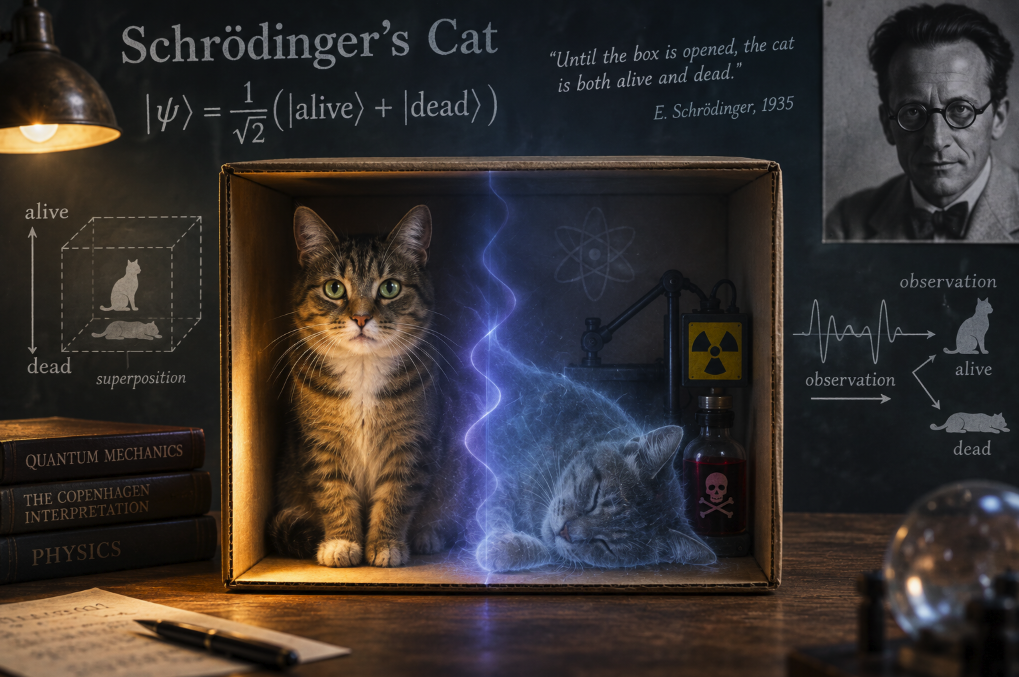
Seal a cat inside a box with a radioactive atom, a radiation detector and a mechanism capable of releasing poison. Arrange the experiment so that, after an hour, the atom has a 50 percent chance of having decayed. If it decays, the detector triggers the mechanism and the cat dies. If it does not, the cat remains alive.
Now refuse to open the box.
According to the simplified version of quantum mechanics familiar from countless popular explanations, the radioactive atom is described by a superposition of “decayed” and “not decayed” until a measurement occurs. Because the atom controls the lethal device, the entire system becomes entangled with it. The mathematical description therefore appears to contain both outcomes: atom decayed and cat dead, atom not decayed and cat alive.
This is Schrödinger’s cat, probably the most famous imaginary animal in science. It is often introduced as though physicist Erwin Schrödinger wanted us to believe that a real cat is literally alive and dead until a human lifts the lid. In fact, the thought experiment was designed to make exactly that conclusion look absurd.
The cat was not an explanation of quantum mechanics. It was a challenge to it.
Why Schrödinger put a cat in a box
Schrödinger introduced the scenario in 1935, during one of the most important debates in the history of quantum theory. Earlier that year Albert Einstein, Boris Podolsky and Nathan Rosen had published their celebrated EPR argument questioning whether the quantum-mechanical description of physical reality was complete. Schrödinger corresponded with Einstein about the problem and soon developed his own dramatic illustration of what happens when quantum rules are extended from microscopic systems to ordinary objects.
The American Physical Society’s history of the thought experiment describes Schrödinger’s purpose as exposing the uncomfortable gap between quantum superpositions and everyday experience. Atoms and other microscopic systems can be represented by combinations of possible states. But what happens if the fate of a macroscopic object is made dependent on one of those quantum events?
Schrödinger imagined a cat enclosed in a steel chamber with a tiny radioactive source, a Geiger counter, a relay, a hammer and a flask containing hydrocyanic acid. If an atom decayed, the detector would activate the hammer, break the flask and kill the cat. If no decay occurred, the cat would survive.
The microscopic event and the macroscopic animal were now linked. If the wave function describing the atom contains both possibilities, then following the quantum formalism without adding anything else seems to produce a wave function containing both a living and a dead cat.
Schrödinger called such consequences “ridiculous cases.” That wording is important. He was deliberately pushing the theory into a domain where its implications clashed violently with ordinary experience.
What does “both alive and dead” really mean?
Quantum superposition is frequently described as a particle “being in two states at once.” That phrase is useful, but it can also mislead. A superposition is a precise mathematical feature of a quantum state, not simply ordinary uncertainty about something we have not checked.
Suppose a coin is hidden under a cup. It is already heads or tails even if you do not know which. Your uncertainty reflects missing information. A coherent quantum superposition is different because its components can produce interference effects. The alternatives are combined within the quantum state in a way that has experimentally measurable consequences.
In Schrödinger’s setup, the radioactive source becomes correlated with the detector, poison mechanism and cat. The two relevant branches can be represented schematically as “undecayed atom + living cat” and “decayed atom + dead cat.” The problem is that we never encounter cats in obvious macroscopic superpositions. We open a box and find one definite result.
So where, exactly, does the quantum description turn into the single reality we experience?
That question is the measurement problem, and it remains one of the deepest conceptual issues in quantum mechanics. The Stanford Encyclopedia of Philosophy’s discussion of quantum theory explores the difficulty created by the apparent transition from a superposition of possible outcomes to one observed outcome.
Opening the box is not magic
Popular accounts often say that “the observer” opens the box and collapses the wave function, which can make it sound as if human consciousness possesses a mysterious ability to create reality merely by looking at it.
That is not a conclusion established by quantum physics.
In physics, a measurement is fundamentally a physical interaction in which information about one system becomes correlated with another. A Geiger counter interacting with a radioactive decay is already a physical process. So are the poison mechanism, the cat and the air inside the box. The role of a conscious human observer depends on how one interprets quantum mechanics and should not be smuggled into the story as an experimentally proven requirement.
This is one reason the cat is such an effective thought experiment. It makes the boundary between microscopic “system” and macroscopic “observer” difficult to locate. Is the atom in superposition but the detector definite? Does the detector join the superposition? What about the cat? The box? The scientist outside?
If quantum evolution applies universally, simply moving the boundary does not obviously solve the conceptual problem.
Decoherence explains why real cats do not look quantum
Modern physics adds an ingredient that was not fully developed when Schrödinger proposed his cat: environmental decoherence.
A tiny quantum system can maintain a coherent superposition only if its delicate phase relationships are sufficiently isolated from the environment. A macroscopic object is almost impossible to isolate in this way. A cat interacts continuously with air molecules, thermal radiation, the box, its own trillions upon trillions of constituent particles and countless other degrees of freedom.
Those interactions rapidly entangle the system with its environment. Interference between macroscopically distinct alternatives becomes extraordinarily difficult to observe. This process, decoherence, helps explain why the quantum weirdness that can be demonstrated in carefully controlled microscopic systems does not normally appear as visible cats occupying contradictory everyday states.
The Stanford Encyclopedia’s discussion of quantum superposition notes that interference between macroscopically distinct cat states would be strongly suppressed by decoherence, consistent with the fact that we always observe a cat as alive or dead rather than as some visible mixture.
Decoherence is enormously important, but saying “decoherence solves everything” goes too far. It explains how interference between alternatives becomes effectively inaccessible and why the classical world emerges so robustly from quantum interactions. Philosophers and physicists still disagree about whether it fully resolves the deeper question of why an observer experiences one particular outcome.
Different interpretations give different answers
The cat becomes even more interesting because quantum mechanics has several major interpretations that agree on experimental predictions in ordinary circumstances while telling very different stories about what the mathematics means.
In textbook collapse approaches, measurement leads from the superposition to one definite outcome: the cat is found alive or dead. The unresolved issue is what precisely counts as a measurement and how collapse should be understood.
In the Many-Worlds interpretation, there is no fundamental collapse. Quantum evolution continues, producing branches in which different outcomes are realized. One branch contains an observer who finds a living cat; another contains an observer who finds a dead one. The current Stanford Encyclopedia entry on Many-Worlds emphasizes that in each world the cat has a definite state rather than appearing to an observer as a half-dead, half-alive creature.
Other approaches, including Bohmian mechanics, objective-collapse theories and relational interpretations, handle the problem differently. Schrödinger’s simple box therefore opens onto a philosophical landscape far larger than the original experiment.
Scientists have made “cat states” — but not with cats
No serious experiment needs to endanger an animal to test quantum superposition. Physicists use the phrase “Schrödinger cat state” for quantum states in which distinguishable alternatives are coherently superposed.
Researchers have produced such states using trapped ions, photons, superconducting circuits and other carefully controlled systems. In a famous 1996 experiment at the U.S. National Institute of Standards and Technology, researchers prepared a trapped beryllium ion in a superposition involving two separated motional states correlated with internal states. Interference provided evidence of the coherent superposition. The American Physical Society later described it as an atomic analogue of Schrödinger’s scenario.
The challenge in modern “cat-state” experiments is precisely the challenge highlighted by the original thought experiment: the larger and more complex the system, the harder it is to preserve quantum coherence against interactions with the environment.
That makes Schrödinger’s apparently absurd cat unexpectedly relevant to real experimental physics. Researchers now deliberately build increasingly large and controllable superpositions to study where, or whether, ordinary quantum mechanics gives way to something else.
The cat was meant to make us uncomfortable
Schrödinger’s cat has survived because it compresses the measurement problem into an image anyone can understand. An invisible atom can feel abstract. A cat whose life depends on that atom cannot.
But the familiar phrase “the cat is both alive and dead until we look” should be handled carefully. The quantum state of the idealized isolated system contains superposed alternatives in the formalism. What that mathematical statement says about reality before measurement depends on the interpretation of quantum mechanics. Real macroscopic cats also interact so intensely with their environments that decoherence suppresses observable interference fantastically quickly.
Schrödinger was not asking us to accept an animal suspended magically between life and death. He was asking how a theory spectacularly successful for atoms could be reconciled with a world in which tables, detectors, scientists and cats always seem to have definite properties.
Nearly a century later, quantum mechanics continues to make extraordinarily accurate predictions. Yet physicists and philosophers still debate what its mathematical machinery tells us about reality itself.
The cat remains in the box because the question Schrödinger placed there has never completely left it.